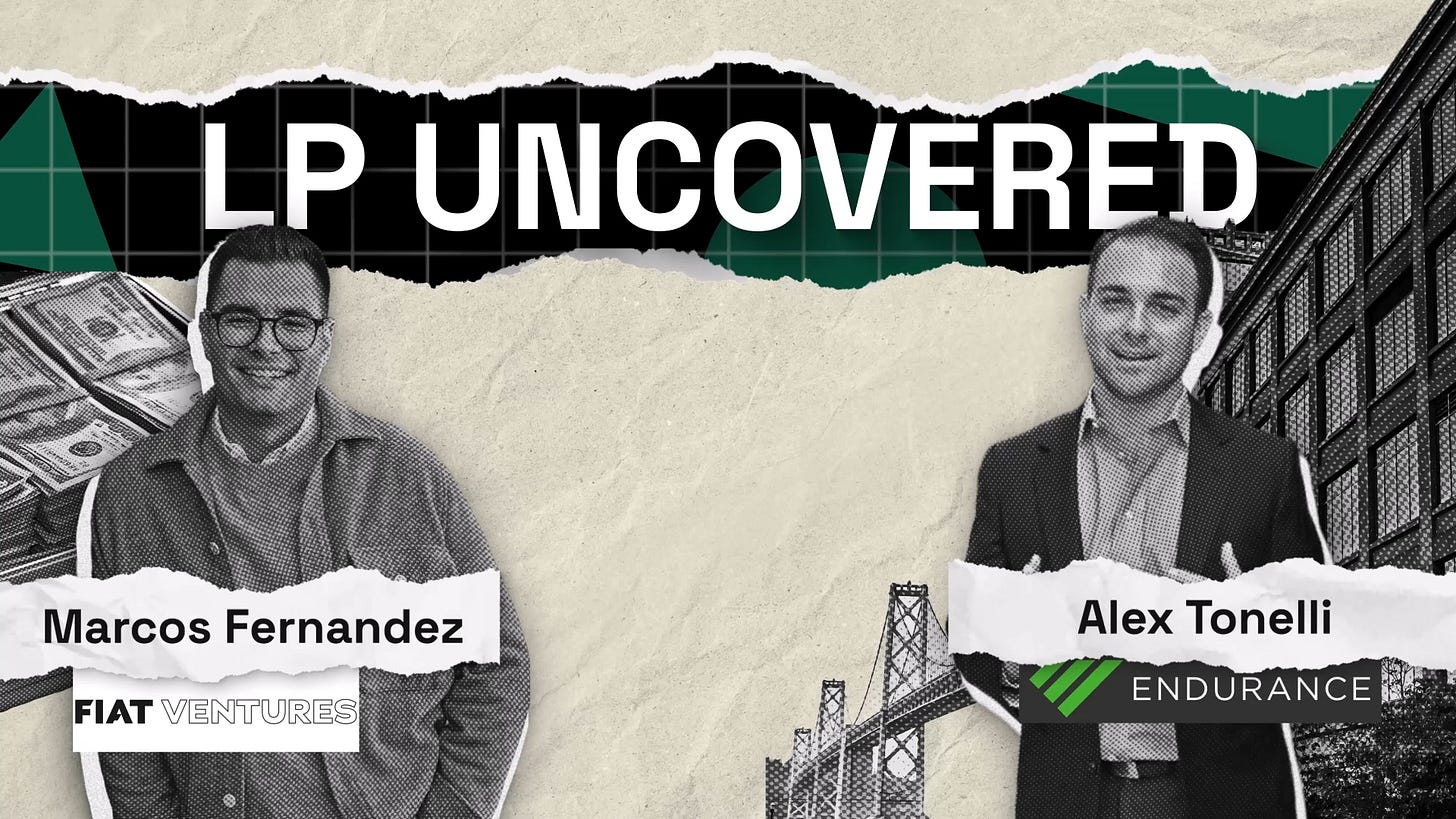
Alex Tonelli
Endurance Companies
The Builder Who Never Stopped Building.
In This Episode
Most allocators learn to evaluate risk from a distance. Alex Tonelli learned it by nearly running out of money.
“We closed a round with $16 in our bank account,” he says, describing the early days of what would become Funding Circle, the small business lending platform he co-founded after Stanford GSB. That number isn’t metaphorical. It’s a specific, concrete memory he returns to often, because it shaped how he thinks about conviction, partnership, and what it actually costs to get a business off the ground. He often relates abstract investing concepts to specific moments from one of the companies he has built.
Today, Alex is a Partner of Endurance Companies, a platform of serial entrepreneurs that manages their investments across asset classes while continuing to incubate one to two companies per year. He sits in an unusual seat: a founder who became an allocator but never fully made the transition. That in-between identity, somewhere between the garage and the investment committee, turns out to be one of his sharpest edges.
From PE to Founder to Allocator
Before Stanford, Alex worked at Summit Partners and was inspired by the entrepreneurs. Initially, that spark caused Alex to build a chain of fitness centers “off the side of his desk.”
“I was a 25-year-old junior PE guy right before the GFC, and I had people trying to take me to baseball games to stuff $100 million in our pockets at 9x EBITDA,” he recalls. “And yet I couldn’t raise $100,000 for our very successful small business.”
That frustration became the founding insight for Endurance Lending Network, which later merged with a UK-based platform Funding Circle to form the largest global marketplace for small business loans (which went public in 2018) and a pioneer of the early fintech wave.
He and his Stanford classmates built six companies over a decade through the Endurance platform. Five of the six succeeded, which is less surprising when you realize that his early Partners include Chris Klomp of Collective Medical (having moved recently to an inactive role since taking the positions of Chief Counselor at HHS and Deputy Administrator of CMS) and Sam Hodges of Vouch Insurance.
The liquidity from those outcomes raised an obvious question: What do you do with the money? “We felt like we had a better vision for how to manage that capital than the commercially available options,” Alex says. So they started investing together. Over time that became an investment office, though Alex is quick to resist a tidy label. “We never intended to become a family office or an asset aggregator,” he says, nor do they use those labels today.
The firm still incubates companies, analogous to how some family offices have a core business. Alex often serves as founding chairman with healthcare and fintech as primary focus areas. An archetypal example of their current focus includes Rockland, an AI-native administrative platform to help community health organizations manage reimbursement and other workflows that currently run on post-it notes.
The entrepreneurial identity isn’t just biographical color; it’s the operating premise of everything Endurance does on the allocation side.
How Endurance Actually Constructs Its Venture Portfolio
Excluding incubations, venture capital accounts for roughly 15% of Endurance’s total allocation, which Alex describes as “endowment-style” based on modern portfolio theory. “We carefully project return, volatility, and correlation assumptions within and between the asset classes to arrive at a theoretically optimal portfolio. It’s false precision, but I prefer that to no precision. It’s another way of saying, “aim small, miss small.”
Endurance’s partners and co-investors subscribe to annual funds to create agency in steering asset allocation while maintaining discipline on vintage risk, one of the most important, but least talked about drivers of returns. Within each annual pocket, the allocation is roughly even amongst three categories: market leaders, breakout funds (typically funds three through five in sectors where the firm has developed genuine first-choice status), and emerging managers. The direct investments that flow from these funds and the partners’ wide-reaching networks represent a large and growing allocation percentage.
That allocation to emerging managers is deliberately high, and Alex is comfortable defending it. “Every piece of data I have seen points to the fact that smaller, earlier funds outperform,” he says. The explanation is straightforward: a fund manager in their first or second fund has everything riding on performance. “In fund seven, a 1.5x return isn’t a disaster for the GP if you’ve got a billion-dollar-plus fund. But in fund one, their entire livelihood depends on it. People often confuse franchise risk with risk to an LP. We don’t need an emerging manager to become a16z for it to be a success for an LP. We need them to produce a 5x net, which is much easier to do on $50M than $500M.” Alex acknowledges that this isn’t a secret. “Many investors know this is true, but are not authentic to the ecosystem in a way that allows them to capitalize. We are natives, not tourists,” which gives Endurance an unfair advantage.
What Alex Looks for in an Emerging Manager
Alex stresses the importance of value-add beyond the check. Strategies built purely on access, writing small checks without a distinct reason a founder would choose that firm over another, are harder to scale and replicate. He looks for a right to win. Examples in their portfolio include a healthcare firm with regulatory expertise that genuinely opens doors to partnerships, a seed fund with an embedded consultancy that generates proprietary insights, and incubation models which get founding economics.
Fee structure, he says, is a revealing contra-signal precisely because it isn’t supposed to be the differentiator. A manager presenting 2.5% management fees or a carry ratchet without having earned that right isn’t just asking for more money. They’re demonstrating a misunderstanding of what the LP relationship is supposed to be.
“If you show up looking abnormal on the things you’re not trying to innovate on, that’s a mismatch,” he says. “The thing you’re trying to innovate on should be a narrow, specific differentiation, and I promise you it’s not fees and terms. Most firms we speak with who do this get bad advice from their lawyer about what they perceive to be ‘market,’ when the reality is that we see hundreds of firms who don’t hit their target and are turning off a large number of investors, likely without knowing it.”
Alex advocates strongly for emerging managers to seek anchor investors early, even if it means giving up a GP stake, a revenue share, or agreeing to fee structures that favor the LP. “Getting in business is so important,” he says, drawing from the Funding Circle experience, where passing on early capital to hold out for better terms nearly cost them everything. For managers trying to cross the chasm from a $25 million fund to a $150 million institutional vehicle, an anchor partner willing to write a meaningful check and engage as a genuine thought partner can change the trajectory entirely. “Most EMs never get there.”
Endurance is walking the walk by starting to play an anchor role in new funds, earning participatory economics for their willingness to show conviction before others.
Where Alex Thinks the LP Community Gets It Wrong
Alex noted two common pieces of LP wisdom that he thinks are misguided.
The first is what he calls the 10% rule, the common institutional practice of refusing to anchor more than 10% of any single fund. The practical effect is that LPs using this rule can only meaningfully participate in funds of $100 million or more, which structurally excludes many early-emerging managers. “That’s basically so you can hide behind other people,” he says. “It’s defensibility, not conviction. Someone is prioritizing their warm seat or trying to drive consensus over hunting the best return. As Principal-first investors, we don’t care about how things look.”
The second is the flow of capital toward brand-name mega-funds. He points to the widely cited dynamic in which institutional capital concentrates in a small number of established firms, driven not by return analysis but by perceived safety.
“Swimming against the flow is almost a necessary feature of success in entrepreneurship and VC,” he says. “Being a follower can work for short periods of time, but over the long-run, the lemmings wash out.”
Investing in a $5 billion fund that needs to deploy enormous capital into late-stage companies at high valuations isn’t lower risk. In his view, it’s a higher-risk, capped-upside play.
An alternative positioning: identify firms in the three-to-five fund range that have built first-choice status within a specific sector, still operate with normal terms and fund sizes under $500 million, and still have a legitimate path to a five-to-10x fund return. “That’s the golden zone,” he says. “Not chasing the biggest, shiniest name because they have to deploy a certain amount into projects whose valuations you can’t verify for another 10 years.”
Looking Ahead
Alex’s view of the current moment is less about AI as a theme and more about portfolio construction. By building concentrated exposure to pre-seed and seed companies through a diversified roster of emerging managers, Endurance will have interest in a wide range of early-stage companies. This synthetically creates a late-stage portfolio, just at a much lower entry point with real outsize return potential.
“It seems like everyone’s playing yesterday’s game by piling into these late-stage companies begging for table scraps. That’s not venture capital; it’s IPO arb. The real winners have already been minted. We had some early-mid exposure to the LLM wave which was earned in our strategy five years ago. Now we’re focused on ensuring that we’re at the main course for tomorrow’s generational winners that are being founded right now.”
More from Uncovered Media





Read the full transcript
0:00 You know our process is typically around finding problems and what I tell people is like find the problem that makes them you know want to pull out their hair and then let's talk about whether there's a real business there and usually that's where you can find you know these great threads to pull. In the World Adventure Capital where the conversations often
0:19 focus on either the megafonds or these mega unicorn companies there's a huge piece to the equation that's missing and that's the limited partners in the allocators that provide a lot of the capital to this ecosystem and I'm your host Marcos Fernandez to provide a little bit of visibility to this ecosystem.
0:34 I'm fortunate to be one of the co-founders in the managing partner Fiat Ventures and Emerging Manager and on LPN covered we want to give a voice to these crucial investors. The goal of this is to help you get a better sense of the people who are leading this innovative industry. Today we have a really really special one for you from someone who's
0:51 become a really close friend advisor mentor Alex Tenelli of Endurance Capital. They're experts, serial entrepreneurs having worked on past companies like Funding Circle, Collective Medical. Alex will share more but essentially what this allows them to do is to get a
1:07 really good sense of what's going on from a pre-seed stage all the way to those that are approaching public stages. Alex will also go into a lot more depth of some of the things of what our Emerging Manager is doing. Well what could they be doing better and why he remains bullish on this space as a whole.
1:22 You're in for a really good episode today. I'm excited to have you listen in. All right Alex thank you so much for joining us today on LPN covered. We've known each other for quite some time but it's awesome to have you on the podcast here. Thanks so much for
1:37 joining us. It's great to be here Marcos thanks for having me. Absolutely and this one I've been looking forward to for several different reasons but certainly because you know the goal of what we're putting together here is showcasing the various backgrounds of folks who are allocating
1:52 and I don't know if there's really anyone as unique as what you bring. I think everyone considers themselves entrepreneurial but very few are actually serial entrepreneurs who have gone out there and seen exits and then gone back into the space and I know we'll dive into it but just the uniqueness
2:07 of endurance and what you're building there but before we jump into endurance maybe give everyone a quick walk back of how did you get into entrepreneur being becoming an entrepreneur and give us a little bit of the history of how you got to where you are today. I was very
2:22 happy to and you know serial entrepreneur is another word for clinically unemployable and so I'm sort of allergic to the idea of having a boss and that's kind of how I got started building stuff. You know the short story and there's a lot of nuance here that I'm just gonna scrape through but the
2:39 short story is I got together with some of my classmates from business school at Stanford and we drank the Kool-Aid. We were all sort of you know pre-MBA investors but drank the Kool-Aid that they serve in Silicon
2:54 Valley about doing startups and you know decided that we wanted to go out and build things but we heard that these things don't worked out very often and so you know we kind of decided to throw our lot in together and try to help each other out. I think it was motivated a
3:09 large part by a desire to work together with with these partners who are still you know the best people I've ever worked with and I feel grateful and fortunate to work with but also to mitigate risk because we were you know a little bit scared of these things not working out and so we
3:25 built six companies over a decade with one of us sitting in the founder and CEO seat and had candid ly a higher hit rate than we thought we would with five of the six companies turned into successes and I'm sure we'll get into it in more depth but that sort of created liquidity and then when we
3:41 looked around and said you know what do we do with this liquidity we felt like we had a better opportunity to manage that capital than what we saw as the commercially available options and so we just started investing together and over time that became more institutionalized sort of
4:00 unintentionally and so today you know we have two sides of the business we still incubate companies though now we're doing it from the founder and chairman seat mostly usually one to two companies a year in that way and we have the
4:16 investment office where we're allocating and I think that's the topic for today but where we allocate across asset class endowment style but with a very heavy focus on venture given you know that's a lot of the sandbox that we plan yeah definitely and and before we dive
4:33 into endurance and learning a little bit more about how you think about allocation how do you think about exposure just a quick walk back into the co-founders that you did meet it was a very special time in a very early sector that that we all participate in now called fintech and this was probably before the term fintech was really coined but maybe kind of walk us back to that GSB
4:52 class or my I know we've caught up but so far was also a company that came out of that that class through a parallel program but yeah like what did you all end up building just for an audience who isn't as familiar with some of the companies that you worked on it's funny because
5:07 you know Marcus you're an old fintech and at this point but you know that term didn't really exist it was called financial technology you know I was in a group at Summit Partners before going to Stanford that did a lot of financial technology and that meant a different thing than it does
5:23 today and when we were raising money you know I laugh about being on the airplane and like changing clothes between New York and San Francisco where you know I would be like in my jeans and whatever going into equity capital meetings trying to raise money from VCs who would kind of laugh us out
5:39 of the room and say why are you raising money from us we don't invest in things that have interest rates or you know they're like why aren't you in New York you know raising money and then we'd go out and you know do the meetings for the capital side of the platform where we'd you know be in suits you know in tall buildings in New York City and so yeah it was a really fun
5:58 time and as you mentioned you know the guys the four founders of SoFi were MBA slash Sloan classmates from 2011 and I remember where I was when I first heard about SoFi and then I still find it funny you know every time I hear you know a SoFi commercial thinking back to those you know
6:15 those times and we had a very close relationship with the early SoFi people as we were building funding circle just kind of you know figuring this stuff out you know we built a company that ended up being funding circle it started out as as endurance lending network and we became the largest
6:31 small business lending platform in the US and then merged with a company that was in the UK that was the largest in Europe and sort of you know put those two pieces together it was it was a wild time you know the first lending conference was you know
6:48 like 50 people in like the fifth floor of a conference center in New York and it was funny to think about you know who those who those people were you know you know Rivet capital we were a fun one investment for Rivet and I think they were getting some of this kind of crazy you know
7:04 what is fintech type of situation Nick Shailik who is a close friend of mine actually from growing up and then also a GSB classmate talking back to that about that class you know bought me lunch with a Bitcoin in 2012 as we were you know doing this and he was working out of our San
7:20 Francisco office and so it was kind of a wild time to be building a fintech company the idea of it actually came from one of our earlier companies which was a chain of fitness centers that I had started because when I was at Summit Partners I was seeing these sort of 24-hour gym
7:39 models and decided you know hey this is something that I want to go out and try to do myself and I didn't even think about it as being an entrepreneur I just thought about it as kind of putting a deal together and my my brain at the time was a very much an investor brain I now look back on it and think of it as you know sort of the entrepreneurial sparks kind
7:56 of kicking out of my brain and so you know we put together a deal that was $172,000 you know with five different partners in it and we bought some gym equipment and started a fitness center and that went well and then we started a second one we were using zero percent interest rate
8:11 credit cards to finance that you know eventually we got these things under a hundred thousand dollars a unit and we were using these like you know these crazy credit cards to finance them and I couldn 't get a loan that I was sitting in a classroom at GSB in my second year formation adventures talk
8:26 hallways teaching he's a legendary entrepreneurship professor and I couldn't get a loan to save my life I'm like physically pan writing these these applications to banks to get a hundred thousand dollar two hundred thousand dollar loan for us to be able to open more of our highly
8:42 profitable joint and severely guaranteed asset heavy small businesses and I thought it was crazy because as a PE guys a 25 year old PE guy I had people trying to take me to baseball games to kind of stuff a hundred million dollars in my pocket to open you know highly levered you know window
8:59 manufacturers before you know the mortgage crisis and yet I couldn't raise a hundred thousand dollars save my life to for our very successful small business and so that was the kind of founding idea for how you know my partner Sam Hodges and I started working on what was originally endurance
9:16 lending and then funding circle was you know this unique insight and yeah I could tell stories all day long about the early days of fintech but that's that's how we got into building funding circle which was our second company out of the endurance holding company yeah no it's it's
9:32 amazing and maybe a different podcast and I know we talk about it a lot but it was it was early endings even so far at that time I believe was still called socially financed and there there's a lot of early nuances particularly within what was peer-to-peer lending eventually became marketplace lending and
9:48 really kind of grew but I I think one of the biggest things here is that you have such a deep experience of the zero to one which again as purely being an allocator maybe it gives you perspective on underwriting but you're still doing this today so you you'd mentioned it at endurance maybe walk at the audience quickly through how do you compose the
10:05 current multifamily office that you built you said really it's from a lot of the liquidity and success that you'd seen in the past but at this point you've got a lot more businesses than just purely asset allocations so maybe at a high level walk through those different lines of business and then
10:20 let's dive a little bit deeper into how you're creating companies and not necessarily just backing them and backing venture funds it I would say it's interesting because our you know our investment office we're sort of fighting the product market fit that we have there the idea of even calling it
10:36 a product is makes me nervous because we never intended to become an investment office a family office or you know certainly not a multifamily office not a you know we don't intend to be an asset aggregator and yet you know we started to build that as a business part of that
10:55 north star that I think makes us successful is that we are entrepreneurs we are builders at heart and our purpose statement is we chase meaningful problems with people we care about and that's about putting solutions in the world to problems that need to be solved for me personally it's very mission
11:11 oriented and it's I don't mean that in a charitable sense I mean that in a the world's biggest problems have the world's biggest capitalist solutions sense and so you know my you know my identity in my mind is tied up in hey I build one you know one new company at a time we do it the hard way we use
11:29 terms like don't cheat the startup gods you know you don't serve caviar at lunch in your office you know it's it's got to feel like you're in a garage a little bit to to feel real and and don't take shortcuts and and we try to build each one in the hard way because we think that's what's
11:45 necessary to be done and and yet you know that adds up to about let's call it one to three companies a year that we end up incubating playing this kind of founding chairman role usually fintech and health care have become the two areas of of great expertise but but it's not all that we do um
12:01 you know our process is typically around finding problems and what I tell people is like find the problem that makes them you know want to pull out their hair and then let's talk about whether there's a real business there and usually that's where you can find you know these great threads to pull um I could talk all day long about like how we do that but I'll I'll back up and
12:18 then you know the investment office I think the the work we do as entrepreneurs very much informs our capability as in as allocators um because I think we understand what's underlying these things and I think that's a huge advantage for us is that we know how hard it is to
12:35 build build a business we know when people are BSing us um we know how you know even you know investors are also building a business right and I don't mean to you know to your own your hornier but like I see how hard you're hustling right like building a venture firm or a private equity firm is
12:53 an entrepreneur or an endeavor and you know we can kind of tell the real entrepreneurs from the fake ones um and you know that that helps them form us in the capital allocation phase two and that's I think why we've had such a great fund one track record of investing fund two track record of investing
13:08 not only because the early funds outperform but because we also you know think we have the ability to find kindred spirits and the investors that we're backing. Yeah definitely and listen a appreciation for that I think we look the world in many similar ways uh certainly in having that
13:23 access and exposure for us it's our consultancy working with companies seeing what's hype versus what's actual attraction but then too and you mentioned it is that you know doing good and doing well are not mutually exclusive and there's actually a lot of alpha to be had when you're trying to solve problems for large swaths of people who
13:40 don't necessarily have access to that today and you mentioned this earlier you were solving your problem as an entrepreneur with small medium sized businesses by starting a company that could then fund these at scale. I'm curious to get your perspective though with some of the companies that you've incubated today whether you can mention them by name or not uh what
13:58 are some of the biggest problems that you see out there in the world both within FinTech and the healthcare space and how are your entrepreneurs trying to solve those challenges today? We take us forever if I had to go into all of them I'll mention one in particular that I think is a great example of it is a company called Rockland and we've noticed that
14:20 the frontline providers of Medicaid solutions so these are you know for people that understand these are federally qualified health clinics community benefit organizations are the term
14:35 for these sort of frontline organizations who are really you know either non-profits themselves you know probably running pretty lean to the bone and they don't have um what's called a managed service organization which is kind of a weird name because that that's that means software uh for
14:51 which is what a normal hospital would have these guys these guys are running on post-it notes and you know you've got nurses uh not getting reimbursed for their time because they're sort of just running from one fire to the next and so you know we see that as an opportunity
15:08 to you know hey that you know this is a big problem for you know we think a lot about like why why is there homelessness problem why is there um uh you know a treatment problem around people with addiction issues um and mental health issues and how how can we solve that and we've
15:23 tried to solve that in a number of ways and so you know we've we've built companies that are um trying to predict the onset of serious mental illness uh is is you know one company that that we built and this company Rockland is trying to build uh uh AI native software solution you know the the
15:39 thought is you know we can take a technical leap rock now because we're not burdened by you know um old form SaaS and we can build an AI native solution to help these organizations get better reimbursement and so that's a great example of just you know finding a problem in the world that you know you want
15:54 to figure out a solution too and and coming up with a capitalist solution that that makes it sustainable yeah i love that and having gotten to know you i i can also uh you know attest to the fact that the other companies are are really fascinating but to stay in i guess in the spirit of health care which is one of your focus areas i i know we've talked about
16:11 this in sharing in that uh health care is an industry that is largely needed largely broken and opaque but really advancements you can say even since call it the affordable care act have pushed the industry forward to a point where now it's a little bit more digitized but the reality is that
16:27 we all get older we all get sick and that that you're dependent on it so i'm curious when you're thinking about that you know you certainly have expertise but how do you go about identifying challenges uh researching those challenges and then moving to a point where you're actually willing to
16:43 create a company source to ceo and then build that company off the ground you know how do you go from idea and insight to actual company creation you know the short story is company incubation is more about the person leading that company it's about
16:59 founder product bit more so than it's about great ideas we have hundreds we have hundreds of great ideas sitting in our database that i am confident that you know our worth and entrepreneurial life of pursuit um that have a very high likelihood of success um the our process is about finding a
17:21 founder who and helping that founder to kind of work through what matters to them and what are the problems that drive them up the wall that are going to be enough to push them through the dark times uh of of being a founder and you know when you're when you've got 16 bucks in your bank
17:38 account and five sales calls and and you know seven venture calls and you know you've got an HR issue to deal with like and your significant other is you know getting mad at you that you never go on vacation what you know what is the thing that's going to drive you through that and and i can't
17:53 tell a founder that for them what i can do is help them come up with various problem set problems and and our my work i say my approach to it because we have other partners here and their approach may be different than mine but my approach to it is hey let's get all the problems on the board
18:09 that drive you nuts right and and you know now that we have hundreds of them on you know we also will throw out the problems that we care about and say do any of these problems make you want to pull out your hair and then once we do you know once we figure out the problems that you know
18:24 uh somebody has enough passion for uh then we work through that and and we take it through a a process of diligence where i call it my nuclear bomb test and what i mean by that is i think often entrepreneurs mix up nuclear bombs and land mines and if you get it wrong in either direction
18:41 your company fails meaning stuff not meaning there are certain things that will kill your business no matter what and obviously if you don't treat that seriously then then it kills you that's the obvious one at the same time if you uh uh take something uh the other way uh you can you can run
18:59 away from something that you know you really could be successful at and you can create analysis paralysis and and and not get you out the door uh in the same way i'm constantly saying hey regulation is a boat for you regulation is an advantage it keeps the competition away there's a reason that
19:15 all these horrible products that are not elegant are able to succeed because there isn't as much competitive force there a lot of entrepreneurs who are technical natives get scared away from the things that they don't know which is which are these you know sort of compliance problems and so for
19:30 funding circle as an example and and i want to credit my partner sam who who kind of led this work but uh one of the things that made us successful was that we didn't uh at the time the jobs act was coming out and everybody was waiting on this crowdfunding legislation and you know this is going to change
19:45 the world and and we always had this view that you don't raise ten billion dollars by asking your neighbor for ten thousand dollars and i and i had a blog post called funding from the right crowd and i was like the crowdfunding entrepreneur who hates crowdfunding and uh it meant that
20:00 we only focused on institutions and by having the insight that you could work with the existing securities laws to kind of synthetically create a marketplace um using uh normal private fund options uh we were able to get in business and get in the lead and and um that create that put us
20:18 out ahead of everybody else when when people were you know kind of running away from from the legal and and and understanding um those technical issues so um that's an example of how it works in in fintech and health care that's you know obviously there are our our corollaries everywhere about not running
20:34 you know or running into the into the regulation on health care and and finding a way through it awesome well i i love that analogy right so landmines verse nuclear bombs and and certainly your background as an entrepreneur and even today incubating companies it gives you the pattern recognition
20:49 of understanding the the nuances but i'm curious you know you all do allocate towards venture capital funds what do you look for in those partnerships as you're you're getting those up off the ground is it access to information is it access to founders and and what are you really looking for from those those emerging managers i think it's probably
21:06 useful to to talk about what our venture firm strategy is like what what is our the composition of our venture capital efforts um and so you know from an allocation perspective vc is about 15
21:21 percent of our total allocations in the investment office right and and i i mentioned i believe that we're endowment style right and i think 15 percent is sort of a down-the-fairway kind of allocation number and so then within that pocket you know what we're trying to do is create a systematic
21:38 way to have a very high likelihood of being in the top quartile maybe even in the top decile with very low volatility which is a hard thing to do in an asset class that has a lot of vol a lot of all and so what we do is we try to take out the vintage risk by having pretty structured
21:57 formalized annual pockets um where you know we're putting down we you know we think we have our v c 25 fund and our vc 26 fund or vc 27 fund that creates vintage discipline which is i think one of the
22:12 you know people don't necessarily realize that vintage is one of the highest predictors of success amongst uh amongst funds and then within those pockets we are trying to have a mixture of a divers ification all the vectors that we think are important and so what are those one is fund stage and
22:29 what i mean by that is we call the market leaders breakout funds and emerging managers so we do about a third a third a third in those three three buckets um a third emerging managers from what i understand is is
22:44 actually a quite high allocation to uh you know funds one through three uh and so that is you know us putting a very strong tilt on you know the emerging manager bucket uh other vectors of verification matter are staged uh we have a two-thirds tilt towards pre-seed
23:01 and seed and you know we could talk for a very long period of time about why that is but i'd say especially for emerging managers we're looking for the outperformance we're looking for the earliest stage um uh you know so that's you know one thing that we look for uh you know your question about
23:18 if it's all getting to your question about like how do we like what do we look for in those um uh pre-seed and in those kind of funds one through three and those pre-seed and seed and it's a lot about people uh it's about identifying um world-class people who have a lot of spikiness to them right so
23:42 that doesn't mean that everybody has to like them but they have to have a sort of a world-class orientation to them in some way and when you talk to people about them uh they have to be you know we don't want to hear people saying that they're good we want to hear people saying that they're
23:58 world-class um and yeah you know a lot of that is you know we're but i think a unique advantage for us is that because we play in this ecosystem uh we have worked with a lot of these people and a lot of these funds uh you know and and so there have been uh uh you know over a dozen
24:15 firms that have led winning investments and endurance companies that have you know sat on our boards right and so that's one obvious natural place uh we've worked with these people as colleagues it's just so we have a lot of people in our you know kind of one degree of separate like not one degree but i don't know what
24:30 that's called it's uh you know people that we already know um but for the people that we don't we can get very good very quick is this person world-class kind of references uh uh quickly and so i'd say that's kind of the you know uh a a and it's a difference between us and
24:49 and i'd say professional asset managers where their networks are one or two degrees away and so it is a lot more of an arm's length kind of rubric style investing process um i think for us we either you know we are able to very quickly determine is this person a tourist or you know are
25:06 they reading about these deals in the Wall Street Journal or are they you know living and breathing these things and you know uh having four coffees a day with the people that matter uh and and have unique insights and that's really what we want from uh you know those early stage
25:22 folks and i'd also say something that is unique and differentiated uh about you know why are you different as an early stage person um in the sea of early stage people and so we tend not to like the strategies that are like oh yeah we can just you know tuck a check in and and i think that
25:40 's a harder strategy to scale and do at an institutional level we see often people who have like great pre-fun track records you just can't replicate it yeah at you know any kind of scale and so you know various forms of value at you know is it is it that you're incubating companies is it that
25:56 you're having a growth consultancy associated with what you're doing where you're getting like very real unique insights and the ability to to put people into projects is it that you have like real health health care experts that are you know part of the founding of your firm in one way or
26:12 another that give you unique access to um uh regulatory or uh you know these big institutions that in places like FinTech and health care having access to partnerships with institutions is a major unique advantage and so um it's like a combination of what is your you know are you world-class
26:29 and what is your unique angle on it that makes you you know have a right to win that other people don't yeah that it's super helpful you you answer probably my next two or three questions which is great which is what what are those tangible things that you're looking for that help you
26:44 identify what spikiness means and and I think what I'm hearing back is there's not necessarily a single answer there's a whole bunch of things that help you ultimately determine are you bought in do you get that alpha and can you ultimately earn that allocation and I'm curious to hear from you
26:59 there are some folks who maybe aren't your network or are developing their track records as emerging managers and in those cases you know what advice or recommendations do you have for making sure that they're really representing what that spikiness is like it in in certainly talking with
27:15 someone like yourself but how do they really stand out amongst a very very noisy a group of emerging managers yeah I mean it's hard I would say candidly it's a weakness of ours one of the things that we're working on is how do we get you know how do we how do we go from zero on somebody to to a
27:31 sizable investment and that by the way is why we have I guess I didn't even go into this we we end up with well to 15 sometimes more fund investments per year alongside probably 20 or so direct investments
27:46 in our fund so we're doing a lot of volume and that allows us to have sort of a farm team some people call it you know small checks to get to know people so you know that is one way that we we deal with that but we're not good at going from zero to mid-
28:03 sized conviction check on on somebody new for this reason is that you know these relationships are hard earned I would say finding substantive ways to work with people that are not like oh it's time for money you know how you know how come you know will you consider our fund and you know
28:23 that's you know and and are there you guys have an advantage I'm looking at you so I'm thinking about the you know you you guys have the growth consultancy where you can work with company like we have companies that we're building we have you know some managers are do a good job of showing
28:38 us their individual deal flow and their SPVs and we get a sense for how they work and like what deals are exciting to them and how those things are coming out I feel a little bit like a justice warrior something my partners and I sometimes are justice warriors on like things in the market that
28:53 we want to doubt to every entrepreneur do not come out with a 2.5 and 25 fund and tell us it's because you're super special and unique you are not super special and unique most of the funds that we see that have that do not fill their fund size and so like I can look
29:10 at you and call your bluff and say we're not even going to look at anybody who comes in and don 't tell me about ratchets and like no all right the reason I'm betting on you as an emerging manager is so that because I'm expecting you to have the 10x fund and if I have and if you have
29:25 the 10x fund I don't want to give you three or four x or five x of the 10x fund like you know that's the whole point of the investment so if you cap my upside I am uninterested hard stop don 't talk to me like get it out of your deck you're not going to fill your fund so if you show up looking abnormal on
29:40 the things and maybe the right way to say this is if you show up looking abnormal on the things that you're not trying to innovate on right that it's like that's a mismatch don't try to innovate on like the thing that you're trying to innovate on should be a pretty narrow
29:55 thing that is your unique differentiation in the world and I promise you it's not fees and terms same thing goes for like SPV terms right so like again you show up with the two and 20 SPV for me I 'm like okay you don't care about your LPs you haven't thought at all about like what this
30:11 partnership is meant to be it's like you're just trying to like extract value and stack 20 percent gross SPV fees and not net them again like it just it shows no level of thoughtfulness or care on a partnership and so like that's one way that we get to start working with people is and we start
30:30 seeing like are they in this to like create a genuine partnership thought partnership you know capital partnership you know with us and so some of the best firms that we've started as a know with and gotten to a yes over time have been because we start working with them in a
30:46 very substantive way and and you know those are some of the ways that that that plays out I love this answer I'm glad that you tied it back to the question but the most interesting point was like that very real feedback that I don't think a lot of people spend enough time on it in candidly when we're
31:01 very early we thought about there's all these creative structures to your point the firm we're working with not our current firm had these and I said I don't want people to spend time thinking about the economic model of our fund. I want them to think about the uniqueness of how we get access and make investments. That's super how Alex, well, I got you on that. Is
31:18 there anything else that the justice that you have behind you of things that you see from emerging managers that you just are non starters, please do? I mean, I can go out. So like, I have the world's tiniest violin for, you know, like you telling me that 2% is not enough to run your business on like nobody is
31:36 feeling like fund managers don't make enough money at two and 20. And so like the first thing I hear back is, Oh, well, we're a small fund. And so we need, you know, more money to run it. And I'm like, that's a you problem, not a me problem. And by the way, that's not, you know, that's not a real thing. Like, you, you know, you, you need to raise like
31:51 , you have 2%. That's enough. And it shows that you're not thinking about your LP in terms of like why like fees, fees are a big deal. Like they really, you know, can can represent alpha in an investment. And so, you know, my advice to LPs is to, you know, is
32:11 to make sure that you're not paying more than 2 and 20, except in situations where people earn it. So like as, and maybe this is another kind of thought about, you know, for the LP listening, like as firms grow, right, they start charging tolls in different
32:29 ways. And so that mark, like getting into that like market leader category, you know, the market leaders who start stapling a four to one fund at three and 30 on, like those are the ones that we drop. And we would advise other people to drop, even if they have the
32:46 biggest, shiny as names, because it's very hard to turn $5 billion, $1 billion into a 5x or 10 x fund. And so when we look at where we do have some patients for it is when you see a
33:01 firm who could raise a lot more, and they are still working hard to keep the terms reasonable and the tolls down. And so there, I think it actually does make sense for them to start charging higher ratchet, like a ratchet fee would make sense. And, you know,
33:18 that differentiates for us like a market leader that, you know, we want to be part of and continue to work with versus one who is just becoming an asset gatherer and an AUM gatherer. And so like in like in a weird way, you know, the firm that's charging three and 30 on a $
33:33 500 million firm fund is way better than the $5 billion fund that's charging $2.20. So like the commentary about fees changes as firms evolve. And it's something that's, you know, worth paying attention to. Yeah, absolutely. And for those that are listening that are as familiar with
33:49 the management fee structure, but essentially what happens is that management fee gets taken out of your LP buckets. So your investors now have less money that gets invested into companies because they're paying higher fees. So knowing Alex very well, you know, the reason why
34:04 he doesn't want to pay a two and a half or three over time is not because he does not care about your wellbeing, but because the fact that his money is not getting put into the category in which it should be, which is the backing of founders and companies. And I know one thing that you had mentioned, Alex, too, is, you know, there has been a little
34:21 bit of ballooning of these name brand firms. And, you know, I'll throw out some examples like the Andresons and the Sequoias in the excels of the world who have been around for a while. I think the stat was 75% of all capital invested into the venture capital category over
34:36 the last two and a half years have gone to 30 firms, 30 globally. And so I'm curious of, you know, what are the trends that you're seeing on your side as it comes into asset allocation? And why do you still stay so bullish on our merging managers? Because you have
34:51 exposure across like, what do you see there, especially in today's market that makes you , you know, have such overweight exposure? That's a great question, Marcos. And I just took a note down to come back to it . But there was one more thing on the last topic that I want to get to that on much kind of
35:09 advice for merging managers section. One thing I would tell emerging managers on this point is we're talking about fees, et cetera. And it's, by the way, I mean, this is self-serving. This is something that we're trying to get into. But, you know, we sometimes hear emerging managers say like, Oh, yeah, no discounts ever. We're not doing that. Or, you
35:29 know, we don't need to do that. Again, in my experience, this doesn't make them bad funds to invest in, but like most emerging managers do not get to their target on the fund race . And what I would advise somebody to do independent of us is do the mafia deal. And,
35:46 you know, it's kind of interesting because we nearly died in the funding circle days by not doing the mafia deal because we had various opportunities for people who were trying to extract what we felt was like unreasonable terms at the time. And we kind of held out for a
36:02 better deal. Now, just because it worked out, I mean, we closed around with $16 in our bank account. And so, you know, when I use that number, it's like a very real, you know, we 've heard that we got lucky, I think, in many ways. And we sort of overcame some of the decisions
36:17 that we made that I would make again. One of those, which was obvious, was I realized once we did a big capital deal, it took us to another level of stability. And getting in business is such an important thing that, you know, I advise everybody to
36:35 just do the mafia deal at first because getting in business is so important. And when I think about emerging managers, like, you could have a great fun one, fun two, fun three at like under $50 million and have great returns. And you may never get to an institutional scale
36:53 doing that. Now, there's nuance and exceptions. I actually think some of the best funds that I like are, you know, one or two GPs, very lean that just have a $50 million fund every time. And you can build a good business doing that. And I really admire that, actually. But I do think that most GPs I talk to want to build something that is enduring
37:11 institutional scale. And there's this big chasm between the sort of let's call it 25 to $50 million fund and the $150 million fund. And if you have somebody that's willing to put you in business with an anchor size check, like, I don't understand why. I mean, I
37:29 actually think mathematically it works out better in almost every case. But like, I don 't understand why you wouldn't be open minded to that mafia deal. And so that is one of the growth areas that we're trying to get into given that we have a phenomenal fund one track, or we think we know what we're doing in picking fund ones. And so a growth initiative
37:44 for us this year is to sort of intentionally, you know, partner with a emerging manager and be their sort of growth coach about like, you know, how are we setting this thing up and being a genuine thought partner with them and how they build their firm and
37:59 write that anchor size check for them. So that was, you know, kind of putting a bow on the fee conversation. I did want to kind of come back to the question you asked after that, which was about why have confidence in emerging managers given that capital has flown
38:15 into top 30. Alex, I'm so glad that you brought up this topic around what you're describing as mafia deals. But but the reality is that there are structures out there that can help managers overcome that cold start problem. So if you don't mind describing, are you referring to GP staking management fees, companies staking, what are some of the
38:33 structures that you're looking to explore? Yeah, I think the answer is all of the above. You know, I think we have an idea of what we would like our core deal to be. But we are going to be negotiable in that in terms of finding the right partner and the right partnership fit. If you're looking
38:50 to kind of define those, you know, GP stake is a, is a, you know, you can, you can buy equity in the GP and put money directly in the management company. You can put a big number, you know, kind of 30, 50 plus number into the, the fund. And then through that, get a
39:05 percentage owner fit in the management company. I've seen people, you know, do rev shares, you know, for that there's, there's, there's fee waivers, there's hybridization of all, you know, all of these terms are levers that can be pulled. But you know, kind
39:21 of my, the advice was meant to be be open minded to it and just sort of look at, you know, does this make sense for our firm or not? Because it launches you into a different category of business. And, you know, I don't, I think it's a whole other podcast
39:37 conversation about like which of those structures are better and why. But I think it's so hard any emerging manager will tell you it's so hard to get somebody willing to talk to you about putting 50 million dollars into your fund that like when you have that, I wouldn't even , you know, I wouldn't even be, don't try to play cool. I would sit there and say, 50
39:55 million dollars changes our trajectory. Like what's a deal that you think sets it up for success? And you know, there's no reason to try to play games on it because, yeah, I think saying that and being honest and working out a deal that makes sense. If you've got a
40:11 partner who is at all interested in, and you can suss out like if somebody's really just has no care about your firm success, then obviously that maybe that partnership falls apart. But in most cases, people are trying to do a good deal and they do want a
40:27 partnership that's collaborative. And I think that will, that will play out through that negotiation. Yeah, I think it's well said. And to put a bone even from the GP side is I think sometimes these programs get poor representations because what can happen in some cases
40:42 is someone comes in either with a smaller check or it's not a true seating. They're coming in towards one of your final closes and asking for certain terms. But in this case, what Alex is describing and we've seen this work with others is a true partnership. So it's less of an LP relationship
40:57 and almost somewhat of a similar co-founder type relationship. So yeah, separate podcast, separate topic, but I'm glad that you brought that up because I do feel like especially in today's market where capital is becoming a little bit more scarce. Those are the opportunities that can really separate and create a name brand firm over time, who's trying
41:15 to almost cross that proverbial chasm from emerging manager to name brand institution. Let me think about leather justice warrior comment to make this time for LP. Please. Yeah, please. One thing we know exists in the LP community is this sort
41:30 of rule. We can't be more than 10% of a fund and we have to write a $10 million check, right? Which essentially means that you have to have a hunt. Like that's actually something that emerged. Actually, that's one piece of advice for emerging managers is think hard if you want to raise 50 or you want to raise 150 because sometimes raising 150 is
41:47 easier for that reason. But on the LP side, guys, why does that rule make sense? Is that basically so that you can hide behind other people? And I think the answer is yes. I think a lot of the LP community or people happy in a warm seat that just don't want to rock
42:02 the boat and have defensibility. I don't have a lot of respect for that kind of decision-making process. It's like if this is your career, you should be in a position that if you like something and you can put $10 million and ask for terms instead of saying that
42:18 you can't be more than a certain percent. That gets the ecosystem going. That's the way that you generate alpha returns as opposed to third quartile returns. And so I would love to see the LP community start dealing more. In the meantime, I hope take advantage of
42:35 the fact that that space exists in the world. But that's a phenomenon that I have heard a lot and I have not heard a good argument for why it exists. No, it's great that you mention that because that is the paradigm, especially as emerging managers are thinking about what is the size that you are looking to raise?
42:52 What does that mean for the LP base that you're going out there and courting? Again, maybe a conversation for a different podcast, but it does kind of lead into this fact of I think the statistic is that over the last two and a half years, about 75% of capital that has been
43:08 allocated towards the venture capital category has gone towards 30 name brand firms. And so you mentioned this almost like LPs who have restrictions around exposure really as a means of trying to de-risk an investment. But then you do see the pouring of capital into these
43:25 different funds, the Andreessen's excels, Sequoia's of the world who are deemed as being less risky but in a risky category, but ultimately capping that upside. You, on the other hand, you described it earlier, you have a really strong allocation towards both emerging managers
43:40 and in early stages. I'm curious of your perspective on the macro environment and why you remain really bullish on emerging managers when a lot of the allocator community has tended to kind of shift back towards these mega funds? Yeah, I mean, one thing I'd say is entrepreneur Fitbit and being swimming
44:03 against the grain is almost a necessary feature of success. And so, you know, the idea of like following the bird and venture is what's going to have you be last the party and first to leave. And that's how you're going to get slaughtered in the kind of certainly in the
44:18 venture world. I think it applies more broadly in the investing world. One thing I'd just say is every date, every piece of data that I have seen points to the fact that smaller funds, earlier funds, you know, outperform bigger and later just and it makes every sense why. People
44:36 in funds one through three, their entire livelihood depends on it. Whereas in fund seven , you know, if you just have a one and a half X fund, is that such a bad thing given that you've got, you know, a billion dollar plus fund? It just, it is going to be the case.
44:54 You know, I'd also point out that I think in today's world, people are trying to turn venture into private equity. They're trying to make it sound like there's a lot of these secondaries, firms out there as an example, pitching, you know, hey, we can get you a quick
45:09 two X and, you know, sort of private equity type returns and, you know, people view it as more as a safer way to do venture. But, you know, when you think about that, people are under writing through a two X
45:25 with a heck of a lot that can still go wrong. You know, we're talking about valuation ranges that, I mean, I believe that there will be a 10 trillion dollar company. It's not that I don't believe that. I just don't think every single company is going to be a 10 trillion dollar company. And so, you know, you've got, you know, I look at that and I say, wow, there's
45:45 a lot of downside in this and, you know, necessarily capped upside in these, you know, large places where you can stuff a lot of capital. So, I view that as much more risky to be investing in one of these larger
46:00 late stage firms. Now, you know, one additional way to play that is the reason that you might invest in a and reason, let's say, is because, you know, you would argue that they are a first choice firm. And therefore, they get, you know, first first pick of an investment. And
46:17 to an extent, that's true. And that's very important. You know, we look for firms that are developing first choice attributes. But, you know, that's that breakout firm category. I was mentioning these kind of funds three through five, where in certain fields, you know, in healthcare, for
46:32 example, for investors and two funds that we know, because we are healthcare entrepreneurs, our first choice firms for for healthcare founders, right? And yet, they're in funds three through five. And so, they still have funds that are under 500 million. They still have normal terms.
46:47 And, you know, they still have a legitimate chance of five to 10 X on their fund. You know, that's kind of the golden zone. You know, it's not, how do we get into the $5 billion fund that has a really big, shiny name, because they have to deploy a certain amount of money into these
47:02 projects. And, you know, when you have to deploy large, kind of a weird chicken and egg of, are these things really worth that much? Or is that just a function of how much the large firms are able to raise to deploy in the capital? And then you don't find out if that's a good idea for 10 years.
47:17 Like, that makes me very uneasy and feels riskier than investing at, you know, 5 million valuations, 10 million dollar valuations, 15 million dollar val uations. There is another thought that I actually have on that as well. Yeah. What gives you confidence in these earlier stage firms?
47:34 You know, if you were very familiar with the Stanford GSB community, there was a study published that said, if you invested evenly across every GSB company for 10 years, you'd have a 20 X return. And we had the normal kind of skepticism about
47:51 that and said, oh, is that just because all the returns are in door to ash and new bank? And, you know, if you miss those, then like all the returns would go away. We audited our class, which did not have door to ash or new bank. I guess it did have so far, which
48:06 is an example of success. But we had 18 specific firms that met our criteria of success, which was either bootstrapped with more than a 300 million dollar valuation or venture success
48:23 at over 500 million dollar venture exit fund. And what we found is the data set actually under stated the return from this group. And the reason was because they actually missed some of the winners, actually missed one of our companies from the data set, right? And we're going,
48:38 well, if you miss one of the winners, right, like it's going to under represent the return. And yet, and this is circling back, and yet, if you start taking that valuation up the entry valuation, you get into the 20s. You know, once you start getting into the 20s, it takes that
48:54 return into a very normal kind of, you know, now you're under five extra term. And once you get into the, like, the 30s, like the YC nonsense range that I would, that I see, like, it's very hard to make your, put yourself in a winning scenario repeatedly at those valuations. So obviously
49:12 , like, if you knew something was going to be a winner, you'd pay anything to get in. And that 's often the argument for it. But as a portfolio construction, you're betting against the casino once you start getting up in those valuations. And so that's why systematically being an emerging managers
49:27 to cover the precedent seed landscape in a really thoughtful way. So that we're in hundreds and hundreds of the world's best companies with the idea that we're going to have a portfolio of kind of mid and late stage companies that are in the many dozens, right? That's how I want to
49:42 synthetically create my exposure to this next generation of AI winners, not by buying it at Series D, Series E, or, you know, whatever, you know, $10 billion valuation that people are getting into. Yeah, no, it's a really helpful thought of too, of just back to the
49:57 portfolio construction, emerging managers in early stages that then gives you exposure to co-invest ments at those mid stages, you obviously have your own networks for things that are getting later in stage. And yeah, I'll tell you, Alex, I feel fortunate to have you as a partner and as a
50:13 friend so I can pick your brain all day. And, you know, maybe for part two, we'll have you on L PN covered. But, you know, just being mindful of your time and covering a lot of ground, we covered a little bit on what are both emerging managers, in some cases, LPs doing wrong. But I'm
50:29 curious, are there anything that you have seen from emerging managers that they've done right, either in a meeting, materials that you wish more managers did frequently? I think value before you take value at a high level, it's what they have to do with founders. And, you know, you
50:50 did this phenomenally where, you know, you showed your muscles, right, in a humble and, you know, integrative way, right? And I'm going, wow, not only is this guy hustle, but he
51:05 's got a lot of muscle or, you know, whatever analogy you want to use tools to deploy. And I think people who show through our discussion that they are excellent at this work, I think that says a lot to, you know, it shows me a real life version of your
51:25 competency in the work that makes it hard not to, you know, hard not to want to kind of keep pulling that thread. And so, that's my advice to an emerging manager of like what you can do well in that meeting is sort of, don't tell me, show me, right? I appreciate that. I appreciate that.
51:43 In the meeting, what matters to us, right? And then figure out how to provide it. You know, that not only interpersonally as a human being makes me feel a debt of gratitude to you and a desire to get to know you better, but it also shows me your capability.
51:58 Yeah, no, thank you. I appreciate the con words and it is great advice to emerging managers before you ask for money, you know, try to try to help out as much as you can, and it's a long game. You know, wrapping it up, curious if there's any books,
52:13 podcasts that you recommend to people who are maybe newer to the space but want to learn more or honestly just ones that have really captured your attention recently. We're talking about investing. I mean, David Swenson's pioneer, you know, pioneering portfolio management is sort of the gospel,
52:28 and I think it's still very, very relevant. I reference it all the time, you know, superman like a technical perspective. That's, you know, that's my, you know, go to. In terms of, you know, we give books to everybody at Endurance, we give Shack
52:43 leton's way, so Endurance is the boat that, you know, Ernest Shackleton's boat and that that we think is very entrepreneur-focused and we, we give built to last by Jim Collins. Kindly anything written by Jim Collins is excellent and, you know, we highly recommend it. Podcasts, Tim Fer
53:01 ris, I think, is really excellent and we, you know, listen a lot. The, I was just on a podcast, How I Invest, which, you know, has got introduced me to it and taught me, you know, and I'm
53:16 devouring the library now because I think there's a lot of great stuff on it, so that's kind of an off the, you know, off the road map type of podcast that I've really enjoyed. Yeah, those would be the recommendations off the top of my mind. Yeah, love it, love it. And any parting
53:32 words that you might have for people listening in and know the audience are, you know, either other LPs or emerging managers that you want to kind of leave folks with today. Fortune favors the bold. Don't, you know, don't follow the crowd. Be interesting. Uh-huh. You know, I love it. Yeah
53:51 , that's, that's my best quick quib. Hey, spoken like a true serial entrepreneur, though, and, and I love it for many reasons because you can go the plain route that feels safe and there's still risk inherent in everything. So why wouldn't you, you go big and, and do something truly unique
54:07 and Alex, very, very grateful to have you on the podcast in our network, just an absolute wealth of knowledge next time we're going to book out three hours because I feel like we're just scratching the surface on a lot of topics. But thank you so much for joining us. If anyone wants to get in touch
54:22 with you or the endurance team, you don't have to give out your phone number or personal email, but what's the best way for folks to get in touch with you? If you ping me on LinkedIn, you know, with a note that describes, you know, that you heard this and, and,
54:38 you know, want to talk. That's great. Marcos is a common frequent participant at Tuesday Twilight, which is a event that we host every week golfing in the Presidio. And so, you know, Tuesday Twilight is a pretty open invite for people to come and, and chop it up. And so you might find both me and
54:54 Marcos, but at least me every Tuesday. And, you know, I'm happy to, you know, have the longer form version of any of this conversations. Yeah, I love that. And I can attest that maybe this is an Easter egg for folks who have listened to the end of this podcast. But it is the best meeting
55:09 of the week for me. You get to go out there and play some golf and enjoy some good company out in the Presidios. So, thanks for having me on that. I'm looking forward to a lot of future rounds. Thanks so much for joining us here and looking forward to, you know, keeping in touch and continuing to learn more from
55:24 you. But for that, we'll wrap up this session. Alex Tenelli from Endurance Capital on LPN Covered. Thanks so much for joining us. Thank you, Marcos. And that's all P on Covered. I'm so excited to have Alex Tenelli on the show today. I learned a ton as I do every
55:40 time I get to hang out with him. And I hope you did too. Like you mentioned, reach out to him on LinkedIn if you want to get in touch. But I think some of the biggest takeaways for me today know the difference between landmine and a nuclear bomb and having people in your corner who can help you assess that.
55:55 If you're an emerging manager, make sure that you're trying to provide some value ahead of when you're making that specific ask, especially if you know that this is a long-term partner. Looking at these, what he called the mafia deals or these staking claims, it's not a bad
56:10 thing in this market, but just make sure that you're looking at this from a partnership perspective. Not all of them are the same. You want to make sure that there's capital there, that these are backers early. And most importantly, these are long-term partners. So, it's more than just the exchange of capital. These are people that will go into the trenches with you.
56:27 Outside of that, I love his perspective of what's going on in FinTech and health care into the emerging manager space and their unique way of working with incubation and bringing those companies to life. I hope you enjoyed it. We're excited to bring you a ton of new episodes really exposing what's going on across the LP and asset allocator class. Thank you so much for joining
56:45 me today. We'll see you on the next episode of LP Uncovered. And that's a wrap for this episode of LP Uncovered. I'm Marcos Fernandez. I'm one of the co-founders and managing partners at Fiat Ventures and we appreciate you listening. We'll see you next time as we continue to uncover this world of limited partners and allocators that place such a key role in both the founding and
57:03 funding of these world changing and innovative ideas and founders. So, explore more insights. You can find a lot more related to this publication and other publications on LPUncovered.com. And I encourage you to take a look at a whole bunch of the different things that we have going on uncovered
57:18 media. Get to know the teams, the thesis, the founders, and everything that's driving the industry around this. We'll We'll see you on the next episode.
Transcript generated automatically; it may contain errors.
Originally published on LP Uncovered · By Marcos Fernandez