Courtney Leimkuhler
Springbank.VC
From the NYSE to the Care Crisis: Rebuilding the Economy’s Overlooked Backbone.

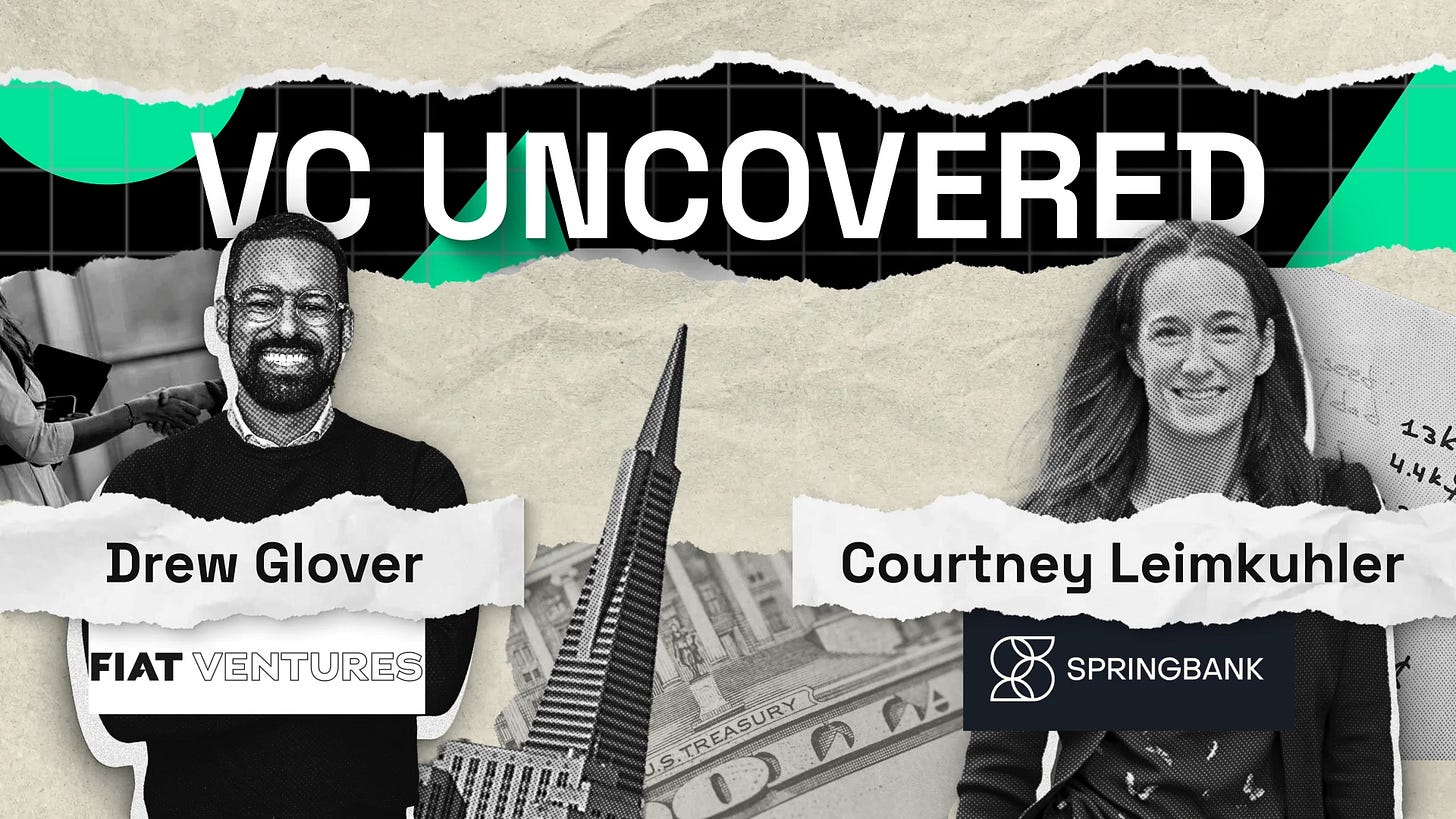
Courtney Leimkuhler - Springbank.VC
Read her VC Uncovered profile here: https://www.vcuncovered.com/p/courtney-leimkuhler-springbankvc
In This Episode
Drew Glover talks to Courtney Leimkuhler from Springbank Collective on investing in the overlooked backbone of our economy. Courtney breaks down Springbank's thesis of funding the critical infrastructure for how we work, live, and care—tackling massive, historically underfunded markets like childcare and elder care. She introduces the "Doritos versus daycare" paradox: while consumer goods have become cheap and abundant, essential services for families have become prohibitively expensive and difficult to access, creating a huge opportunity for innovation.
The conversation gets really interesting when Courtney shares how her deep background as an operator in "big finance," including running M&A for the New York Stock Exchange, gives her an edge. She explains how she uses her intuition not as a gut feeling to invest, but as a "veto power" to walk away from deals, especially when founder dynamics feel off or early customer wins seem unrepeatable, not just unscalable. She also offers sharp advice for founders in the care space, warning them to avoid the "me" trap of building for their own niche problem instead of solving for care as the massive economic infrastructure issue it truly is.
This season is supported by SVB. Silicon Valley Bank, a division of First Citizens Bank. Member FDIC.
SVB is a trusted collaborator for the founders pushing boundaries and the investors who back them. We're proud to have them as our sponsor.
Please note, this podcast is for informational purposes and is not investment, financial, or legal advice. The views expressed are those of the speakers and do not necessarily reflect the position of SVB.
More from Uncovered Media


Read the full transcript
0:00 A lot of things that make our life more convenient are more abundant than they 've ever been. The paradoxes, like for other things which are truly day-to-day requirements and so we think about education, day care, health care, college tuition, the price of those
0:15 things has actually gone the other direction, right? Welcome to VC On Tevert, a series where we highlight the next generation of investors who move faster, take bigger risks, and build shoulder-to-shoulder with founders. I'm your host
0:31 Drew Glover, co-founder of Theot Growth and General Partner at Theot Ventures. In this episode of VC Uncovered, I'm sitting down with Courtney Limecooler, founding partner at Springbank Collective, a firm investing in the infrastructure of daily life. From how we work, to how
0:47 we live, to how we care for each other. Courtney, thank you so much for joining the VC Uncovered podcast. I've known you for so many years. I feel like we have been in the trenches together building venture funds but just so everyone
1:03 knows, when I first met Courtney, I was contracting for an HR tech company. I was presenting at the SAP demo day for their accelerator and Courtney was one of the conversations I had and I was like secretly building Theot Growth at that time and Theot Ventures and I told her
1:21 during that call and that blossomed into a really awesome relationship. I was so excited to have Courtney as one of the first VC Uncovered spotlights on our newsletter. With that, I'm thrilled and honored to have
1:36 Courtney on the podcast, Courtney Run Springbank Collective. I will not risk messing up the beautiful thesis they have. I'll pass it over to Courtney to quickly introduce herself, tell us a little bit more about Springbank and then we're going to dive into everything.
1:51 Yes, great. It is awesome to be here. I love hanging out with you when it's recorded and also when it's not recorded, obviously. I am excited to share more about Spring bank as always. Could talk about it forever. You know the thesis very well and send me great
2:07 companies and we have co-investments as well. But for everyone else who's tuning in, thanks for listening. We describe Springbank as a venture fund that's investing in the critical infrastructure that is paving the way for the future of how we work, how we live, how we care. Our basic take on
2:27 it is that these are many sectors of the economy that have historically maybe been overlooked even though they're massive and they're sort of the backbone of how a high functioning society should work. But because they've been maybe considered hard or difficult, things like
2:42 childcare or elder care, they have maybe escaped some of the traditional venture funding. But demographics are kind of making these bits of the economy truly urgent now and the exciting thing is I
2:57 think tech is also making it very solvable now in ways that it wasn't a few decades ago. So we're really early stage investors. We're usually like the first or second institutional check, pre-seed and seed funds and investing out of a $40 million fund right now that's about two thirds
3:14 of the way deployed. So getting on with it. I love it. I will say I always sell Courtney if I was a billionaire, I would be an anchor in her fund because not only am I a huge fan of what Springbank does, but I'm also about to enter 40, have a wife, have two children, I'm in the middle
3:33 of childcare, I'm in the middle of the sandwich generation, have a mother on the backside of 70 who, as much time as she spends with us and is helpful, she tries to be, I am taking care of her more than she's taking care of me now. And this is the world that we live in today.
3:51 And I know Springbank does a ton of investing in just what the future of that looks like. I want to pull out a couple things that we talked about in our newsletter, which I'll make sure I link in the notes. But one is the Doritos versus daycare model that you talk about. We're really it's
4:09 very simple like it's as easy as possible to or it's incredibly easy to go buy a bag of Doritos very hard to go find a really great nanny, a really great individual or team that can help you with daycare. And it
4:24 should not be that way because of the need and how essential it is in our lives . We'd love for you to just talk a little bit more about how you're trying to solve for that companies that you're working with and what that problem means in the stay and age. Yeah, yeah. Totally right. The Doritos
4:42 paradox, which sometimes we also call like the abundance paradox, which is I think a very well established fact of modern life is that a lot of innovation has really given us too much of many
4:58 things as much if not more of what we need consumer access to Doritos consumer pricing for a lot of tech and other lifestyle goods has you know, frankly plummeted through the
5:14 floor in terms of the pricing over the past decade or two. So a lot of things that make our life more convenient are more abundant than they've ever been. The paradoxes like for other things which are truly day-to-day requirements and fundamental to what you're describing sort of how
5:32 families live and what consumes the majority of both their wallet share and their mind share. The price of those things has actually gone the other direction, right? So if you think about education, daycare, health care, college tuition, all of those things have far outpaced inflation,
5:49 whereas the price of our phones, our televisions, you know, our Doritos have all, you know, come down and have grown at significantly less than the price of inflation. So we think of that as just this like big consumer paradox where we have more of stuff than we ever had before at usually better
6:07 prices than we could even imagine, but the things that really kind of stalk our day-to-day in terms of like getting through our lives have just become more and more inaccessible, more and more expensive and frankly more and more essential because more people are in the sandwich
6:23 generation, you know, we need care infrastructure more than almost any other working generation in history because we have more people working who are in that sandwich generation who have are caring now for aging parents and young kids. We have more moms of young children in the workforce
6:42 today than we've ever had. And so the need for kind of thinking about something like child care as economic infrastructure, the same way that we think about roads and bridges, right? Like we need roads and bridges to get people to their jobs. We also need reliable care infrastructure to get people
6:59 to their jobs. I'm not saying it has to be publicly funded necessarily, but we have to invest as a society into addressing and solving these problems with tech and with like our best and our brightest, you know, like I love to see the smartest people coming out of Stanford
7:16 thinking about these huge problems and not thinking about building yet another gaming company, for example. Totally. And from a care perspective, I mean, obviously one of the hardest, most challenging parts of building in this space is trying to make it scalable.
7:33 Obviously, from a digital perspective, you know, we can make things scalable to a certain extent. For you're talking to someone that runs a growth marketing agency and as much as I sometimes wish that like growth marketing and just be done with me vibe coding some incredible product,
7:48 like I need people and strategists to be able to work with every single client to ensure that we're scaling something. The same thing sits in the care generation. We are talking about I need someone physically to be with my kids. I will one day need someone to physically be with my mom. If that be short term and long term. So how do you kind of marry taking
8:07 these people driven industries, digitizing them to make it so it keeps up with this abundance concept that you talk about? Yeah, it's a huge challenge, right? I don't think we're going to have robots taking care of cocoa anytime soon. You know, we might have them doing
8:28 something in the background, maybe they're vacuuming, you know, that would be great. But you're totally right. A lot of the reason that many of these sectors of the economy have been viewed as really hard is that they are very people intensive. But I think there are huge ways to
8:46 address at least some of the supply side problems with the availability and access around care by using tech. So yes, I don't think tech is the answer to the direct supervision nature of care. But
9:01 we all know that there's a lot of other parts of the process between you deciding to have a child and needing to go back to work and someone walking into your home or you walking into a center to drop off someone who needs caregiving. And there's a lot of inefficiency built into that at the
9:19 different levels. So the search process is incredibly difficult for finding care. The administrative process of enrolling or paying is still, you know, pretty paper based in a lot of settings. And actually a stat that has
9:34 really like blown me away is we think about the term child care deserts. A lot of people use that term as parts of the country where, you know, there's no available child care slot for, you know, 40 mile radius or something like that. And which is totally true. However,
9:49 what the stat that I heard just so mind blowing is there's a very large percentage like half of day cares. I think it is are running under the capacity of their physical footprint. So they are basically facing talent and worker shortages that mean they cannot
10:07 reliably open that second classroom even though they have the physical space to do it. And so to me, if there are ways that we can address some of the, you know, administrative elements of staffing and reducing churn and making these jobs more attractive so that they can be a
10:25 steady income for someone instead of something that people churn out of really quickly because they're hard and frankly, they're really poorly paid in a lot of cases. If we can strip out some of the administrative burden and cost, I think we can actually create supply in a way that today feels really hard.
10:41 So I think there are lots of opportunities to think about applying tech to the administrative side of arranging care and also to improving the quality of jobs so that we can attract a different type of person into them and therefore increase supply. Yeah, we're still
10:56 going to have to have humans actually changing diapers. I don't think that's going to change. Yeah, obviously I'd love for anyone but me and my wife to have to change diapers. Tomorrow problems though, right? So me myself, I'm a huge power law investor.
11:13 I mean, I think a lot of like really early stage investors are we're power law investors. We're looking for really incredible founders that are building billion dollar visions that have the opportunity of creating a generational business. Sometimes when I think about
11:29 this like care economy, I see a ton of use cases where they are true like billion dollar visions. But I also see some of the most exciting potential problems that need to be solved as edge cases that aren't
11:44 billion dollar visions but I think can drive a ton of value to the market. How are you kind of sifting through uncovering what is a generational opportunity versus something that I'm sure you wish you could invest in but just like doesn't fully align with your thesis
12:03 around investment. Yeah, I think that's totally right. And because of our interest in the space, it means we attract a lot of founders and a lot of people building awesome companies that you're not or you're right or not necessarily going to be venture scale. And to
12:18 be honest, the worst part of the job is saying no to some of those companies, right? Because I love the founder, they're working on such an important problem but it's not something which is going to have those power law type outcomes that you and I obviously both get paid to
12:33 find. And that is one of the hardest parts of the job. I think in terms of how we sift through them, we really think about TAM like everyone else. A lot of the markets we invest in end up being like market creation type of bets where there isn't a market today. And so there I think a lot of
12:51 times we're really leaning into things which feel demographically inevitable like an aging population. There's nothing that's going to change. Absolutely. More people are going to be cared for and living at home. And that will open up a huge number of opportunities. Some of them are going to
13:09 be very people intensive and may not necessarily lend themselves to venture scale outcomes. And others of them are going to be huge venture scale outcomes. And when we think about that, it's care as a topic in particular, it just has so many different facets, right ? It also
13:24 includes something like financial caregiving which I know you and I have talked about a lot. There are huge opportunities just in the small category of things like elder fraud, right? You know, dozens of billions of dollars of fraud per year. The greatest wealth transfer in the history coming in the next 10 years of wealth moving between baby boomer
13:44 spouses as, sorry, to tell you my friend, but the men are dying sooner. So they're passing first to their wives, then it's going to go to the millennial. So there's a lot of money on the move. And those are, you know, huge outcomes, right? We think about estate planning, fraud protection,
13:59 just the day-to-day active financial caregiving, paying bills, keeping track of accounts, dealing with insurance. And so there's a lot of automation and interesting tech, like in that one tiny vertical alone, I think there are some absolutely massive businesses. So we think really
14:15 expansively about where is there, you know, demographic inevitability? And then where do we think tech is unlocking things that have been really difficult to get to, you know, in prior generations, call it of innovation,
14:30 that, you know, feel like this is a 10x improvement over the experience from here. You know, one example, we have not an aging, but is more in kind of workforce, is like teacher tooling with this company called Brisk Teaching that we've invested in, has
14:46 over 250,000 active teachers, over a million teachers. So, you know, downloaded it and tried it. It is cutting teacher time, you know, by hours per week, you know, in terms of grading,
15:02 curriculum development, taking a first pass at doing feedback on an essay, creating, you know, feeding in something like a YouTube video and saying, do me a lesson plan based on this, feeding in an interesting article and saying adjust this for a fourth grade reading level, or customize it by
15:19 these groups based on what you already know about how these kids are tracking. And so those sorts of tools are complete game changers if you're a teacher. And again, back to sort of demographics, lots of teachers leaving the workforce burnt burnout, you know, it's not like kids don't need to
15:35 be educated. So there's some really interesting tooling opportunities there that don't replace the teacher, don't take a teacher out of the classroom, right? But give the teacher time back to focus on the stuff, which is really human, which is very hard to replace and augment with all these
15:50 other efficiency enhancing tools. Yeah, yeah, I definitely love how you think about the areas to invest in at the core of again, like people will always pass on. Kids
16:05 will always need to be taught those being like kind of tentpole places to look and then uncover the opportunities that frankly are going to have the drive the largest impact. Yeah, before I change the subject, are there any kind of spaces within care that like people are not focusing on
16:24 right now, but as someone that lives in the space, you believe are just massive opportunities, these like unspoken opportunities that people aren't talking about enough? Yeah, I think there there are a few that
16:39 come to mind. I mean, we've got bets in them. So of course, I'm hoping that they do become more more mainstream. You know, something that we have been spending a lot of time on recently, back to this theme of kind of financial caregiving and and I think of solving
16:56 for some of the call it like off balance sheet liabilities in people's personal lives, like off balance sheet liability was the thing in the financial crisis, right? Oh, God, we have all these mortgages no one knew about. But I think about, you know, the cost of getting sick, the cost of
17:12 maybe caring for your millennial kid who wants to move back home when they're 25, which apparently is a thing, right? The cost of caring for an aging parent who may live much longer or want to live at home. And these are things that generally we don't have good products and planning
17:29 around these sorts of down the road liabilities. They just aren't necessarily very well cared for in a way by like the existing financial markets. And so I think there 's really exciting
17:44 opportunity to help people plan and productize opportunity for these sort of off balance sheet opportunities. That also may have a different constituent and buyer back to this point of the Great Wealth Transfer and the percentage of capital that is going to be
18:00 controlled by women who we know generally direct money more towards things like education, health care, savings, you know, more kind of values driven investing and saving schools. And so I think there is a big opportunity that's sitting out there that is the reality of demographic, you know, kind of
18:19 shift in terms of who controls the assets. And also just the cost structure that an American family is facing with a 20 or 30 year view that may be a lot different from what it was a few years ago. So those are some of the opportunities I'm really excited about. We have a couple portfolio
18:35 companies that are nibbling way at that. So one I love is called First, which is actually a prenup legal tech company back to like starting young on the planning, you know, the most important legal agreement,
18:50 you know, we hope you'll never have to use. But the truth is almost 50 percent of millennials either have or intend to have a prenup. That data totally shocked me. Like that 's Harris poll data. That's very good quality data. And that's really surprising. But it
19:06 makes sense, right? People are getting married later. When they get married, they maybe have a lot of student debt. Maybe they actually own an apartment. They definitely own a dog these days, right? They have a pet baby. They don't want to inherit their partner's medical school debt if it doesn't work out. They don't want to lose the dog. And so people are really engaging earlier in
19:25 conversations about their long term financial planning and, you know, the opportunity to then talk to that couple, become their trusted advisor and help them be thinking much more proactively down the road around wills, estate planning, things like that. I mean, that's not just for
19:43 the ultra wealthy, right? We all need to be taking a very proactive approach to that long term kind of financial planning investment and the sort of product menus that are available to us. The prenup piece is really interesting. Also, the divorce side as well, these
20:02 are like all different sides that aren't exciting conversations to have, which actually makes having a digital process in place that makes it as frictionless as possible. Really helpful
20:17 because there's nothing worse than having to do that, but also spend, you know, 10 grand on lawyers to make it happen. Oh, so worst. That's why I love like when we looked at first, that's what put me over the edge is, is like the UI is gorgeous. And it's all the things we should be talking about, right?
20:32 Each person signs on, you answer a bunch of questions. It shows you kind of like, hey, you guys are, you're a little different on this, right? Whether it's your retirement plan or like, oops, you forgot to tell someone, you forgot to tell your partner that you have this debt or you own this property or whatever. So it surfaces these things that we
20:48 all need to be having as conversations, but we don't. We avoid them. They're awkward. They're hard. And this is a place where we've seen it, right? We've seen that, you know, men, for example, talk to AI for, you know, mental health and therapy at a pretty surprising rate
21:04 . It turns out that we are willing to engage in some of these difficult conversations and areas of care or, you know, human engagement with the support from a sort of digital companion. So let's use it. Yeah, no 100%. Libby, they're CEO. I've met many times. She's super impressive.
21:24 Yeah, she's amazing. But yeah, really exciting edge case that I think is, it's much larger. We see it as an edge case, but it's actually a use case. It's just not spoken about like an edge case. To change the subject a little
21:39 bit here, you talk a lot about the operator edge in VC. And I will actually say, Courtney , I feel like me and you initially connected because we're both operators and we 're in this VC space. Yeah, it's just a different level of energy. I think it gives us a lot more.
21:54 It gives us an edge when it comes to underwriting and recognizing talent, but more importantly, recognizing talent that can actually like follow through with all their promise . As I always talk about this like say to do ratio always being at 100% and like a really good operator,
22:10 make sure that's a really high percentage. So we'd love for you to talk a little bit more about what it means to be a VC that comes from an operator background kind of being in the trenches with every single portfolio company that you work with. Yeah, I mean, I think it
22:26 makes the job even more fun because who doesn't like the investing part, right? Spending all day talking to incredibly smart people who cover great ideas. But I also love the follow through part to your point. I think some of my best days are also the days when I spend an hour or two with a
22:44 founder trying to figure out something that's hard, right? And it varies a lot. I'm an M&A person by background, so having lived through, you know, $20 billion worth of M&A transactions is really helpful. Give the listeners a little bit of background on what we
23:01 were doing prior and just feel free to pump yourself up a bit. It's really impressive, but they need to hear like they need to hear why you are an operator, how you became an operator. Yeah. Yeah. So I have spent a long time, sort of almost 20 years as an operator in mostly
23:19 financial services. And I think of it as, you know, now I work in little finance. That was definitely very big finance. And I did all I sort of started as a banker at Goldman. I actually spent a few years at a company that Goldman acquired. And that was my first taste of
23:35 like really living through, you know, investments and M and A sound really good. And then you got to go actually do the thing. And so I had the opportunity to go do the thing on the ground and figure out what to do with this company we had acquired. And frankly, to
23:50 make the most out of in particular the sort of technology assets that we had. And, you know, from there, I ended up spending almost a decade at the New York Stock Exchange in basically an internal banker type capacity. I ran strategy and M and A for them. And that was an
24:06 incredible ride. I got there when it was still a nonprofit owned by its members. And so we had to turn it into a private for profit company for starters, everything from setting up billing systems to, you know, engaging customers in a totally different way, preparing a budget
24:25 for the first time, you know, all those things, which was crazy. Because at the point, it was already a multi hundred year old institution. So it was this very well known brand that in a way was still incredibly young in terms of developing as a real company. And then we took it public
24:40 through an M and A transaction with a public company. So almost a sort of spec type of deal, but it wasn't a spec. It was just a small public company. But that was the sort of backed our way of going public, which is what we needed to do because we were a mutual . We just needed to go quickly. So that was super interesting. And then I spent the next, you
24:57 know, seven or eight years running M and A and we did a bunch of deals. We did tuck ins. We did tech investments. We built a tech business from scratch to be, you know, a few hundred million of revenue, mostly through acquisition. And then we sold the company in in 2013
25:14 for $10 billion. So that that was just like an incredible ride. And I saw it all and I made all the mistakes for sure as well. So that was incredibly valuable experience. And then after we sold the company, I was the CFO of March for four years, which is insurance broker, 130 countries
25:32 , you know, completely different from the NYC, actually a much more mature public company in a lot of ways. So that was really exciting as well. That's sort of the dawn of ensure tech, which is why I went just thinking, here's another old industry being disrupted by
25:47 tech, you know, how do they incumbent figure out how to survive and thrive, which they have have more than done. So March is a fantastic company. So I feel like I've, I have definitely been in the trenches. I've seen a lot within my jobs. I've worked for really big
26:02 companies, but I've also worked in groups that were, you know, very small, very edgy at the front end of tech adoption at a time when, you know, most people weren't really thinking about it. So that has given me just so much perspective on, you know, I think number
26:19 one, how do you think about where change is going in an industry? And specifically, how do you think about and understand the incentives of the people who are already operating in it? Because there are lots of good ideas and certainly many ways to make something like insurance
26:35 better, right? The hard part is not looking at something that's a sort of older overlooked industry and pointing out what could be improved. That's super obvious to everyone who works in the industry. The hard part is actually figuring out how can you design something
26:50 which has that kind of 10x improvement and then how do you actually drive through the execution and the adoption? How do you work within the constraints of the existing incentives or how the, you know, companies in the industry interact? What is the value chain
27:05 within the industry? How can you drive technology and change all the way through that value chain, which is often the key to getting adoption even within your own company? So I think I've just had a huge amount of experience both doing it right and doing it wrong,
27:21 you know, and recognizing there are lots of intangibles that often are the difference between success and failure. It's often the incentives of the specific humans who are involved. It can be as simple as, you know, cultural fit between companies that are coming
27:37 together. And so sometimes you can get the product exactly right, but if you get the change management wrong, the whole thing obviously is a failure and it doesn't matter how good the product was. So I think having that like 360 degree view of what it takes to, you know, really
27:52 drive adoption and change has served me really well both in terms of evaluating investments, many of which seem really good and smart, but probably wouldn't survive contact with the enemy once you really kind of dig into the industry dynamics.
28:09 I love that. Now, I would also say your operator background also gives a lot of your investments and then the founders and the people within those businesses, some upside because a lot of VCs are just giving money. A lot of the VCs that are that are, I would say
28:26 this next wave of VCs are giving much more than money. And I actually think a lot of founders are getting smarter here where they're saying, we only want you on our cap table, if you can give us more than money. Typically, that's in the, that's in the form of maybe a distribution advantage, maybe an operational advantage, maybe a data advantage. But like
28:45 what, like, I would say from you being an operator that's done a lot, like what would you say your superpower is, is that like, call it the investment plus type of mentality of like what's that extra sauce you're putting on every investment that like really helps them out.
29:01 Yeah, I think for us, a lot of it comes down to almost like this sort of business acceleration stuff when it comes to intro deductions, for example, on the distribution side. So thinking about in particular B2B, like what are the partnerships and how can we use our
29:18 network, which we've established over, you know, many decades between myself and my partner, Alana, to make those kind of introductions that are unlocked on the revenue side. So we're able to do that pretty consistently for our portfolio companies. And then also coach
29:33 them through the process. You know, one of our portfolio companies is about to sign a huge agreement with one of the largest brokers in the country. And I mean, that is like a roll up your sleeves. I am really in it with them thinking through not just what does the proposal look like, but you know, it was literally calling me saying, you know, they came back and
29:50 they struck this term and they, you know, changed the economics. And it's the tactics of like, what should I do next, right? Should I call? Should I send an email back? Should I have my lawyer call them? And I've just been through that so many times. And so there's a lot of sort of on the ground tactical support, especially when it comes down to
30:09 partnerships and big strategic relationships that can be really helpful. The other thing I say, which I think stands out is, I think if you've been an operator, you know, stuff goes wrong more than it goes right. I think if you've been a career investor and something starts to go
30:26 wrong, it can feel like you made a mistake or this was a bad investment. And I think if you're an operator, you know, that happens all the time. And so I really try to get to the point with my companies where I don't want to see the vanity metrics. I just want to talk about what's
30:43 not working and I want them to be open with me because I'm not going to freak out. I'm used to it going wrong. I've been in the seat when it's gone wrong. And I think being able to have that trust a relationship where I can just say, Hey, don't tell me what's going right.
30:58 Tell me what's going wrong. And we can kind of get to it also really helps. And so there's just this sort of calmness that comes with having seen the cycle, having made the mistakes, having lived through, you know, a model that turned out to be really wrong or off by half that can be really valuable for those like trusted relationships that then
31:15 gives access to all the other things that I can do with my network or with my background, you know, in M&A, for example. One thing that you talked about in the in our newsletter issue was the intuition using
31:30 intuition as a veto power. And I think that's super fascinating because I'd say like universally for the most part, VCs use intuition as it's like, I've spotted the superpower and this founder like, I know this is the person, but you have have sharpened the knife
31:47 of using it as a as a as a veto moment of actually, this is why I'm not investing. And with love for you to just assign a little bit more like because I think that's a superpower that all VCs should actually have. Yeah, there's the road in VC surely is littered by, you know, the charismatic
32:04 founder who felt like the next big thing, of course. And obviously, that's the false positive trap that we're all very susceptible to and trying not to fall into. I think some of it's just my personality, like I'm just a very data driven
32:19 person. I'm really drawn to founders who know their business inside and out know their metrics hard, know the industry dynamics, as I said, I'm less attracted to founders who have been, you know, cooking three or four different ideas that are all really interesting and
32:34 then finally landed on one, you know, in three or four different industries. Like, I think that's just something that I'm a little less drawn to. So I tend to be someone who operates from a position of like, I want to see data, I want to see expertise, I want to see
32:49 depth. Where intuition kind of kicks in, you know, on the positive side, of course, and I talked about it before, like there are things which seem inevitable. And I can often make a decision, which is I don't know if this is exactly the way it's going to go, but I know
33:05 five years from now, we will not live in a world, for example, where we have no idea what 's happening inside women's bodies. That's a black box of their hormones, like I'm pretty sure in five or 10 years that will absolutely not be the case because hormones are so essential
33:20 to almost every other bodily function. And so I can make a bet like level zero, which is, you know, pretty far down the road in terms of coming to fruition, because it's a hardware play, it's going to have an FDA angle, but I know that continuous
33:35 hormone monitoring feels like something we will do. On the flip side, the intuition of stopping things and the veto to me, I think mostly services in two ways. One is, I think it's mostly around founder dynamic, it often comes up if there are more than one
33:52 founder. And to me, I am very attuned to how the founders are interacting with each other. And I really listen if something about that interaction just doesn't feel exactly right to me. Back to sort of the operator thing, you can have the best strategy in the world, but
34:09 if the people are not able to work together, it's going to miscarry. And so I really do use my intuition a lot, like if something just doesn't feel right to me, especially between the founder and the co-founder or the founder and other teammates, if that dynamic is off,
34:24 I can kind of overlook everything else and that'll be a veto. So that's a really big deal. I think the second place intuition kicks in for me is, you know, venture everyone loves to show a lot of early success. And I am very skeptical around the early client wins,
34:43 if there are sort of some big early client wins to me is almost always a story there. Unscal able is the name of the game in early venture, but unrepeatable is a problem. And so I really feel like that's where I get my antenna up. If the story feels too good to be
34:59 true on some of the larger initial client wins, if I kind of can't make sense of that one, that'll also be a veto for me. Yeah. Unscalable versus unrepeatable. I mean, that is, that's a LinkedIn post if I've ever heard one. That's good though. I really like that. I think that's a, that's
35:18 just like generally a question that should be asked in every kind of like, honestly, B2C, B2B and B 2B2C. Okay, we're wrapping up here. I'm going to start asking a couple quick fires. The first one I have is what is like one wellness hack that you do that like everyone
35:34 else should be doing. I am a total convert to the Aura Ring. So that is my advice to everyone. I think it's sort of the best kind of data in the background that is actionable, but not invasive. I love it. Right on. I feel like I've been at the very end of a purchase of an
35:51 Aura Ring many times and I always bring the plastic thing around. I hear you. Yeah. I'm a , I'm a whoop guy though. I wear, I wear the little whoop band. Okay. I don't think I need both. So you go to the airport, someone's offering you round trip ticket with
36:09 whatever your family anywhere in the world for a week fully paid for. Where are you going? Really would like to go to be tan actually. I've never been loved to go there. Tell me, tell me where that is just so everyone. It's near Nepal. It's like a tiny little country that
36:24 sort of measures its GDP in happiness equivalent instead. So beautiful scenery, amazing hiking, it seems like a really cool place. Love that. Love that. If you could only invest in one
36:39 industry outside of your current, that your current focus, what, what industry would it be? Probably go down the rabbit hole of biotech actually. I think there's so much incredible stuff happening there. We've done a couple. We'll only follow a really
36:55 established biotech investor into that one. But yeah, that would be awesome. Such cool stuff. Love that. If you could be the best at any sport, like the best for the next 10 years, what sport are you choosing? I think I would choose tennis actually. I feel like tennis has
37:12 just figured out how to get the most amazing like fancy people to show up and watch. So I feel like who doesn't want to play in front of, you know, the King of England. That sounds great. Exactly. Let's go to Wimbledon and win. Let's do it. The spoils. The trophies look so nice.
37:27 Yeah. Okay. Last two. What is the last book you read that made you want to share it with everyone? Oh, can I do two? Bring it on. Oh, three. I forgot three. Sorry. Okay
37:43 . Number one, I just finished Boys in the Boat. Great book. It manages to be very suspenseful, even though, you know, the ending. It's about a University of Washington crew team winning gold at the Berlin Olympics in 1936. Very cool. Invisible Child, another
38:01 fantastic book written by New York Times reporter following a homeless child in New York. Truly heartbreaking. By the end, you kind of hate everybody. So, you know, there's something for everyone. Liberals, progressives, we, you know, conservatives. We're all part of this problem. And then third
38:18 book is a great book called Subliminal, how your unconscious mind kind of rules your life or something like that, which is sort of my pet topic and I highly recommend. Last one is there is a founder that is thinking of starting a business in the care space
38:37 hasn't landed on their idea yet. What is the one bit of guidance? And yeah, what's the one type of kind of guidance you give them? I think it's avoid the research. I think care is so
38:52 universal. We all to some degree are caregivers. And I think it's the sort of topic area where everyone comes into it thinking that they need to build for their unique problem. And the truth is our problems are not unique. And we are not the first to encounter
39:07 them. And that is the biggest trap I think people can fall into care is an infrastructure issue. It's an economic issue and it needs to be solved at scale. It's not about building for the particular friction point that you have encountered. Of course you have. We all
39:23 have again, it's not about identifying the problem. That is the easy part in most difficult opportunities. The really hard part is figuring out scale and adoption and focus on thinking about it as infrastructure as economic infrastructure. Think about the incentives, the
39:40 huge barriers to change, and solve it as a structural issue that is and avoid this research problem. Love that. And if you can't get out of the research, just talk to a couple of potential customers and do a little research before you haven't talked to them. Yeah,
39:57 before you vibe code for the next couple of months here. That is incredible. Courtney, line cooler. Thank you so much. That was awesome. Big fan of you, big fan of Spring Bank. And yeah, thank you for being on BC Uncovered. I'm sure we'll see each other soon in New
40:13 York. I hope so. Yeah. This season is supported by Silicon Valley Bank. For decades, Silicon Valley Bank has been a true partner to the innovation economy, helping both founders and funders grow. Silicon Valley Bank, a division of First Citizens Bank,
40:31 member FDIC. Please note, this podcast is for informational purposes and not investment, financial or legal advice. The views expressed are those of the speakers and do not necessarily reflect the position of Silicon Valley Bank.
Transcript generated automatically; it may contain errors.
Originally published on VC Uncovered · By Drew Glover