Jeff Becker
Antler
Investing in “Maniacs”: The Day Zero Math Behind a 63% Chance at a $10B Win.
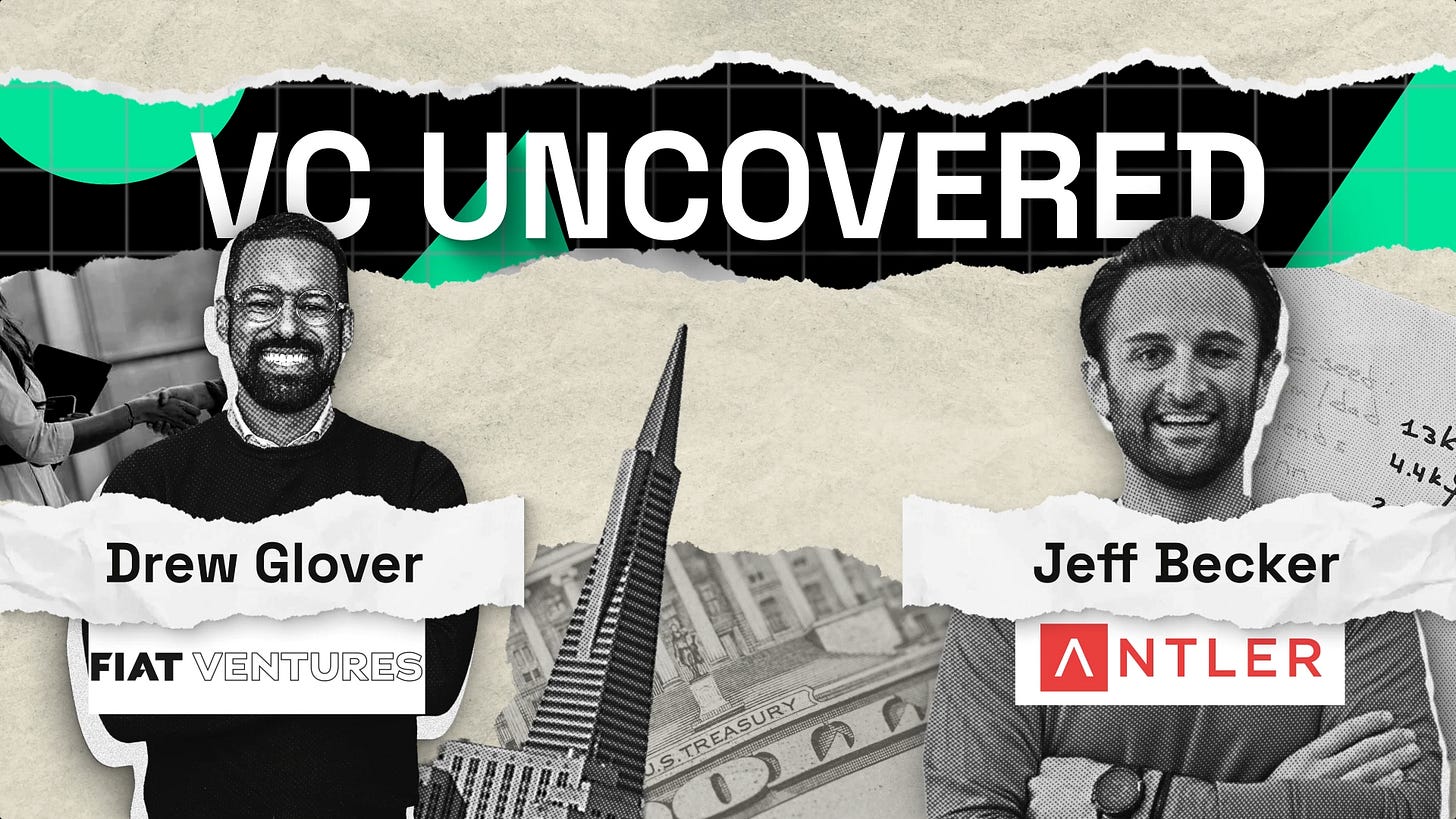
Jeff Becker - Antler
Read his VC Uncovered profile here:
www.vcuncovered.com/p/jeff-becker-antler
In this Episode
Drew Glover talks to Jeff Becker from Antler on backing people, not companies. Jeff explains Antler's unique model of investing in founders at "day zero"—sometimes before an idea is fully formed or a company is even incorporated. He shares how Antler provides the capital, culture, and community to help individuals get through the most vulnerable stage of their journey.
The conversation gets really interesting when Jeff describes Antler's ideal founder as a "maniac"—an outlier who is intensely driven, creative, and inspiring. He also breaks down Antler's investment strategy, framing it as both an "insurance policy and a lottery ticket." He explains how their high-diversification approach gives their fund a 63% chance of landing a $10 billion company, offering a compelling look at a different way to approach venture capital.
This season is supported by SVB. Silicon Valley Bank, a division of First Citizens Bank. Member FDIC.
SVB is a trusted collaborator for the founders pushing boundaries and the investors who back them. We're proud to have them as our sponsor.
Please note, this podcast is for informational purposes and is not investment, financial, or legal advice. The views expressed are those of the speakers and do not necessarily reflect the position of SVB.
More from Uncovered Media


Read the full transcript
0:00 By the way, I think sharing this sort of gives up my edge, but I'm not sure it anyway. I'll ask people, like, what does your family think about you? What are your siblings like? What was it like growing up? You know, like, what's your claim to fame? What are the things you're most proud of? If I knew that if I was inside your head,
0:16 what would I be hearing? [MUSIC PLAYING] Welcome to VC On Tougher, a series where we highlight the next generation of investors who move faster, take bigger risks, and build shoulder to shoulder with founders. I'm your host, Drew Glover, co-founder of Theot Growth
0:32 and general partner at Theot Ventures. Today, I'm joined by Jeff Becker, general partner at Amlet, a firm that specializes in backing founders at the very beginning. We're talking pre-product, pre-deck, and sometimes pre-anything, just a founder with the spark of an idea and the ambition
0:48 to build something world-changing. Jeff Becker, thank you so much for taking the time with me. I've been following you. I've known you for a couple of years now, and you're one of my favorite people to talk to, especially when we started talking about what's really going on on the ground within investing.
1:05 I would love for you to maybe just kick things off by just telling everyone a little bit more about what you're focused on at Antler and the specific type of companies you're looking to invest in. Sure. Well, the short answer is not companies' people. We're looking to meet the most insane and intelligent
1:21 and amazing people we can, and we bring them together in a room to work together. My experience starting companies and working with founders has led me to this realization that being a founder's a lonely journey, and at those moments before you get funded, there's no culture,
1:36 there's no community, there's no cap table or capital, and there's certainly no co-founders usually. It's like, what do you do when you're in that stage? And what Antler aspires to do is create that destination, that place where the highest octune people can come together,
1:51 work on their ideas, meet their co-founders, be in a culture of high execution, and I call them maniacs, but being a maniac environment, and then ultimately receive the money and get the capital. And if you can do all of those things early enough and you can do it based on the person and their ideas
2:06 and the way they operate and execute, I think that is an opportunity in venture capital to support people to create incredible businesses rather than waiting for there to be something to underwrite and waiting for there to be a business. And so, yeah, I'm going to short answer on your questions
2:21 is people and not companies. We'd call out good correction people, 100%. I triple down on that statement. You use the word maniacs and you actually use it in the newsletter issue that we dropped. I love that idea of backing maniacs.
2:38 How are you defining maniacs? How are you defining that type of ilk? - Yeah, just a word I use. I'm not sure there's a clear definition. And the reason I use that word is 'cause it has this like visceral experience behind it, right? Like when you say maniac, people get this like,
2:54 you know, there's something about it. And the same is true when you work with people in person. You get this sense of them. They could be a 10x engineer, 10x sales person. They could be someone with incredible resilience. They could be insanely creative. They could be putting in seven days a week in work.
3:11 A maniac is not necessarily one thing. To me, it's that visceral experience you get with someone that they are out there doing their life's work, putting everything they have into it, making incredible progress, inspiring people to join them, inspiring investors to back them to other people
3:27 to be their employees, customers to be part of their journey. And you get a sense of these people by being in person and you just, you know it when you see it. I'm sure a lot of the listeners here and other VCs that you speak to, if you think back over the arc of your career,
3:42 there's always one or two people that stick out, right? Like, wow, that person definitely is gonna do something amazing. They're different than other people. They work harder, they're smarter. They know this thing and they really are going for it. To me that, you know, demonstrates a maniac. It's someone who's an outlier in many dimensions at a time
3:59 and you can just feel it when you're around them. - Totally and there's almost this like love at first sight, especially when you get to like invest that inception. I actually think a lot of folks that wanna be in the venture capital landscape, they sometimes over romanticize venture capital
4:15 because they think that at every single stage of the venture chain, you can invest with that love and first sight inclination in your body, like that you get to feel. And unfortunately, you know, even where I'm investing, even pre-seen seed, I don't get to invest
4:30 with that love and first sight mentality. There's enough data where I like, I do have to unearth it and underwrite it. Series A, BC, the higher up, the more it becomes more of a data and financial underwriting process, then a love it first sight process.
4:45 But you truly get to invest from like that love at first sight, you see that maniac, you see how they take, you've seen it enough times before that you can like lean in with an investment. But I'm curious, like what parts of that can you underwrite? Like the day zero, even like negative one moment
5:03 when someone just has an idea? - I personally find it to be a lot less noisy. You know, when companies start to get a lot of traction or they start to surround themselves with, you know, big names or other firms, it's natural to get this sense of foam hour,
5:18 like the sense that you're missing out on something and you treat that as a real signal of it. Oh, if so and so is investing, I should be there or if this many customers are signing up, I should be backing it. But I found that when you go earlier and there's less, meaning like there's less of a product, less customers, less revenue,
5:34 you're left with what is true about the people? You're left with, are they an inspiring leader? Are they a good communicator? Can they build product? Can they sell? Are they putting in the time and energy and effort? And because I'm willing to underwrite at that level, I can also price it much lower, right?
5:49 I can come in and say, "The only thing here is the person." And while that's the only thing that will never change and I actually think it's less risky to back the people when you know who they are and what they're like, it also commands a lower valuation. And so for me, it's less noisy on the signal
6:04 and on the business ins and outs, so to speak, right? Like the numbers and the objective realities and it's more a sense of what does this person like to work with because that's never gonna change throughout the company. And because I'm taking more risk, I'm gonna price it differently too.
6:20 And so when you're this early in venture capital, we're talking like pre-Y combinator, pre-incorporation in many cases. The game is really high diversification and high caliber people, so that you can get to a resulting portfolio
6:35 that is a meaningful size, enough great companies that are making it a student series A, but I can afford to take more shots on goal because we're doing the lower price. I think that's a good trade-off for founders too, because you leave your job. It's nice to put half a million bucks in the bank
6:52 and go back to work. And there's not a lot of people that are writing those checks and doing it at the scale and velocity that we're doing it. So I think that we're going after a certain type of founder for that, but yeah, it's just a slightly different model than underwriting revenue and doing customer reference calls and that kind of thing.
7:10 - The other thing that comes along with the way that you and the broader Antler team invest is you are investing in so many more companies than a lot of other venture funds. Like I always jokingly say, like, I love all my babies, but I have like 30, 35 investments I've made
7:28 since inception of Fiat Ventures. I'm assuming you have hundreds. And so another piece from the venture side, it's what are you adding beyond capital? And I'm curious how you kind of approach that is, do you take a lot of pride in just being capital?
7:43 Is there like this extra thing that you're bringing along with the capital beyond the investment? - Yeah, I think the number one most like underrated thing in all of venture capital and tech and business and like in the world is culture.
7:58 And people say that and they talk about it, but they don't internalize, they don't like, they don't feel it. And I was fortunate to kind of grow up at LinkedIn and Jeff Wiener was the CEO there and he just drilled it into us new year after year, after year after year.
8:13 What I learned from that leadership team and they were exceptional beyond Jeff and into the whole leadership group is that what they were very good at was teaching other people how to think in their absence. So framework, how to operate, framework, how to make decisions. And a lot of that was our culture
8:28 and our mission and our vision and our values. And when you're a founder, you don't have any of that. It all has to come from you. And so if I can provide a place where you are surrounded by people working seven days a week, you're surrounded by the top 100 people out of 10,000 applicants
8:43 that wanted to be a part of Anler. You're surrounded by people that are domain experts that are technologists that are just wildly interesting and amazing each individually on their own, whether they were an Olympic athlete or the two-time world champion of NBA 2K. We have that guy here.
8:58 There's a bunch of interesting, smart people. And so you can create that culture. All of a sudden, you start to look forward to going to work in the morning, even though it's insanely lonely to build a company. You start staying late in the afternoons and in the night and well into the morning,
9:13 because it's fun to be around other people that are problem solving. And what you see after weeks and months of that is those decisions and those habits compound, and you start to general momentum, and you get people around you, and then you get cash from Anler. And that creates some credibility in the institution.
9:28 And then you get the introductions to downstream investors, and then all of a sudden you have a seat around coming together. And you start to feel like things are moving upwards, but there's this momentum building in your business. But for everybody else, like 99% of people that go to start a company,
9:43 there is entropy from the beginning. Like you wake up and it's hard. Like what do I do today? Who do I talk to you? Where is money from? 10 people said no. My customers don't understand it. I can't find a co-founder. I'm not technical enough. Like whatever it might be. And so we want to do is remove all that
9:59 and invest deeply in culture. We're going to add on top of that the coaching from people that have done it before. And then we're going to add capital on top of that. And then we're going to help them go raise their next round. So it is much more than just a lot of deals and a lot of capital. To me it really is the ethos of being a founder and building with that sort of energy and momentum
10:16 and being surrounded by other people doing the same. - That's awesome. And I love that you've learned culture from LinkedIn. I love the idea of what are you doing in my absence that mindset from a leader and kind of being trained up.
10:34 And building culture, I feel like you typically need to have bodies in place to build culture. It's very hard to build culture at least outward looking in. It's just an individual sitting in a room as like an individual founder. How do you think about building culture from day zero
10:49 versus building culture when you have 10, 20, 30, 40 employees? - Yeah, I mean, it's how you show up and how you communicate. So I have founders that build WhatsApp groups and they keep adding in the most interesting people you've ever heard of. And they're texting and they're talking about their business
11:04 and they're creating a sense of forward movement and progress. I've got founders that come into the office and they're just electric in the way they engage other people. I've got people like at nine p.m. at night, I'm here last night and there's founders working and they look at me and they're like,
11:19 where is everyone? It's the middle of the day. They bring that enthusiasm for their work even at nine p.m. The way that you show up, the way you communicate, the things you choose to share, the positivity you choose to bring to things, the way you communicate progress,
11:35 all of those things create a perception that eventually becomes reality in my opinion. That's one thing, that's like the daily grind of getting up and feeling inspired by the work you're doing and willing it into existence. The other thing that you need to think about is
11:50 how to manufacture forward progress. And some of my best founders, they have a real sense of accountability for themselves and for others, they ask a lot of other people, they want to work on hard problems, they want to create progress. And so they try to figure out how to move the ball forward,
12:07 whether that's asking for introductions, setting deadlines on contracts, celebrating victories and wins. They do things that make it feel like you're in motion and then people want to get on that train with them. They want to go where that train is going. And as you do that, what you find
12:23 is that those extra bodies you mentioned, they start to add themselves to the right. You have advisors and you have investors and you have employees. And all of a sudden, they're wearing the Anner t-shirt or they're wearing their company swag and then they're talking about it with their friends. And like that amoeba, that sort of thing, it just grows.
12:40 And founders that can manufacture that are really special. And I think founders that appreciate that are really special. - Yeah, I know, I love that. And getting them through that most vulnerable time in the journey is like so important, but also more importantly to be able to send them off
12:57 with foundational tools that are gonna help them when they're at a hundred and a thousand employees. It's like also incredibly helpful also. - Setting them up with those tools, setting them up with a sense of how do you manage a team and lead a business?
13:12 What are the true and rough metrics? How do you measure them? Where are the visuals? How do you message those things? How do you recognize people so that they know what matters and how to continue down the right path to creating what you want to be creative? How do you help them do investor updates?
13:27 How do you help them engage the right investors or the right angel investors or the right customers? How do you help them show them what other founders have done at those stages to catalyze a customer contract, for example? All of these little moments, they just, they mount into this mass of learnings
13:43 that when you do fundraise, you know, exactly who you wanna hire and how you wanna go to market and how you wanna delegate things because you've done them yourselves, but it's hard when you're alone. And so doing that with people and people that have done it for, you know, my opinion is an irreplaceable sort of moment at the founding of a company
13:59 and people dramatically overestimated or underestimated, I guess, so put yourself in that position, just like anything in life, surround yourself with amazing people and you become a lot more like them, to me that's super important. - Love that. I 100% agree and, you know, even over here at Fiat,
14:17 we are constantly, whenever we have a founder that we invest in that lives within the area, where like, do come work here, we need that energy, we need that push, we need to create that environment. And so just slightly changing, I wanna talk a little bit more about Antler's model
14:32 and like, you guys really emphasize scale and diversification and it's a kind of a non-traditional VC. And so, and also as you kind of talk about, you know, you guys are investing, you know, $500,000 check shirt, you're really, you're attaching on to these founders
14:47 to make sure they get through their most kind of vulnerable stages of their business, but tell me a little bit more about the unique structure of Antler. - Okay, structure of Antler and then like, fund strategy of maybe two things. The structure of Antler's interesting, we've built Antler Global as a tech company.
15:03 So we've raised money to build Antler Global and Antler Global is made up of capital, people to raise money, marketing, people to build a brand, technology, people to build the infrastructure for the founders, and then a senior leadership team that manages it.
15:18 And then what they've done is they've used the money on the balance sheet to hire partners around the world, people like myself that will manage the United States, for example. So myself and three other partners, we have our own institutional grade venture capital firm, and we get capital and we get marketing,
15:35 we get technology, we get leadership to help us build out that business and move really quickly to set up the fund. But all we do is share a bit of our economics back with them, and they've done that across 30 cities around the world. And so what you have is these different venture funds
15:50 all around the world that are tied together by a similar infrastructure, a similar brand, and a very robust capital team to help us capitalize each of those funds around the world. What's great about that is when you are decentralized
16:05 on the edges, you can normalize terms for that region. So what we do in South Korea or India or Central Europe, maybe different than what we do in the US. However, you also get the benefit of everyone doing things twice a year. So you have 30 cities, you get 60 shots
16:22 on goal a year at these programs to figure out how do we do co-founder matching? How do we think about doing hackathons or leveraging our office space for community? Or how do we think about the investment community process? We're supporting our founders to raise the next round
16:37 of funding or engaging with the rest of the ecosystem. And because so many people are working on it, we just learn so fast and we evolve incredibly quickly. It's also enabled us, unlike most emerging managers, to get to institutional grade in a very short period of time.
16:52 And so in the US, we're already on fund two, it's oversubscribed, and it's made up of similarly, you know, great sovereign wealth funds, pension funds, corporate VCs. Folks that you normally wouldn't see in a fund two. But because we have this global infrastructure, it's really allowed us to move quickly
17:08 and get to institutional grade capital. When you get to actually investing the capital and the fund model and how that works, I believe in diversification at this stage for two reasons. One, it's very good for the founders,
17:23 and two, it's very good for the LPs. And those things need to be in tandem, otherwise the kind of flywheel breaks. And so why is it good for founders? One, like I said earlier, founders are very lonely building their companies. They lack culture, they lack co-founders,
17:39 and they lack capital, specifically friends and family money, like enough money to leave their job and give it everything they have, 'cause that's what it takes. And so we can create that product before there's a business, before there's a customer. And because we're so early, we don't need to invest upfront, right?
17:54 We don't need to do anything other than give them that space and work with them and invest when we get conviction. And what that allows for is a founder who wants to test their metal and go build a company, it allows them to come into that environment without incorporating, without taking capital,
18:09 without any board members, without any complexity, and it allows them to test it out around other people that are putting in 150%. And they can decide before they go and incorporate a company and raise money and have a board, do I wanna be on this venture treadmill or not?
18:25 Do I wanna build a venture-backed business, acquisition, business? Do I wanna build a services business? Do I want to build something that I can exit quickly or something that it's my life's work? And it's important to decide those things, I think very, very early.
18:40 So one on the side for founders, it's a much earlier opportunity to get capital, get community, and get coaching, and really figure out what it is you wanna be in this world and in your life. And on the LP side, what you do is you basically work alongside these founders in person,
18:56 and so your diligence is very longitudinal, it's very visceral and it's very in-person in the office, understanding how people operate. And what you're doing, not unlike a Y Combinator Techstars or 500, you're investing early at low valuations, but you're reducing all the bad checks, right?
19:13 If someone's working four days a week, five days a week, that's not gonna cut it, I'm sorry, like this is venture capital, this is a, you know, we're seeing companies go to 100 million in nine months, you're not doing that with four days a week or part-time, right? - That's right. - But there's a lot more to it that goes into it, of course, but that in-person experience allows us
19:29 to de-risk by only working with the most crazy, maniacal, awesome people. And so we found a way to get our LPs into these companies at very low prices without just, you know, what it would seem like, which would be like, oh, they're spraying a lot of checks everywhere.
19:44 That's really not the case. We have 165,000 people apply here, and I'll do 70 investments this year. So that's probably the most selective firm on the planet, you know, if you really dig into the numbers. - Dude, love, and so quick clarifying question,
20:00 are you guys power law investors, or are you okay with someone saying, hey, like, I just want to sell this thing for $50 million in the next year, and I know exactly how I'm going to do it. Yeah, I love this topic. I, the reason I invested this stage is because I think
20:15 that the model is both an insurance policy and a lottery ticket. What I mean by the insurance policy is, and you can see this math done by tech stars and those guys from, you know, a couple of decades ago, and you see it playing out with YSE and others, when you invest in more than 150 companies, your chances of not having a big company, a unicorn company
20:35 or something larger goes down dramatically because of the diversification. And so the other thing that happens though, when you have 150 companies is your downside starts to raise your chances of losing all of that money go to zero. So what you end up with is something
20:51 that looks on paper or acts on paper as essentially something that mimics like the S&P over 10 to 15 years, meaning you're probably going to three or four X the capital because you're coming at such low valuations, and we can run the money Carlo thousands of times. If you
21:06 are okay to lock your money up for 10 or 15 years, you're going to get, you know, three to four X on that capital. But the lottery ticket side of this is what I've done is I 've bought 10% of a company, and I've done it 225 times in my second fund. And the chances
21:21 of having a $10 million company in the money Carlo is 63%. So I've given my investors a much better than a coin flips chance that we have a generational outcome in the portfolio. And when that happens, you're talking about 10 X or more. And so the risk reward profile of high
21:40 diversification low entry price, if you're doing it well, if you're reducing the bad checks, if you're spending time with the people, if you have access to the right caliber, folks, if you are, you know, generally smart investors, and you can think about how things are moving in the market, and you're seeing enough of it and getting enough of the bats,
21:56 you can generate a very, very interesting financial vehicle. And even though it's painful for me to wait 15 years to see the returns, I don't see a better opportunity to deploy capital. There's both so low risk and so high upside. First and foremost, I think the
22:11 model is super fascinating. And secondarily, you know, if if you're saying that there's a 66% chance based on the model to be able to see generational opportunities come out of it, like those are good odds for a high risk investor that is looking to risk risky investments,
22:33 you guys obviously have to get that 160,000 applicants to be able to turn it into to steal it down to those 70 investments. But I can only imagine how crazy that funnel looks to turn that amount of top of funnel activity into such a distilled amount of investments.
22:52 How big is your team? How are you guys going through that process of literally kicking people out instantaneously? I'm sure when you see some stuff on the top, all the way to like mid to bottom. Yeah. Well, I think about this as like an infinite endeavor in game. Like I'm
23:08 emailing like psychologists on the side to tell me how to do better interviews. I'm always trying to make it better. It's a whole series of things. Then not the least of which is just hand to hand combat. Like smart people in our HubSpot, ETS system, going through applications and looking at them. And yeah, it takes a long time. But like, if you're going
23:26 to find needles and haystacks, you got to be pulling apart the hay. One is just hand to hand combat. Two, we are looking at we have built AI and ML models that look at people's LinkedIn profiles, works at, you know, their job, or shouldn't call them job applications, but
23:41 look at their applications. It looks at the way they communicate, the language use, their, the network density they might have on LinkedIn, for example. And we start to score them just so that we can at least go through the applications in a more efficient manner. As opposed to just random,
23:56 we at least are putting higher probability towards the top so we can spend time on the best stuff. We're starting to look at and test things like video interviews to understand things like EQ and IQ as a function of the speed at which they talk, the speed at which they
24:11 type, the language they use, the level of creativity that's apparent in the answers to their questions, the level of resilience that's apparent in the anecdotes they share about their life. And so we're trying to pull out some of these things from video and from voice.
24:26 As well as chat, we are attempting to, you know, do some chat with founders and see how that goes. But it's just like never ending idea of like, how do we optimize? How do we get better? And the reality is, if you're looking for outliers, creating a system to find them is sort of non-intuitive thing. And so at the end of the day, like I
24:44 will be in HubSpot with my principles and we will be pulling stuff apart and spot checking and randomly doing interviews. And I get some flak for this. I've been on like the VCs congratulating themselves, Twitter feed for posting my calendar. But truthfully, 14 founder
25:02 interviews a day for six weeks, leading up to program, you know, like I can get through a ton of interviews and talk to a ton of people broaden our network, broaden the other brand and try to uncover who I think are overlooked people or folks that may not be overlooked, but just
25:18 need the product we offer in them. And yeah, so I don't use any secret sauce, but we are always trying to get better at it. Yeah, dude, it's just fucking hustling, man. Like I appreciate their being a you, you were expecting the fact there always needs to be a human element in this under
25:34 writing process. But obviously leveraging everything you can from a technology standpoint to make it so you as an individual leading this program along with some other folks, I 'm sure being able to replicate themselves multiple times over. One of the last questions I have before a couple quick fires is pattern matching. Obviously, a big part of our world is
25:55 obviously to to match up things we've seen in other people that are in your words, like the maniacs where like, Hey, I saw this in this last person who built a generational business. I see it in this person. Therefore, we should invest, you know, with the mix of kind of your general
26:10 intuition as a human versus some of the structured data that you guys are pulling out of, I'm sure the many applications successful, not successfuls. How are you approaching patterning matching as a as a team today? Let me I'll give you like a little bit of
26:25 context and then I'll give you the actual how I do it. The context is most VC firms basically invest in like one half to one percent of what they see. It's pretty like pretty selective venture in venture capital. See a hundred maybe make one deal or do one deal. Because I
26:43 'm not investing in front because we're focused on creating this experience in community, they actually admit 3%. So I can work with three times as many people on a percentage basis as my peers. And because I'm not investing up front, it affords me the ability to, you know,
26:58 provide that invitation to our space. However, I'm only investing in 10% of the 3%, right? So 0.3% of those people are actually going to get our capital. And so I can be less selective up front and more selective on the back end through watching them operate. That
27:16 to me, it reduces the bar a little bit for what you're required to do in that like interview period and in that pitch period relative to maybe pitching fiat or a fund that is really focused on the metrics and the core fundamentals of the business. And so then the
27:31 question is who makes it into the 3% right? And so it's three things for me. The first is sort of like a psychological assessment or like an origin story. By the way, I think sharing this sort of gives up my edge, but I'm not sure it anyway. I'll ask people like, what
27:49 does your family think about you? What are your siblings like? What was it like growing up? You know, what's your claim to fame? What are the things you're most proud of? If I knew if I was like inside your head, what would I be hearing? And I'm not at all interested in what you 're building when we talk about this part of the interview. What I'm interested in is, how
28:06 do you see yourself? Like what are the stories you tell yourself? What are the stories others have told you? Like your mom tells you, you're a competitive person. Like you're probably a competitive person. It's probably the way you've been conditioned to believe and it's how you operate and show up in the world. So I really try to find out, are you
28:22 resilient? Are you creative? Are you a hard worker? Are you someone who has your 10,000 hours and has a domain expertise? Are you someone who's committed to things for a really long time or competed at very high levels? If they were a spider chart of all your different qualities,
28:38 which ones are like the tens or the hundreds that are off the spider chart? And is your spider chart really funky and cool and different than someone else's? And I'm trying to find the uniqueness in someone's psychology. Once I figure out if that thing is interesting or not, like whatever goes on in their head, I'll move to obsession. And this
28:55 is like a Ben Orway, it's Marc Andreessen thing, but essentially the idea is to interrog ate somebody. So they tell you what they're building and you pick up on a subject or a subject matter in that conversation and you just drill it. You go a second, third, fourth level questions
29:10 and you try to find out how deep can this person go? How credible are they on this topic? How legitimate is their unique insight they think they have? And can I really learn something from them? Can they teach me something about this space? Can they go deeper than I would have expected? And if you can, if you do this, you know, it probably is like 30
29:28 , 40 times a week. So when you do it a lot, you start to realize that most people are not getting past the second or third level. They start to talk around the idea as opposed to like in the into the idea or like deeper into the problem space or into the customer space. So first it's the like the origin story, then the obsession and then the
29:46 observed execution, right? It's what have you already done? What actions have you taken? Have you demonstrated what it's going to be like to work with you? What sort of steps have you taken? What things have you built? What things have you shut down? You know, what's actually happening on the
30:01 day to day? So I just kind of take them through this funnel of those three elements. And I sort of grade them on those things. And then I rank them a, you know, a tier one or a tier two or two or three, tier ones are like, let's go, let's close this, let's work with them. They're standout tier two. It's like, probably fits within that like second or
30:18 third percent of applicants, like the people that are that should be in the room, but maybe need a co-founder or they are really amazing at something. But I'm not sure they're on to the right business and there's something kind of loosey-goosey about it. But you never know, you bring them together with a bunch of smart people and things happen. And I've seen a lot of
30:36 our best investments come from moments like that, where you give someone an opportunity and they really surprise you or they meet a team and they create something you never could have predicted. And that's the value of being upstream and not investing in front. So much insight that you're bringing, dude. I appreciate you opening up your little secret
30:51 box dude and sharing a little bit with us. Seriously, some really great insights. We're going to wrap things up here, man. I've got a couple quick fires that I don't plan for. I just, based on the conversation, just go off the top of the dome. So the first one being is if you had to only invest in one industry for the rest of your life,
31:10 what industry would it be? Rest of my life, I'd go longevity so that my life was longer. And that makes any sense. Smart. No, I like that. Like my favorite angel investment, if I can plug one is loyal.com. They have
31:25 the first ever FDA approvals, extending life of any kind. They're extending dog's lives right now. And it's just so cool. Yeah, loyal.com is a really cool one, but longevity has always been one of those impacts everyone on the planet kind of things.
31:40 That is the smart VC response. Love that. If you could go to, you go to the airport right now, you have a free round trip ticket to anywhere in the world with a plus one . Where do you go? I'm skiing a second. That's it. I'm going to Japan. I'm bringing the
32:00 skis and I'm back country, climbing up the mountains, earning the turns. Dude, love, love that. Love that. If you could be the best at any sport, what would it be? Baseball. I grew up like that was my thing. Love it. Okay. And what's the first
32:16 thing you do when you wake up in the morning? Honestly, I just look at my girlfriend 's smile. You just have a great time. We wake up in the morning, goof around for a little bit, and then get the day going. So, dude, I love that. Everybody says phone. Everybody says phone. No, I shouldn't
32:33 even say this on a podcast, but we find each other like, oh, I found you. Where were you all night? We have a happy moment in the morning. She works hard too. We get on our phones pretty quickly thereafter. Yeah. No, I love that. I love that. And then
32:49 maybe just finish it out with the, there was any kind of like day zero, like single sentence advice you could give a founder right now. I think it's, it's so, I was just in a room with people talking about this. The advice is out there and it's obvious and
33:04 still people don't listen to it. And so like the meta advice would be to like, go look at all the most obvious things that are core startup advice and try to really internalize them. You know, like the first famous is polygrams like build something people want, you know, and
33:21 people move past that way too quickly. They're bar full of people want and they're like objective proof that people do want it or they are sharing with others is so low because they're just so anxious to get to the next thing and like move beyond the hard parts. But like, you could battle off 100 of those types of things, right? Like sell to a smaller
33:40 customer, you know, find the known unknowns and test your hypotheses. Do things that don't scale like you go through all of them and you can tell people this and you can show them what they need to do. And it's painful. But I think if you talk to a founders, the ones
33:56 who are doing that naturally are the ones who like appreciate the pain, they end up being really successful because they spend the time to like harden the business and prove to themselves that they're right and really understand if the customers care at all. They're
34:11 not optimizing for the venture capitalists. So I know it's a long way to answer. But I think I would really go internalize the lessons of people that have come before you and not take them for granted because they're lessons for a reason. And 99% of founders just glow right
34:26 past them. Dude, amen, amen. Jeff, thank you so much for joining huge fan of you, huge fan of antler and no doubt you're going to keep keep shaking up the market, bro. But I'll talk to you soon. Next time in New York. And again, appreciate you being on awesome. Yeah,
34:42 thanks for having me on. I'm always a huge fan of fiat and what you guys are doing. So I appreciate it. And hopefully you guys edits this down to something that I'm proud of. This season is supported by Silicon Valley bank. For decades, Silicon Valley bank has been a true partner to the innovation economy, helping both founders and fund
34:59 ers grow. Silicon Valley bank, a division of First Citizens Bank, member FDIC. Please note this podcast is for informational purposes and not investment, financial or legal advice. The views express are those of the speakers and do not necessarily reflect the position of
35:17 Silicon Valley bank.
Transcript generated automatically; it may contain errors.
Originally published on VC Uncovered · By Drew Glover