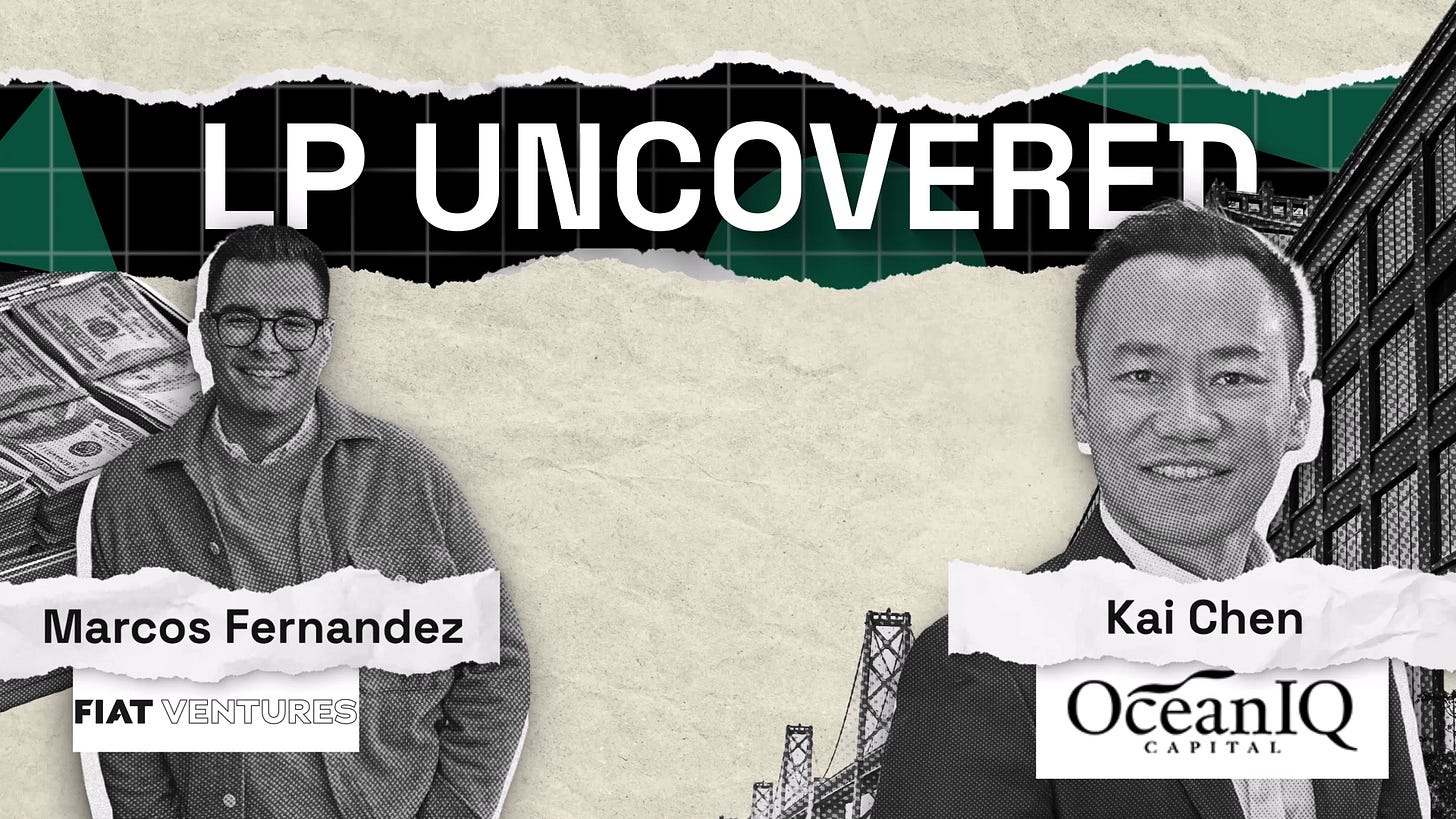
Kai Chen
OceanIQ Capital
Access is the New Advice: Building a Wealth Management Firm Around the One Thing AI Can't Replicate
The short version
Kai Chen, founder of OceanIQ Capital, discusses how AI is commoditizing financial advice and why access to networks and managers is becoming the real differentiator in wealth management. He explains his approach to venture investing for semiconductor executives and high-net-worth families largely from Taiwan, his views on the AI hardware versus software divide, and what he looks for when backing venture managers. The main takeaway: as AI makes information free, the value wealth managers provide shifts to relationships, ecosystem access, and co-investment opportunities.
- Kai Chen founded OceanIQ Capital after 13 years in private wealth management at Goldman Sachs and Credit Suisse, and also co-manages Silicon Catalyst Ventures, a semiconductor-focused venture fund backed by Taiwan public companies.
- Chen believes financial advice is becoming a commodity due to tools like ChatGPT, so the differentiator for wealth managers going forward is access to good managers, ecosystems, and co-investment opportunities.
- He sees hardware (GPUs, networking equipment, memory) benefiting significantly from AI infrastructure buildout, while traditional SaaS companies are getting hurt with stock cuts and layoffs despite healthy earnings.
- When underwriting venture managers, Chen prioritizes 'ecosystem builders' who create communities and events across an industry, rather than solo GPs, and he reviews actual portfolio companies for valuation exclusivity and revenue traction.
- Chen's largest private client came through a referral from a venture fund whose portfolio company was acquired by Nvidia, illustrating how ecosystem access directly drives his wealth management business.
- He recommends managers maintain consistent, non-transactional communication with LPs year-round, not just during fundraising, with at least an annual in-person touchpoint.
The Belief That Drives Everything
Ask Kai Chen what separates a good wealth manager from a great one today, and he won’t talk about returns models or asset allocation software.
“If you want to learn how to plan for an exit, how to save on taxes, you can talk to ChatGPT and it will give you all the advice,” says Kai, the founder of OceanIQ Capital. “So I feel like advice will become a commodity. And in the future, it will become access.”
This conviction in the idea that value in wealth management has migrated from information to access is the principle behind everything Kai does. It shapes how he builds his team, why he invests in venture funds, which managers he backs, and even why he set aside six weeks at Stanford completing a program with 200 executives from around the world. Every decision maps back to the same belief: in a world where knowledge is free, what matters is who will let you in the room.
Meet Kai Chen
Kai arrived in the United States as a teenager when his father came to USC for a PhD. His parents eventually returned to Taiwan, but Kai and his younger brother stayed, and Kai went on to study economics at UCLA. He spent 13 years in private wealth management at Goldman Sachs and Credit Suisse, building deep fluency with clients across mainland China, Taiwan, and Singapore during a period when Asian companies were listing on Nasdaq at a rapid pace.
“At the time there were very few Mandarin speakers,” he says. “So I was assigned to work on clients in China, Taiwan, Singapore very early, and built a lot of these relationships with cross-border funds and public companies.”
When Credit Suisse exited the U.S. market, Kai saw a natural opening. He launched OceanIQ Capital with the intention of going beyond public securities, offering clients, many of them semiconductor executives and their families in Taiwan, access to a more flexible and diversified set of investment opportunities. Today the firm manages capital across public equities, private equity, and venture capital.
Kai also co-manages Silicon Catalyst Ventures, a small venture fund backed by Taiwan public companies and focused on semiconductor startups.
The Allocation Logic: Hardware, AI, and a Falling Knife
Kai’s client base gives him an unusually close view of the semiconductor and AI hardware markets. That proximity sharpens his read on where the current cycle is headed.
It’s obvious to Chen that hardware is winning, and software is getting hurt. He points to traditional SaaS companies, many of which historically traded at high multiples, now watching their stock cut in half while running through layoffs. “Employees are probably not gonna get their stock options in the money,” he says. At the same time, hardware makers, GPU manufacturers, networking equipment providers, and memory companies, are benefiting significantly from AI infrastructure buildout.
He is cautious about calling a bottom on software, describing it plainly as “catching a falling knife.” Even companies beating earnings estimates are getting punished by the market. He holds some exposure to the largest names but avoids reaching for smaller, more speculative positions.
On the venture side, Kai sees three distinct access points into the AI wave. The first is through oversubscribed pre-IPO rounds in large AI names, where he has some exposure. The second is through niche emerging managers who have built genuine communities in specific AI verticals. The third is through hardware-adjacent startups, companies working on making AI data centers more efficient in terms of power consumption and infrastructure costs, where his semiconductor relationships give him a real evaluation edge.
He is also watching a structural shift in how AI is changing the math of company formation. “It’s so much easier to build a startup now,” he says. “You could build a pretty amazing startup with very few engineers and very little capital.” If companies need less funding, he notes, the entire dynamic of venture capital changes, making the sourcing and selection role of a good niche manager even more important.
How Chen Underwrites Managers
When Kai evaluates a venture manager, he’s trying to understand whether the GP is building something larger than a portfolio.
“I’m really looking for ecosystem builders,” he says. “A lot of funds or incubators are able to create an environment where they could host events with hundreds of people in the same industry, get public companies, private companies, entrepreneurs, and other investors collaborating together. They’re seen as leaders of an industry.”
He contrasts that with the solo GP who may be a sharp investor but whose value is contained to a single person making calls across 20 companies.
Beyond manager character, Kai assesses the portfolio directly. He prefers to come in toward a fund’s final close intentionally to evaluate what has actually been deployed. He targets markups attributable to genuine exclusivity, paying attention to rounds where only that specific VC had access. He also looks for early signals of revenue traction and customer adoption rather than companies still operating at the idea stage.
“It’s much better to see what’s in the portfolio,” he says. “That’s also partly why SPVs are so popular now, because people are marketing the company itself versus the track record of the manager.”
At Ocean IQ, the ecosystem criterion is not just an abstract concept. Its largest client came through a referral from a venture fund that had invested in a company acquired by Nvidia. Those three entrepreneurs needed wealth planning, and they became the firm’s most significant private client relationship.
The Relationship Layer: What Managers Get Wrong
Chen expresses a few frustrations with how managers communicate. He’s watched the fallout when fundraising intensity collapses the moment a fund closes. “Managers are probably more aggressively communicating during fundraising, but after fundraising it becomes a lot less,” he says. His recommendation is straightforward: maintain that same energy throughout the relationship, at minimum with an annual in-person touchpoint.
He is equally direct about outreach. Mass email campaigns and automated LinkedIn messages are, in his words, simply overwhelming. The managers that break through are the ones who arrive through a genuine referral, whether that is from an entrepreneur, a fellow LP, or another high-net-worth individual. “If you have a genuine relationship-building perspective, that’s what matters. I like to meet people that are not transactional.”
He also carries measured skepticism about co-investments. While he values them as a way to show clients real assets behind the fund strategy, he acknowledges an honest tension: co-investments have become so common that the question of whether an opportunity is genuinely high-quality, or simply a way for a manager to grow assets under management, is not always easy to answer.
Looking Ahead: The Access Imperative
Kai’s recent six-week stint in the Stanford Executive Program crystallized his beliefs on the power of getting in the right room. He came away with friendships across 200 executives from Saudi Arabia to Singapore to Kazakhstan, a network that has already produced 15 to 20 co-investors in a recent FinTech SPV. But more than deal flow, the experience reinforced his view that the most durable form of value in his business is relational.
As AI steadily commoditizes financial analysis and advice delivery, the wealth managers who survive are those who can open doors that algorithms cannot. For Kai, that means investing in venture managers who run ecosystems, attending programs where global relationships are built over six intense weeks, and positioning Ocean IQ not as an advice provider but as a network hub.
Chen predicts that the future of wealth management will be governed by access, not advice. That future, by most indications, is already here.
More from Uncovered Media





Read the full transcript
0:00 In the future, a lot of the financial advice have become commodity, so basically if you wanted to learn about how to plan for an exit or to save on taxes, you talk to chat GBT and it will give
0:15 you all the advice. So I feel like advice will become a commodity and in the future it will become access. In the world of venture capital, where the conversations often focus on either the mega funds
0:30 or these mega unicorn companies, there's a huge piece to the equation that's missing and that's the limited partners in the allocators that provide a lot of the capital to this ecosystem. And I'm your host, Marcos Fernandez, to provide a little bit of visibility to this ecosystem. I'm fortunate to be one of the co-founders in the managing partner Fiat
0:46 Ventures and emerging manager. And on LPN covered, we want to give a voice to these crucial investors. The goal of this is to help you get a better sense of the people who are leading this innovative industry. Welcome back to LPN covered. This is a podcast that focuses on the
1:02 individuals that are leading the limited partner LP category. And as you know, the goal here, right, is to give you perspective across a wide array of limited partners and investors. And today is definitely one of those. Kai Chen, who's the founder of Ocean IQ, is a large wealth
1:18 manager that has spent his whole career in the space, but has launched his own firm and really scaled that out. A few things that we're going to learn about today, right, is how does he think about investing in the venture asset category as just a sliver of a much broader portfolio? It'll help you understand
1:33 where things sit there both for fun investing and direct investing. Two, a lot of his clients are these large semiconductor manufacturers and executives. He's managing capital on their behalf. So he's got good perspective of bridging relationship between a lot of
1:48 these high net worth individuals largely out of Asia and Taiwan and giving them exposure to US markets. And then three, we'll spend a lot of time just talking about what's going on within AI. How is this impacting his client base? How is he thinking about exposure to the asset category? And
2:03 certainly, how is he using that within his own firm? So this one's another action-packed episode. We 're excited to dive in with Kai. All right. Welcome back to LPN covered. Today, we have a very, very special guest, Kai Chen of Ocean IQ. You just heard it, but someone who spent a lot of
2:20 their career in the wealth management space at Credit Suites, SAC, Goldman Sachs, and then in the founding of the firm that you manage and run today. Kai, thank you so much for joining us. Well, thank you, Marcos, for having me. Yeah, absolutely. Absolutely. I learned a ton every
2:35 time we get to hang out. So I'm excited to share that with others today. But before we jump into any of the topics, if you don't want to give the listeners a quick background of who you are and how you came to the founding of Ocean IQ, what is Ocean IQ? And then we'll kind
2:50 of dive a little bit deeper from there. Yeah, sure. So I started my investment management career in my early 20s out of college with the economics major and worked at Goldman Sachs, private wealth management, Credit Suites, private wealth management for a total of 13 years. And then I
3:12 decided to launch my own firm when Credit Suites at the time in the US decided to exit the US market. I find that it's a really good opportunity to basically start something of my own
3:27 and be able to invest across various asset classes instead of just focusing on public securities. Awesome. Awesome. And I know too that you grew up in Taiwan, that you have a large client base that's still there. But maybe talk about the roots and what brought
3:44 you to school. I know you went to UCLA, so it brought you to the California area. But what was that first impetus for both coming to school here as well as a little bit of your background and being from Taiwan? Yeah, so my dad, so I'm an immigrant. My dad came to US to study for
4:02 his PhD degree at USC, brought us as a teenager me and my younger brother to go through high school and college here. And they ended up my parents moving back to Taiwan when I was still a teenager. And then my younger
4:17 brother and I stayed on. The language and the ability to connect with Taiwan actually later on helped me a lot with my career. So at the time, at Quety-Suisse, there are very few Mandarin speakers. So I was assigned to work on clients in China, Taiwan, Singapore,
4:37 very early and built a lot of these relationships with cross-border funds and public companies. Yeah, I love that. And also, I didn't know that about your father. What a healthy family rivalry between UCLA and USC at
4:52 that time. It must have been interesting during football season. Yeah, yeah. So , yeah, I just brought my daughter to check out USC as a potential school. So she's going to apply to both UCLA and USC. I'm okay with either. Good. Yeah, both great schools. I'm sure maybe a
5:10 little bit influencing one versus the other, but that's a win-win there. That's amazing. And so you talked about very early on in your career, you were getting exposure to the Asian market in a bunch of different countries. Maybe talk a little bit about how that's evolved throughout your career and
5:26 then also a little bit more around Ocean IQ and the work that you do today and bridging the gaps between some of these different geographies. Yeah, so I think at the time, there were a lot of IPOs on NASDAQ from Asian companies, well-known ones like Alibaba that went public in the US. There's a
5:45 lot of Taiwan companies that went public in the US as well. So it's really good to be able to get access to these type of management team and early venture capitalists that invested in some very exciting
6:00 internet companies. Yeah, so I think the culture and the language definitely really helped. Yeah, awesome. And on a recent episode, we had Milana Kuzmanovic, who is a partner at WIL.
6:15 And what they do is they work with a lot of Japanese conglomerates to get exposure to the US market, both through direct investments and fund investments. I'm curious to learn from you, what have you seen historically in interest from your clients and clients that in the US market? Were they looking for exposure and has that shifted at all over the
6:33 last couple years? Or has it really held steady in how you're providing access to them? Yeah, right now I'm managing a lot of capital for semiconductor executives and a number of
6:48 them from Taiwan as well. And I think a lot of these families, they wanted to diversify kind of their investments into the US. And looking into early-stage venture capital is kind of one area, for sure, which is less correlated with the public markets, which is pretty
7:08 elevated. In addition to Ocean IQ Capital, I also run a small venture fund. It's affiliated with an incubator called Silicon Catalyst. And the venture fund is backed by a lot of Taiwan public companies. And with the same idea, getting exposure to US and also global early-stage
7:27 startups and semiconductor. Yeah, definitely. And maybe talk a little bit about that, right? So also very entrepreneurial view to have both the wealth management aspect, but also the venture capital fund. What was the impetus for creating that? And what are the things that you're actively looking
7:45 at on that side too? Yeah, I managed capital for one of the families that was a former CEO of a large semiconductor company. So he brought me on to be a co-manager of this fund. I think I never
8:03 expected that I would become basically an venture capital, given that I know nothing about semic onductor, purely an investment background. But just seeing the type of success that
8:19 people could have in Silicon Valley, I feel like very honored that I could basically join the group. Yeah, absolutely. And what I love about the experience that you have right is it's really
8:34 you're cultivating these new lines of business based on decades of experience and then seeing opportunities and opening them up. I'm curious to get your perspective of not just where the firms are today, but what do you see happening next? What are you seeing in the
8:52 market? How are you thinking about evolving your own strategy as you grow? Yeah, on the wealth management side, we added a lot more younger advisors from Credit Suisse, Merrill Lynch, and others. And they have a platform to basically invest more with invest with a lot of
9:14 flexibility. So, for example, we have an advisor that specializes in put writing. So he does a lot of put writing in the semiconductor and high tech sector. So I see sort of a growth of asset under management on the public equity side. And then on the private side, I think
9:34 that's really where we will differentiate because in the future, a lot of the financial advice have become commodity. So basically, if you wanted to learn about how to plan for an exit, how to save
9:50 on taxes, you talk to chat GPT and it will give you all the advice versus 10, 15 years ago, you would probably call it up your broker or financial advisor to get that advice. So I feel like advice will become a commodity and in the future, it will become
10:06 access. And that's actually part of the reason why we invest into venture capital, both on the fun site and direct basis. The idea is that one is to get access to a really good manager that's already a hard part. And the other is we could also get off for
10:25 co-investment opportunities, get to see an ecosystem with that manager has cultivated deeply. So if the S case, it would be FinTech and in the Silicon Calist case,
10:42 it would be semiconductor. Yeah, and I'm curious to get your perspective too, as you're thinking about building out those networks and certainly grateful for the partnership that we have. But what are the sectors, I guess, that you're looking for exposure to? Obviously, you have a
10:57 background and a lot of clients in the semiconductor space, but we partner together very well on the FinTech space. Are there any other spaces that you're spending a lot of time in today and that you're looking at investment opportunities in? Yeah, I would say pretty much all venture capital or majority
11:14 are now AI venture capital. So we're definitely looking to get access through a very early stage AI companies finding kind of niche manager that cultivated a community in San Francisco or
11:30 in that particular kind of AI niche. We historically had really good success in FinTech and because we're doing financial services as our primary job in wealth management, I feel like we
11:46 understand FinTech fairly well and could also add value potentially to the companies and entrepreneurs that we invested in. Yeah, and then semiconductors, the majority of our assets and the majority of our client capital
12:04 in terms of in the public markets. And we will keep focusing on that both in public and private markets. Yeah, definitely. I'll steer us into the AI category. It's impossible to not talk about it. It's impossible to drive down the road for more than a minute without
12:21 seeing an AI billboard all over the Bay Area, which it's an exciting time and there's a lot going on. But I'll maybe shift over just to kind of this venture asset category. We've seen a huge polarization of assets, right? So you have the majority of money invested into the category going to 20
12:37 firms, largely one firm. And then you see this emergence of emerging managers who are able to out compete just because of their networks. And then in the middle, there's a lot of folks who aren't able to compete in either direction. So you're seeing a real shift in the category. I'm curious, how are
12:54 you thinking about that? How do you think about exposure to traditional blue chip firms for submer ging managers that might drive more alpha and exposure? And yeah, how do you think about the category? Where do you see it shifting? And how do you think about deploying capital towards it?
13:10 Yeah, I definitely feel that everyone is chasing a handful of AI names and their evaluation just grows doubles every six months. And a lot of venture funds, a
13:27 lot of SPVs are kind of chasing these very large, pretty IPO names. So I think those are kind of one way to invest. And we have some exposure there. Another would be, in my mind, that similar to cloud, similar to the internet, it's so much easier to build a startup now. I have
13:47 first stories about, you know, 20, 20 year olds dropping out a Stanford and just stay at home coding all the time. And now you can build these pretty amazing startups with the help of AI with very few, you know,
14:03 engineers and very small team and very little capital. So I think that's potentially going to change venture capital quite a bit because if they don't need so much capital, it's going to be so hard to kind of invest in them. But yeah, that will be one way to to invest is
14:22 to find a niche manager that has a lot of exposure to these new AI companies. Yeah, and I think the third way would be if you look at the public companies, the monies are being made by the
14:37 hardware makers. And, you know, whether it's the GPUs, whether it's the networking equipment, pretty much all hardware sectors or memories, you know, are just making a killing. And that
14:54 also trickled down to hardware startups. So startups that enable these kind of AI data centers to be, you know, more efficient, less, you know, power consumption, etc. would be very
15:11 attractive to investors. Yeah, definitely. And you have a unique perspective on hardware being very close to a lot of the manufacturers. And certainly it's a picks and shovels business. And we're seeing a lot of excitement there curious to get your perspective. You know, how is
15:27 this shaping out for a lot of your clients and for where you're looking investing on the hardware side and semiconductor side? How is that changing now as we're seeing this race towards AI? And where do you see that shifting next to? Well, that sector is just so hot right now. I think that the
15:45 concern is always like, especially like in a commodity business like memory. Do you kind of see this trend going forward? Or do you say that, oh, I want to take some chips off the table? But they're
16:02 doing so well, like the hardware is doing so well right now. In contrast, software are really getting hurt pretty bad. If you look at these traditional SaaS companies, historically trading at very high multiples and even today, they're getting hurt. So a lot of their stock
16:24 got cut in half. They're experiencing a lot of layoffs. The employees are probably not going to get their stock option in the money. So there's going to be a lot of issues on the software side.
16:39 Yeah, it's an interesting space, right? Because at least from what we see, there's two things happening is software, to your point, had such healthy multiples because of the stickiness of the products you get in. It's based on licensing or seats. And these are multi- year contracts. And two is the way in which you get that companies now have alternatives. They
16:59 can build their own solutions. There's ones that can get spun up a little bit more quickly, more natively, or get embedded into their AI tooling. And two, the way that we think about charging is shifting, too, from a licensee perspective to a used perspective, credit- based system, you pay for what you use that technology for, which is a quicker path in and a
17:18 quicker path towards monetization for those companies. So it's been interesting to see now you get both sides of the spectrum. So I'll ask you and get your perspective. Obviously, the large private equity holders of these are saying, this is over done. This is a great time to buy.
17:34 And then on the flip side are people like, no, SaaS is completely dead. I'm curious to get your perspective. Are you on either side of the camps or are you kind of see it evolving somewhere in between? Yeah, it's so hard. It's like catching a falling knife. When you look at kind
17:50 of the earning growth, the revenue growth of the SaaS company, they're actually very healthy. Some of them are very strong, even beating earning estimates. Yet the stock is taking a really bad hit.
18:05 So from a contrarian perspective, you could say that somebody would be a good value play. But I am not smart enough to figure that out. So I have some very limited
18:21 exposure because I wanted to kind of get exposure and buy strong companies when they go on sale. But I'm being pretty cautious. I'm still buying some of the largest companies
18:36 instead of going after kind of the smaller one. I loved your analogy of catching a falling knife . But you're right. There's a lot of value here. It's not like these companies have lost clients overnight. There is some validity over these relationships and the technology. So I'm in
18:51 that camp too. And I'm going to go back to something you said too, which I thought was really interesting is the barriers of entry are falling. So you'd mentioned previously, cloud hosting had done this where you don't need infrastructure to start companies that created barriers entry fell. And then you had a lot of these site hosting and the ability to build sites
19:10 become a lot easier. And now we're to a point where you can prompt and create companies. It's pretty incredible. People are creating viable revenue generating businesses over a weekend. We had an intern, our former intern, our office yesterday. They created a commerce based app that
19:26 's already up to four million dollars of recurring revenue in like a eight month period. And I think what really opened my eyes is it's not just about the software, but also you're seeing the commod itization of physical assets initially in commerce. But the ability to do drops shipping and
19:42 fulfillment at such a a quick pace that the barriers entry are falling across the category. And so I 'm curious on your end, when you think about, you know, stickiness, you're investing over a long time horizon, you're getting exposure to a bunch of different assets. You know, how do you
19:59 balance, you know, alpha and chasing these trends and making sure you have exposure, but also how do you think about longevity and long term assets and durability of portfolios and kind of shifting the conversation into what role does venture play within a much broader portfolio that you're
20:15 building for your clients? And, you know, does that shift now with these, this AI wave of companies growing really quickly? Or do you hold kind of steady to the tried and true methods of, you know, exposure to these private assets? Yeah, good question. I think venture capital had a
20:32 liquidity problem for a while now. So the exit environment has been much more limited. But you still see a lot of very big exits and also big IPOs are coming. Yeah, I think to me, venture capital is
20:50 still much more about kind of spreading the bets. So what one key is if you could bet on serial entrepreneurs, entrepreneurs that has done it before, that's always, you know, kind of our preferred choice, you know, whether it's through a fund or through direct investments.
21:08 But I think, you know, in spreading those bets, I realized that a lot of them will probably fail. And also it will take a long time, you know, to have that to achieve an exit. So I would say it is
21:26 still a smaller part of the portfolio. But but it's an important part, because I feel like that's really where a wealth manager could differentiate, because is everybody just buying, you know, ETFs and buying indices?
21:41 It's really hard to differentiate. Yeah, absolutely. And I'm curious, like the temperature from your clients, and I'm sure you have a wide array as as as all wealth managers do of those who are very risk-averse to those that are very risk-seeking. What is the temperature
21:57 of your broader client base towards exposure to a venture? And in particular, you know, a lot of the wave of AI innovation, everyone's seeing these crazy rounds, these crazy multi ples and headlines. Are you feeling that your client base is pushing to get exposure
22:14 ? Or do you feel like your client base is still a little bit tepid to some of the the mania we 're seeing? Yeah, I would say generally speaking, it's harder to get people to invest in private asset class, whether it's private equity, venture, you know, even private real estate. Just
22:34 when the public market is doing so well, it's harder to justify that illiquidity. Yeah, yeah, absolutely. And shift over, talk us a little bit, but thank you for for diving into that and just great to get an understanding of how you see the asset class. Somewhat recently, you went back
22:53 to school, so you went to this program at Stanford. I remember, you know, we talked a lot about it, but I'm curious to get your perspective. Oh, there we go. Nice. Nice. Yeah, yeah, for folks that know us, they know that you drew an Alex Medic callus. I'm sure somewhere Alex is
23:09 discerning, but I'm a big fan of the program and it sounds like like you got a lot out of it. So I'm curious, you know, what was the impetus for going back? What were the outcomes of that? And I think it's been about a year later, maybe more. How does that help propel
23:24 both the firm and you as an individual? Yeah, I'm very excited about the program. It's called the Stanford Exactive Executive Program, SAP. It's been running for like 50 plus years. Every year,
23:40 there's 200 cohorts. And it takes six weeks and the Business School Awards, Stanford alumni afterwards. I'm actually going to Kazakhstan on Sunday for a week and a half.
23:55 We have a reunion from our class, the class of 2025. Some of the most successful businessmen and politicians in Kazakhstan were our classmates. So I built friends with 200 executives around the world from Saudi to Singapore
24:14 to China, Afghanistan, Russia, et cetera. I love it. It brought in my network quite a bit. So it's not just the Taiwanese-Chinese network, but now it's very broad.
24:30 Gave me a lot of perspective to hang out with, like, to see the Ukrainians and the Russians hanging out, you know, it's like we're all one global families, even though like it felt like we might be enemies, but to see that Stanford is so open to take on all
24:48 these students from around the world, I think that's a very open and global mindset. Yeah, absolutely, and what an incredible way to get that global experience in such a short amount of time in the network you've been able to build.
25:05 I'm curious, too, from the program that you did, I know, it was a very intense time period, but, you know, what did you come out from that other than, you know, the network? I'm curious if there's any time that you're able to reflect on your own business and think through new strategies, and was there anything that you changed with Ocean IQ
25:23 or the way that you're viewing assets of the world from an investing standpoint? Yeah, I think part of it, it was very intense six weeks from, like, academics to networking, to physical exercise, so it's kind of like a bootcamp for six weeks, so I felt
25:43 really proud of myself being able to go through that. It polished my relationship skills. To me, that's the most important. In wealth management, it's all about, you know, relationships, so I felt that
25:58 it's something that gave me kind of more confidence, and I felt like, oh, I did something great, because usually when people go through a program like that, maybe they'll meet, like, 50 people, but I really go out of my ways to, like, meet, like, 200, so I feel like, yeah,
26:17 I met most of my classmates, and I'm able to kind of carry on that relationship even after the program ends. Yeah, to me, that's probably the most helpful, but also kind of give, so a lot
26:33 of people, whether they go through that program, they started their own companies, or they took a different job, et cetera. The most famous alumni is Eric Yuan of Zoom, so he was sent to the program, I think, when he was at WebEx and Cisco, and left and launched Zoom afterwards, so the idea
26:54 is that this is a program that, you know, to give you time to kind of reflect on what to do. My role is a little bit different, or like, compared with my classmates, because I have so much flexibility, it is my own firm, and I'm able to do, you know, multiple
27:13 things, including with Silicon Catalyst Ventures. So to me, it's just an extension and a time for recharge, but yeah, as an example, one of my recent Fintech SPVs, about 15 to 20 of my classmates joined in, so there
27:34 's, yeah, the potential investor, potential partners, there's just so much possibility, and even if there's like no business done, just making 200 friends is like so valuable,
27:51 yeah, now I could go to like Iceland and have a friend there, so that's just so valuable. Yeah, I love that, I love that, and it's also, you know, you being based in Silicon Valley in the area, it's also probably gives you appreciation to get this global
28:08 audience that meets at this university that is also so close to home, so you can maintain that relationship with the university and with the network, and yeah, I wanted to make sure we talked about it because it's such a cool experience, and to your point, it's not just
28:24 about ROI on co-investors and opportunities, but it's ROI on the relationships and your perspective on a global audience, and certainly you more so than most, you're also catering towards a global audience in the work that you do, so I'm sure that was a great
28:41 experience for you, and it, I'll kind of shift over again a little bit, and then I'll kind of bring us into the lightning round, but you are investing into emerging managers, you 're looking at funds, you're also looking at direct investments, I'm curious to get your
28:56 perspective outside of, well, I guess we'll start with manager starts, that's a lot of the audience that we have, outside of some of the things that you know, track record, you know, from building, what are some of the intangibles that you're looking for when you're under
29:11 writing or assessing opportunities on your side, again, like less of the check the box, but more of like what are the core signals that you're looking for to start building those relationships? Yeah, I'm really looking for ecosystem builders, so I feel like a lot of funds
29:31 or incubators, they're able to create an environment where they could host, you know, events with like hundreds of people in the same industry, they could get public companies, private companies,
29:46 entrepreneurs, other investors, collaborate in that industry, and they're seen as like leaders of an industry. I feel like that's really valuable versus let's say a solo GP who might be very
30:01 smart and very good at investing, but that's just one person and investing in like 20 companies versus you could have a team that built an ecosystem in that particular segment
30:17 that they're working. So, so that is very valuable for us. That's like not easily accessible through like track records, et cetera, but we think that you will eventually show up. Yeah, and I'm curious more specifically, why is that valuable to you and to
30:34 OceanIQ? Is it just for co-investment access or how do you utilize that for your own firm? Yeah, our largest client came as a referral through a venture fund and other
30:49 venture fund invested into a private company and the company was acquired by NVIDIA and that became our largest private clients because these three entrepreneurs needed investment advisories and wealth planning.
31:06 So I would say being part of the ecosystem is actually really important for a wealth management for. Yeah, absolutely, and certainly client building investment opportunities. Is there anything that you're looking for outside of, you know, ecosystem
31:21 network that really helps you get conviction behind managers that you like to back? Yeah, I will say I like to look through and see the portfolio companies. I like to assess the portfolio companies either in the current fund that they
31:38 invested in or in the previous fund. So especially current fund, I like to see, I like to come in kind of later toward the final close just to see what's actually in the portfolio. Yeah, and again, this is probably an overly simple response is when you're
31:56 looking at those portfolio companies, what are you looking for? Is it ownership? Is it performance? Is it sector? What are you trying to digest when you're looking at the track record and the fund you're investing into? Yeah, I'm trying to figure out if there is, obviously, if there's valuation
32:15 markup, why is this done at a very attractive valuation where only this VC was offered, but maybe not others couldn't get access to, yeah, and wanted to see if there's like
32:31 revenue and customer attractions, or is it still mainly kind of in the idea stage? Yeah, so a lot of that you can assess beyond just like, oh, this fund had, you know, a 1.4 multiple previous one, it's much better to kind of see what's in the
32:49 portfolio. And that's also partly why SPVs are so popular now because people are marketing the company itself versus the track record of the manager. Yeah, definitely, definitely. Want to get your perspective on SPVs, but on the portfolio side, so I was at an
33:07 event earlier this week, recast capital is a large group that pulls together and having a lot of conversations around ownership for us, as you know, we want to get 8 to 10%, consistently, we see ourselves as an institutional investor, that's our strategy.
33:23 There's a lot of other perspectives, right, and instead of having a concentrated portfolio having 50, 75 investments that, you know, consistency of check size to get broader exposure. I'm curious for you, does ownership matter or is it more performance? You know, we are in a frothy AI market at least where, you know, it's tough to
33:41 hit those ownerships because companies are raising much larger rounds out of the gate. I'm curious for you, what is your perspective on ownership? Are you more interested in the health of the underlying company and sector? Yeah, I have no perspective on ownership because we are more of a passive
34:00 investors into bonds and also into companies. You know, typically we're not the lead investor, don't have a board seat or observer seat. So I think that's really more of a VC perspective.
34:15 I think as a VC, you want to be ideally, you know, leading rounds and pricing rounds and building a reputation, and that means you need to have a sizable ownership. Yeah, yeah, absolutely, absolutely. And then you mentioned co-investments, certainly on our side too, we will
34:34 usually do one to three a year. To your point, it's a wonderful way for us to not just market the quality of companies that we have, but also how we diligence them, how do we underwrite them outside of a dedicated pool. How are you assessing firms for both co-investments, then vice versa, you do a
34:49 lot of co-investments and direct investments. How do you go about marketing that and showcasing that to your own client base as well? Yeah, I would say typically if it's an over-subscribe round, let by a very strong VC, then it's
35:04 very marketable to private clients. And I think the best investment is that when there's some exclusivity, that's usually the best. Yeah, but I would say that it is hard to assess co-investments because it's so
35:28 common now. So most VCs will offer co-investments as a way to scale up their asset under management. And there's always a question of like, is this really that good or is this just a way to grow
35:43 asset under management? Yeah. But yeah, so it's not an easy to assess, but I love seeing them. I think it's always good to show clients even if they may or may not invest. Yeah, definitely, definitely, and similar, we're talking about barriers and
36:01 true falling. You can see that in the SPV categories, so the co-investment category and the fund category. There's things that are allowing this to be easy as a threat word, but it's lowers barriers of entry to offer these types of these offerings. Kai, I could talk to you all day, but I know we're getting close to time.
36:19 I'll kind of switch it over to kind of quick lightning round, but is there anything that you see when you're assessing funds or funds are reaching out or building those relationships that has become almost habitual that you wish hadn't? So kind of starting with, you know, not poor behaviors, but things that you see
36:36 that you wish wasn't as commonplace or advice you have for managers is, you know, they 're building partnerships on their side. Yeah, I think in general, there are just so many of them, and a lot of them are
36:52 using like bots to mess email and mess LinkedIn. So it's just become overwhelming. So I think, yeah, and so like I prefer not to be like spammed, so please take
37:09 me off your list. Yeah, but if you have a genuine relationship building perspective, I think that 's what matters where it's not transactional, so I think I like to meet people that are not
37:24 transactional. Yeah, yeah, I love that and have there been any examples that worked? Right. So to your point, there's a lot of managers out there. There's a lot of tools. I'm sure there's some bots that are blocking all the bots of the info, but anything that
37:39 you've seen work that has cut through all that noise that you, you know, that made you take a look and lean in. I think referrals are probably the best. So if it's, you know, a manager that's referred by an entrepreneur, a high net
37:55 worth individuals, an LP, that's always worth a look. So I feel like that's probably the most valuable. Yeah, absolutely. That's great advice. And that's not a new thing, and that's not something that I mean, I guess use
38:10 AI to understand those connection points, but yeah, it's about trust building and, you know, to your point, it's non-transactional. It's really about a long term partnership and yeah, I guess on that, I know you just mentioned from an introductory standpoint, but has there been anything that you
38:27 've seen from managers or that you've put into practice yourself that you wish more managers would do or you would wish became more commonplace, whether it's a way that you communicate or, or certain decisions being made, but yeah, anything that you've seen that you
38:43 wish was more common. I feel like in general, managers are probably more aggressively communicating, doing fundraising, but after fundraising, it becomes like less, a lot less.
39:01 So I feel like if there's a way to kind of keep up the same intensity, I think that would be nice. Yeah. Yeah. So at that point, knowing there's no perfect answer, what do you recommend to managers in
39:16 that period? What is enough? What is too much? Is it quarterly basis? Is it monthly basis? Obviously checking in on phone calls and things. But what do you recommend being that right cadence that you're looking for that is informative but doesn't become overly burdensome?
39:34 There's probably not going to be overly burdensome because communication is always good, but it's more like the manager needs to manage their time to see how much time they want to develop to that.
39:51 But I think at a minimum, it should be like once a year kind of communicating in person. I think that would be very helpful. Yeah. Absolutely. Absolutely. Okay, any parting words or advice that you have for folks, certainly on the emerging
40:06 manager side, but in general that you want to leave folks with today? No, I think not advice, but I am definitely happy to be on the podcast and be part of your network and definitely welcome any listeners reaching out, building a
40:24 relationship. Yeah. Absolutely. If you want to reach out and get in touch, we know do not send bots to your LinkedIn and email. But what are the best ways for people to get in touch with you and the OceanIQ team? Yeah. I will say send a direct message through LinkedIn or email, but not through
40:44 bots. Yeah. Yeah. Yeah. Yeah. If it says hello first name, then you know, it's not a genuine intro. And if you really want to get in touch with Kai, through warmer furls and through your network.
40:59 Kai, thank you so much. I feel like I learn a ton every time that we catch up your perspective, both on the firm, on how you're building it out, how you're assessing opportunities, how you're bringing a global ecosystem into what you do is just super interesting.
41:16 So congrats to you on all the work that you've done and really appreciate having you on here and also to have a partnership together. But thank you, Marcos. Appreciate it. Yeah. Awesome. Thanks, Kai. And that's a wrap on another episode of LPN covered. Thanks again to Kai Chen for joining us from OceanIQ Capital.
41:34 He is someone who I've learned a ton from. I learned a lot from this episode and I hope you did as well. If you want to reach out to him like you mentioned, don't send a bunch of bots. Certainly happy to make a referral on my side. Reach out on LinkedIn, but it's been a wonderful person to meet in relationship
41:49 to build. And we've got a whole bunch more coming your way. So again, the goal of this show is to give you really good perspective and breadth across the range of asset allocators, so not just those focused strictly on venture funds and emerging managers, but those like Kai that are giving you this broad
42:04 perspective. And I hope with each episode, you're getting smarter and understanding the role that you play and where you fit within this broader category and how decisions are really made. It's not about the checkboxes. It's about the deep relationships of the referrals. My name is Marcos Fernandez.
42:19 Thanks so much for joining us on this episode. And we'll see you on the next one. And that's a wrap for this episode of LP Uncovered. I'm Marcos Fernandez. I'm one of the co-founders and managing partners at The Outventors and we appreciate you listening. We'll see you next time as we continue to uncover this world of limited partners and
42:34 allocators that place such a key role in both the founding and funding of these world-changing and innovative ideas and founders. So explore more insights. You can find a lot more related to this publication and other publications on LPUncovered.com. And I encourage you to take a look at a whole bunch of the different things we
42:51 have going on uncovered media. Get to know the teams, the thesis, the founders, and everything that's driving the industry around this. We'll see you on the next episode.
Transcript generated automatically; it may contain errors.
Questions this answers
Who is Kai Chen and what is OceanIQ Capital?
Kai Chen is the founder of OceanIQ Capital, a wealth management firm he launched after 13 years in private wealth management at Goldman Sachs and Credit Suisse. The firm manages capital across public equities, private equity, and venture capital, largely for semiconductor executives and families from Taiwan.
Why does Kai Chen say advice will become a commodity?
Chen argues that tools like ChatGPT can already provide advice on topics like tax planning or exit strategy that previously required calling a broker or financial advisor. He believes this means the future value of wealth management lies in access to good managers and networks rather than information itself.
How does Kai Chen view AI hardware versus software investments?
Chen sees hardware makers, including GPU manufacturers, networking equipment providers, and memory companies, benefiting significantly from AI infrastructure demand. In contrast, he describes traditional SaaS companies as getting hurt, with stock price cuts and layoffs even when some are beating earnings estimates, calling software investing right now 'catching a falling knife.'
What does Kai Chen look for when evaluating venture capital managers?
Chen prioritizes managers who act as 'ecosystem builders,' hosting industry events and cultivating communities of entrepreneurs, companies, and investors, rather than solo GPs managing investments alone. He also reviews actual portfolio companies directly, looking for valuation exclusivity and signs of revenue traction rather than relying solely on fund track records.
What is Silicon Catalyst Ventures?
Silicon Catalyst Ventures is a small venture fund that Kai Chen co-manages, affiliated with an incubator, backed by Taiwan public companies and focused on early-stage semiconductor startups globally.
Originally published on LP Uncovered · By Marcos Fernandez