Katie Perry
zerohash
Inside the Invisible Architecture of Global Finance
The short version
Katie Perry, CMO of zerohash, discusses her transition from being the first marketing hire at public.com to leading marketing at zerohash, an infrastructure company that lets banks, brokerages, and fintechs embed digital asset functionality. She explains how zerohash's three pillars—trading, transactions via stablecoins, and tokenization—power partners like Kalshi and Gusto, and how she uses AI tools like a 'hater' prompt to pressure-test marketing ideas while still relying on human instinct and empathy. The main takeaway is that AI has made marketers more efficient but not less busy, and that trust-building and in-person relationships remain central to B2B marketing even as infrastructure becomes increasingly automated.
- Katie Perry is CMO of zerohash, an infrastructure company since 2017 that provides the technology and licenses for banks, brokerages, and fintechs to add crypto functionality, working with partners like Morgan Stanley, BlackRock, Franklin Templeton, Gusto, and WorldPay.
- Before joining zerohash, Perry spent two years as a fractional CMO consultant for fintechs, using AI systems to run a lean, high-margin consulting business with a small team.
- zerohash operates on three product pillars: trading (powering crypto trading for platforms like Kalshi and public.com), transactions (stablecoin-based payments, with volumes up 170% year over year and RFIs up 5x), and tokenization.
- Perry compares zerohash's role to YKK zippers or AWS: an invisible but essential infrastructure layer where trust, compliance (52 U.S. jurisdictions), and uptime matter more than brand visibility.
- She uses AI tools like a 'hater' prompt or a project modeled on a skeptical colleague to pressure-test marketing ideas before they reach lawyers or teams, saving time on review cycles.
- Perry argues empathy is the common thread between B2C and B2B marketing, though B2B requires more surgical targeting of a smaller set of decision-makers versus broad consumer segments.
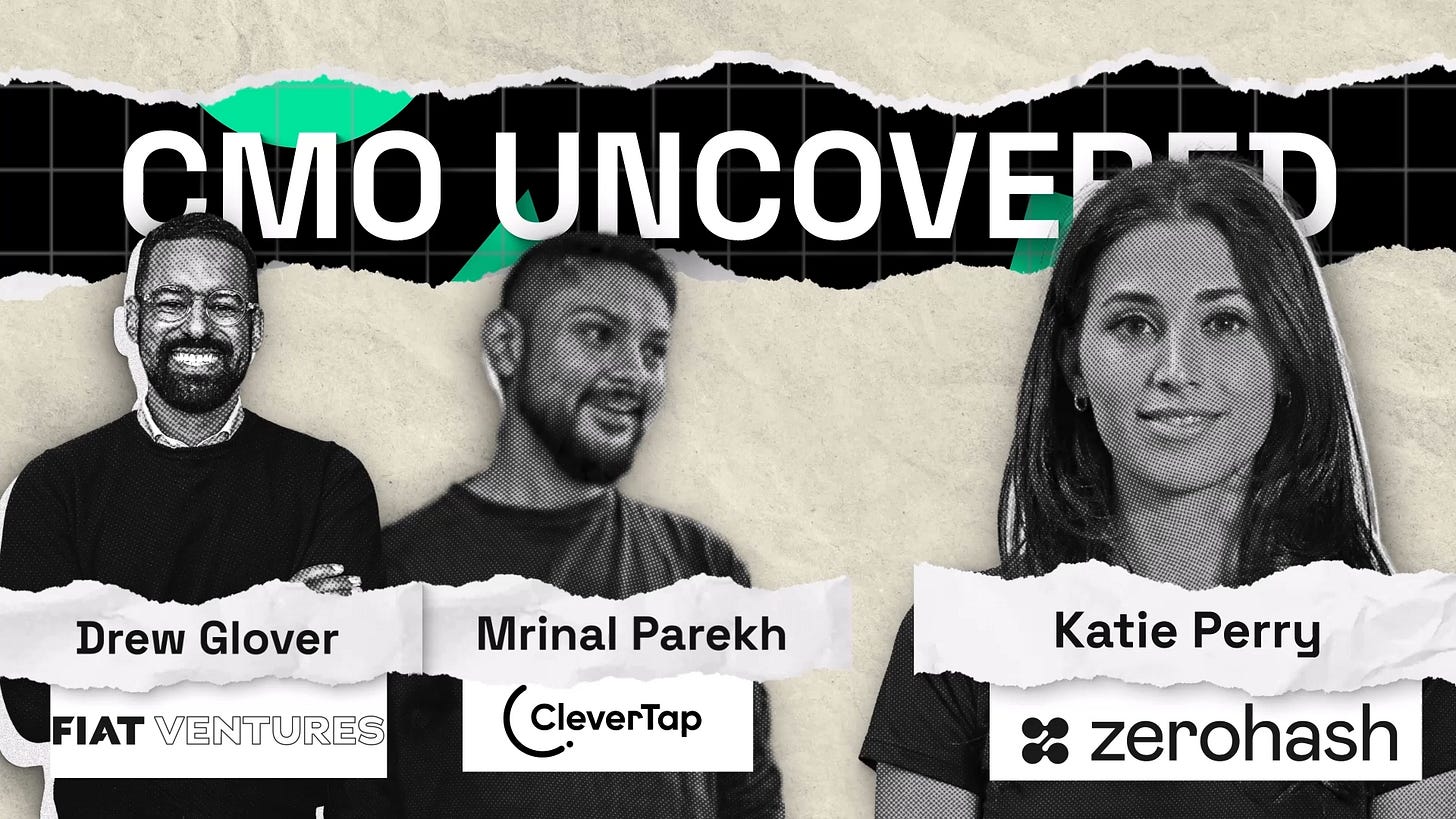
In this Episode
The transition from high-stakes marketing to the invisible architecture of global finance requires a specific type of intellectual recalibration. For Katie Perry, the shift from the retail investment frenzy of 2021 to the infrastructure layer of digital assets was not a retreat from the spotlight but a move toward the “plumbing” that makes the spotlight possible. During her tenure as the first marketing hire at public.com, she navigated the volatile intersection of social sentiment and market mechanics during the GameStop era. That period defined a generation of retail investors. Today, as the Chief Marketing Officer of zerohash, Katie focuses on the exacting task of building the infrastructure that allows banks, brokerages, and fintechs to embed digital assets into their own ecosystems.
The inception of this current phase followed a two-year period of fractional consulting. During that time, Katie operated a lean business, scaling high-margin clients by using agentic systems to bridge the gap between high-level brand strategy and the technical execution of complex ad campaigns. This period of independence allowed her to observe a recurring friction in the market. Companies wanted to offer digital asset functionality but were hindered by the technical and regulatory complexity of doing so. When she encountered zerohash, a company that had operated for eight years without a formal marketing organization while securing clients like Morgan Stanley and Franklin Templeton, she identified a rare instance of product-market fit that lacked only a narrative architecture.
The Uncovered Profile
Outside of infrastructure, Katie operates with a rhythm defined by high-intensity curiosity and a preference for the unscripted. Her mornings frequently begin at 6 a.m. in places like the Ginza district of Tokyo, where the cold air of a Japanese winter serves as a backdrop for endorphin-heavy runs. This discipline carries over into her intellectual habits; she is a self-described “sponge” who uses her evenings to build deep-dive dossiers on topics as disparate as 18th-century infectious diseases or British period dramas. She possesses a natural inclination for the “edge case” about to go mainstream, a trait that manifests in her professional choices and her personal fascination with subcultures.
Her ideal environment is one of functional contrast. While she maintains a professional studio in a Midtown Manhattan Regis office, half-office and half-production suite, she finds equal value in the raw, unpolished energy of a NASCAR race at Talladega. This duality reflects a marketer who values the logical and the strategic but remains deeply grounded in the human element. Whether she is listening to an AI-generated audio summary of medical history before bed or taking partners to the World Cup, Katie’s persona is anchored in a belief that while technology can automate the task, it can never replace the human instinct to explore, learn, and connect.
The Mechanics of the Build
zerohash operates as the infrastructure layer for digital assets; it provides the technology and licenses necessary for companies to offer crypto functionality without building the stack from scratch. Katie describes the company as the “plumbing” of the industry. This role is frequently invisible to the end user but essential for the operation. To explain this, she uses the analogy of YKK zippers. They are ubiquitous, they are essential, and they are only noticed when they fail to work. For zerohash, success is defined by high uptime, compliance, and seamless integration into the partner’s user experience.
The operational architecture of the business rests on three distinct product pillars. First, the company enables trading, allowing platforms like interactive brokers or E-Trade to offer digital assets to their users. Second, it facilitates transactions, specifically through stablecoins, which allow for instant cross-border payments and settlement. Third, it manages tokenization, an emerging field that financial institutions are increasingly exploring for asset management. Katie notes that the demand for these services is rising; stablecoin transaction volumes have increased by 170 percent year over year within their ecosystem, and requests for information regarding stablecoin payments have increased fivefold in the same period.
The Logic of the Pivot
The transition from B2C to B2B marketing involves a shift from wide-reaching data science to surgical, relationship-based strategy. At public.com, Katie managed a diverse user base ranging from day traders to first-time investors. The messaging had to appeal to a broad demographic without alienating specific segments. In the B2B environment of zerohash, the target audience is nearly 1,000 potential decision-makers. The marketing must be surgical; it requires an understanding of what will help an executive get promoted or solve a specific operational burden.
Katie argues that empathy is the commonality across both disciplines. Effective marketing requires identifying the specific anxieties that keep a customer awake. In B2B, this often means understanding the regulatory and compliance hurdles that a partner faces. zerohash holds licenses in 52 jurisdictions within the United States, a feat that took years of manual paperwork and trust-building. This regulatory moat is a core part of the product story. By assuming the technical and compliance liability, zerohash allows its partners to focus on their primary user experience.
AI in Marketing
The integration of artificial intelligence into the marketing workflow has changed the definition of an “entry-level” role. Katie acknowledges that the manual tasks she performed early in her career, such as reformatting award submissions, are now handled by LLMs. However, she maintains that these tools require an architect. The machine can identify patterns and themes within hours of research, but the human marketer must coach the system to know which “synapses” to fire.
At zerohash, Katie uses AI to pressure-test ideas. She frequently prompts systems to act as a “hater” or a skeptical lawyer to identify weaknesses in a campaign before it is launched. This “inversion” technique allows her team to address counter-arguments in minutes rather than through weeks of legal review. Despite this technological leverage, she is finding that she works more hours than before. The efficiency of the tools has not led to more leisure time but to a deeper exploration of possibilities. If a task that once took months now takes two weeks, the team can simply produce more thoughtful, high-fidelity work, such as the 60-page book on stablecoins they recently produced from end to end.
The Future of Finance
The long-term trend in finance is the convergence of traditional finance and decentralized finance. Katie observes that the narrative is shifting from “us versus them” to a collaborative model. Large institutions like BlackRock and WorldPay are not merely observing the space; they are actively investing in the infrastructure. This shift is supported by a growing coordination between builders and policymakers. Unlike previous eras of tech regulation where a gap in understanding hindered progress, the current fintech landscape involves a more sophisticated dialogue regarding how digital assets move and settle.
As the industry matures, Katie is leaning into offline, high-integrity human experiences. While the “agentic” world allows for infinite digital variations of a message, it cannot replace the trust built during a small dinner or a shared experience at an event like the World Cup. For zerohash, the goal is to remain the invisible, trusted backbone of these transactions. Success means that the partner remains the hero of the story while the “plumbing” functions without friction.
“The LLMs need to be organized, architected. There needs to be a system and a way of thinking that you apply to how you’re using them. I’m ideally trying to train these things to have very broad knowledge of our business and our partners’ problems, broader than I could ever have as a single human.”
More from Uncovered Media





Read the full transcript
0:00 Something I think about a lot in this started at public was any sort of regulation that involves tech. You really see the gap between the understanding of the people building in the industry and the people making the laws. And I remember seeing this coming up in digital marketing and we all remember that congressional hearing where it was very clear.
0:16 I forget who it was, but they did not understand how Gmail worked. They had a fundamental lack of understanding about how basic email worked. Same thing with ad targeting. And so I think what I've asked a lot of people about it as I've gotten immersed in crypto is if that feels similar or different.
0:33 I think the difference with crypto and fintech is there's a lot more collaboration between the people building in the private companies and the people making the policies which I think is so important because we've all seen those and we're like, you know, I get it. Like the average person doesn't necessarily know how retargeting works on
0:50 Google, but I mean, man, if you're making a law about it, like some of these questions, I'd be like, how did you? I can't believe you just said that out loud and that it's like a it's a jarring moment. Welcome to CMO Uncovered, which is proudly sponsored by CleverTap, the all-in-
1:05 one engagement platform helping brands turn customer moments into measurable growth. If you're serious about retention, lifecycle marketing and using AI to drive smarter engagement, CleverTap is the partner you want in your corner. So Katie Perry, thank you so much for joining CMO Uncovered. Thrilled to have
1:29 you in our very first episode for everyone listening, just so you know, I'm actually in a closet right now in Japan on a trip. I was here for work. Now I'm here for vacation and I was lucky enough to have to pin Katie down for us to be able to dive into all things growth. I didn't know I was first. I got to say, I'm a little nervous. Now this has to
1:46 be your number one. This has to be good. We are set the bar so high. Yes, I think so. We have to. Ceiling, you know? We have to. Thanks for having me on. I'm so excited. Drew, I feel like I whenever I see, I've never seen you sitting down. I feel like whenever I see you were like at a conference and it's like 15 feet
2:01 away and I'm like, Hey, you're like, Hey, talk to you later. Then it's like the next three months. We're in passing. Yeah. So it's good to know that you actually, you know, sit down sometimes because I've never seen that. It's good. Yeah. Well, I'm glad I'm glad we made it work. I'm glad we made it
2:17 work. And I'm sure I'll be seeing you standing up soon at the next one in a couple of weeks here for FinTech for FinTech a week. Hopefully I'll see you there. But with that, Katie, I'd love to start everything off just so we just get a better sense of who you are,
2:33 what you're building, what you're working on. And then we'll just dive into the conversation. Sure. My name is Katie Perry. Obviously not the the world renowned performing artist. I am the CMO of ZeroHash. You can think of us as sort of the plumbing behind
2:48 digital assets. So helping banks, brokerages, FinTechs, apps, anyone who wants to add any sort of crypto functionality, there's a lot of friction to doing so, whether it's the tech or the licenses. And so since 2017, ZeroHash has sort of been building that infrastructure layer
3:03 that companies can build upon. So we work with a lot of exciting partners from some of the biggest institutions or Morgan Stanley, BlackRock, Franklin, Templeton, but also really innovative. FinTechs like gusto, one pay, world pay. So a range of customers and clients, I
3:18 've been in the role for a few months now. I was actually consulting before I was taking the CMO role there. And I just sort of fell in love with the mission. Everything was building and the team. And so went back to full-time, full-time life as CMO at ZeroHash. And before I
3:35 was consulting, I was the first marketing hire at another FinTech called public .com, which was obviously democratizing retail investing. And that was a whole thing. I was there from 2019 to 2023, so sort of was there through COVID and the GameStop.
3:50 So it's been a really fun journey the past few years. I'm really excited to continue the path I've been on in FinTech because so many exciting things are happening, which I know we're going to get into. Incredible, incredible. And yeah, I was lucky enough to meet Katie when she was
4:06 at public. And also a very different time in the FinTech landscape where direct -to-consumer FinTech specifically like investing apps. NeoBanks, it was a craze, massive rounds, massive growth. Let's spend money quick. Let's do it. And really like, I think it was probably a dream job for
4:25 anybody in growth marketing at the time, but looking back at it, I'm sure there 's a million things that we would have approached differently, done the same, all of the above. But with that, we typically like to kick off the podcast diving into like one kind of meaty topic to start, and then we just kind of start talking a little bit more about, you
4:43 know, what you're doing is your own hash and your journey to it. But the first thing we want to talk about is this agentic world within marketing. I think one of the hot topics right now is really the CMO office is ultimately going to be an office of one, not an office of a large marketing
4:59 team. And this agentic world, I'm sure if anyone's on Instagram or TikTok and you follow anything around business, you're constantly getting these direct ads being like, fire your marketing team, fire your marketing agency, and it's some agent infrastructure that can take over the entire office.
5:18 Katie, I'm curious, like, how you're engaging with AI today and how you're feeling about where it's headed from the standpoint of, will there always be humans or a human in the loop, or is the future fully agentic? Oh, man. What a topic we could be. We'd have like a Joe Rogan 10 hour episode
5:37 on that. It's fascinating. I mean, before, so prior to your hash, I was doing a fractional CMO work for FinTechs. And I did that for two years in AI and the systems I was building for my clients. It was integral to scaling my business.
5:54 And it was really wild to see how much I could do as an individual person and have almost a full team and have very high margin clients running where I'm able to do everything from the top level brand positioning strategy right down
6:09 to knowing how to orchestrate a sophisticated Google AdWords campaign, have it spit out all the keywords, the negative keywords, the bid strategy and do it end to end. So it's definitely been wild the last few years to see how that's how that's played into marketing
6:25 . And I think a lot about early in my career and all the things that was doing in my first job, which was a marketing coordinator at a big ad agency. And it was so manual looking back. I remember spending hours and hours on awards submissions, which was essentially just taking the same story and reformatting it at times 20, 400
6:43 words, 250 words focus on the and I was manual. And so it's crazy to think about all the ways I learned and built my skills as a marketer. AI is sort of replacing now and I think I have mixed feelings about that. I
7:02 think we all have to evolve and adapt and I don't want to sit here and say, "Oh my gosh, this is so scary." But I think about the entry level marketers and how I came in and how I learned was being that sort of person on the ground doing the manual work. But I think, you know, since I have that foundation, what I was able to do and what I can do today is I know how to orchestrate the tools. I know how to build sort of the brain, the ecosystem through which an LLM can pull information and
7:20 I've gotten pretty good at sort of coaching that. So it's definitely been an unlock. I think I'm curious what you guys think about this, but I was reading something the other day and I really resonated with me, which is that when I remember when I started using all those tools, I thought, "Wow, I'm going to be able to get all my work done in four hours a day
7:36 and I can, you know, go to the park." And what actually happened is I'm working way more because I'm very curious. I love learning and with these tools, like, I can learn how to do pretty much anything. Like, it's addicting. And so I'm finding that I'm more efficient, but
7:54 I'm working more hours. So I think that's a fascinating point. I didn't see your direct question in what replaced you. I don't know. I hope not. I don't know where all that's going to go. I know right where we are today, though. The ALOMs need to be organized, architected. There needs to be a system in a
8:14 way of thinking that you apply to how you're using them. I'm ideally trying to train these things to have very broad knowledge of our business and our partners and our partners problems and our products, broader than I could ever have as a single human. But in terms of the marketing instinct, I still apply that. I still have my own POV on what works in
8:32 marketing. I still have my own way of asking questions. That piece I don't think is replaceable. And I think even when you get into the specialist roles, you still need that expert, especially for businesses that are scaling.
8:47 Yeah, and that's very interesting, Katie. I mean, especially what you said, right, that there were certain tasks that you were doing before, and you thought that, hey, marketing is going to be easier, but now you're just doing more. And this was in my master's, and this was this professor of science, technology
9:07 , and society. He brought up this concept of the techno-drome. A techno-drome essentially is a technology paradigm. And as the techno-drome essentially changes, it's not that it's the abstraction level that changes
9:23 after a while. So the kind of detailing that we are getting into sort of changes. So what's your take on the kind of tasks that now we will be focusing on?
9:39 If we can just double click on that, you said we're doing more, but what is that more and has that nature of that more changed for you? There's more, you can get things done more efficiently so you can do more. And I think one thing I think a lot about with marketing is the job's really never done.
9:54 I get to the end of the day, and I'm like, well, I could have done 10 more things today. I could have done 20 more. It's not one of those jobs where you 're like, okay, did the list. There's always, especially now with how fast products are moving tech and culture, there's always some opportunity you could be jumping on.
10:09 So I think it's exciting. It also is making prioritization so much more important because there's so many big little things. Things can move quickly in a lot of directions, and especially running a team,
10:25 keeping people focused. I think that's the sort of the role of a CMO is almost like, okay, what, what should we not do right now as much as what can we do? I think that's 100% right, Katie, and I'll say this, even on the on the on the
10:40 fiat growth side. Our biggest competition is lack of focus, right? And right now it's a double edged sword. The the good side of that sword is, wow, we can do all the things that we know we need to do in really efficient ways.
10:57 But we have the ability to do anything we want to do. In an old world, if we wanted to do something, we had to like ruthlessly prioritize it, right? Because it all took 10, 20 hours to do it. Now, if we want to do a hundred things, we can do a hundred things 10 minutes
11:16 at a time, but odds are 90% of those hundred things are not things you should be spending time. But I will also say to your to your point, I think is really interesting, Katie , like, because you were a part of you've been a part of the marketing world,
11:33 and you've had a career in it, your curiosity is naturally smarter than everyone else's curiosity. Because you had to do all these other things. You had to be the one writing all these, these blurbs, these executive bios down to figuring it out. So, you know
11:48 , again, another double edged sword for you is, you are your curiosity is smarter. It's more efficient because you know what to be curious about. But still, you might be working harder. But I also think it's okay for us for like, in this, like, age of what Google used to do, which 20% of your time should be spent on
12:06 you working on anything you want. I do feel like from a cultural standpoint, that's something that we need to push more. Because right now, people are, we did. I haven't heard anyone doing it in classics. I forgot about that until you just said that. That was like, when I was coming up at the first agency, it was in searches that I remember. It's like, everyone
12:24 's kind of copied that 20% innovation, so I've not heard anyone bring that up in like a decade. I haven't heard. Yeah, yeah. But yeah, it's the way you're saying, but it's also, it's more stuff. But then I think about it, it's deeper into the things
12:39 too. So it's not just I'm doing more things. It's like, I can do something I was going to do before way better. Like, we just, we wrote like an entire book about stablecoins. And the process was interesting. I didn't just like promtee write a book about stablecoins. I
12:55 had like hours and hours of conversations with all the super smart people at the company with, you know, 100 years combined experience. And then I took those notes and I distilled it. And then I brought in third party. Like, I was able to do this quickly in a way that you sort of taken me, you know, months. And so it's the output is better, especially in B2B, the output can be more
13:12 thoughtful and more helpful. And so it's not just, we'll do, you know, I could do 100 blog posts in a week. It's like, we could write an entire 60 page book and write it and have it printed and end in two and a half weeks. And that, that to me is was really cool and fun.
13:29 Is that how quickly you did it? Yeah, it was, it was, it was fast and furious for sure. We had, we started writing something. We're like, this is like a book . We're like, let's just write a book. But it was, for me and I'm working on a book outside of zero hash that I just wrapped up. And it's the process of the book writing. I thought it was the
13:47 hardest part was going to be like the writing. And it's really like what I thought the most powerful use of AI was, was finding themes and patterns within all the conversations I had and helping me quickly create links between my research. And then from there, writing. And so I think that's, that's one of the coolest
14:03 things. I think it's like with AI, you can build these brains and you can make yourself 100x smarter. And if you know how to coach it to know which synapses to fire off, it's pretty cool. And that's actually a very important point, right? Because we need to
14:18 know when to use AI and where to use AI, right? We, I think more often than not, we hear this concept of, you know, human in the loop, right? Like, do we need the human in the loop? I think the human in the loop needs to be where to use AI and when to use AI, right? And that's very
14:35 critical. They're talking to, you know, senior leaders and thought leaders and identifying, and researching themes, right? That's us, right? But identifying patterns, right? That day I can do better. So, and that's, that's going to be such a critical part of CMO, right? And so
14:51 to your question, Drew, I think, what's the CMO's role really going to be? In my head, it's going to be this, right? Where to use AI, right? Like, where does a human need to be in the loop and not in the loop? And it's going to be interesting. So many experiments, so many epic fails and some sudden strain successes, very
15:10 exciting times. Yeah. So, how did you start transitioning to conversation? I'm curious, Katie, because you've had, you had such an intimate experience with the direct-to- consumer side of FinTech and now you are in this B2B side.
15:26 How has that transition been? And I'm also curious to keep that AI layer on there. How would you approach the use of AI in B2B versus B2C? Because I can only
15:41 assume it's wildly different in terms of how you can use it as a power. Yeah. I mean, so it's interesting. I guess this is a lot coming from public, because public was, that's when I was first out there at events and stuff. So, people sort of knew me as sort of like a D2C consumer marketer, but my
15:57 whole career was really B2B. I love B2B marketing. Just so funny, like most people, even in my first job was at an ad agency, I was doing corporate marketing, so agency marketing. And so what I love about that is like the surgical nature of B2B marketing. It 's like, all right, there's a thousand potential people who could buy this.
16:15 I know that this is their job. This is what's going to get them promoted. This is the event they're going to be at. This is what they listen to. You can kind of build this world and really understand who that person is and be very, very surgical and specific in the marketing. The consumer and it's public. It's fun, but it's challenging. It's like, I don
16:33 't know. We have a public. We had day traders. We had first-time investors. We had my dad was using the platform. My 18-year- old cousin was using the platform. And that's, it's harder. It seems harder to measure. You have to be more, the
16:48 messaging needs to appeal to more people, but not alienate, which we see at a lot of consumer brands. And what's fascinating about that is I, when I was leaving public, was when we really started using some of these AI tools. So I didn't really use much of it at all in public. And now I look back and I'm like, damn, that would have been, that would have been nice to have.
17:05 And so, yeah, it's wild. I think I, as a marketer, I prefer B2B. You know, I'm not going to always have the coolest ad campaign on TV or be on the cover of Ad Week, but what I love about it is it's logical and it's
17:21 strategic. And it's all about asking the right questions to map into the right strategy. I think the commonality across the two that people don't talk a lot about marketing is just how important empathy is in putting yourself in the customer 's shoes. I think a lot of people think marketing is just like, well, here's why we're
17:37 the best. Here's why we should care. Instead of being like, you know what? Why is this person not falling asleep immediately at night? What are they worried about? Or what's going to get them to the next job? And then backing out from there into how you're going to help them. And that's what I love about the B2B side.
17:53 I think it's a little, it's there in consumer, but it's really there in B2B. That's right. Yeah. I 100% agree. You know, I very much came in the direct-to-consumer side of the business. I feel like direct-to-consumer is very much a data science type of marketing
18:12 game where within B2B, it's truly personal. And like the word empathy really does land because with direct-to-consumer to your point is, it's very wide ranging. But, you know, I'm looking for people, you know, between 22 and 35. And with B2
18:31 B, there could just be one client that can catastrophically change the trajectory of your business. And so instead of spending all this time on 10,000 different potential customers, hey, let's just spend it on these five and just literally know, you know, like what their, you know, what their favorite coffee is, you know, what
18:49 their favorite shoe is and dive deep. And so the difference is so, is so massive. But frankly, when we first started Fiat, all we were doing was direct-to-consumer and we slowly started hiring and transitioning and involving into B2B.
19:05 And now that's also where the market sits today. It's the most exciting thing. It's also the thing that anybody can invest in and know you can go from zero to ten million dollars in revenue in ten months if you get five really big clients versus trying to find your first two million users.
19:20 Yeah, totally. Yeah, and actually what you said, Drew, right? B2C does feel like a data science role after a while. But there's a trap there, right? Because more often than not, at least, and this has been my experience because I transitioned from B2C to B2B as well,
19:36 right? Like I was with Amazon, then I was with an SME payments company and then now B2 B sales. So one thing that I'm very happy with B2B marketing, why I enjoy B2B marketing right now is in B2C marketing, more you can fall into this trap of pseudo
19:53 metrics, right? And pseudo successes, right? Especially because everything is just digital, for example, right? And then all metrics are tracked. So open rates, CTRs, and then you'll just find teams just chasing those metrics
20:08 , not knowing what the impact on business really is, right? And is there an impact on LTV? Is there an impact on future purchases? Those rarely get tracked, right? And I think that's very important in B2C.
20:23 It's just that in B2B you track this very closely, right? Like it's pipeline and you know that it's this event that got this. It's this channel that got this prospect and it's a lot more measurable in terms of direct impact on business.
20:39 But yeah, I think in B2C I think that data science role sort of also sort of morphs into pseudo metric tracking paradigm, which is a strange fact. And that could even be like a creativity killer sometimes, you're just like,
20:57 you're looking at your emails being like, well, this email got an open rate and it's like, all right, let's write every email. It could be limiting at the same time. So I agree. I think what's fascinating about digital, though, is just even in B2B, you know, spending a little bit of money. I love testing concepts and ideas on like a LinkedIn because I can get to gran
21:16 ular buyer persona company segment. Like, you know what, this line actually landed way more with this audience. I can go tell that to my sales team or my sales team could say, you know what, when I get to this slide that says this, they always lean in. And I'll be cool. I'm going to use that. And yeah, I love that being that much
21:33 closer to like the final handoff to the sale because there's so much interesting feedback. And it's not always like a report. It's sometimes it's a slack being like someone saying like, hey, I said this in a call and the guy's mind was blown. I'm like, cool, thank you for that. Like, I will, I will enjoy that. And I can,
21:48 and with digital campaigns, you know, I could put $50 here, they're tested for two weeks and have pretty directional insights that I can then iterate on. Yeah. Yeah. But I, but I will say from a B2B perspective, I actually feel like you can fail cheaper. Yes. Faster. Yes. Absolutely.
22:05 Which is, which is great. Like, I'm always looking for ways. How can I spend like, again, how can I spend five minutes on it on a personal LinkedIn outreach that cost me $0 to get a directional sense of like, what a fortune 500 executive might want from my business.
22:21 So, you know, the big thing is is how can I fail fast, the cheapest, right? And I do love that about B2B. Yeah. I agree. And I think that's where agent tick will sort of help B2C as well, right? I mean, I think it'll help fail faster cheaper because if I'm manually setting up
22:40 experiments, right? Like, say I'm doing A/B testing or just my, my emails or my push notifications or SMS and B2C. I can manually set up maybe 10, 15, 20, right? And if my manager is being being hard as, then maybe 30, right? And I've done that.
22:56 But, you know, in the end, that's I'm limited by my own manual input, right? And there is always going to be a heuristic human input, right? And I think with agent tick, yes, there is heuristic input, but it's that heuristic input
23:13 that sort of just, you know, expands. And it's like, you know, like a, like a carto graph that just sort of expands, you know, and now I can do 15,000 variations of that same messaging, right? And now with that same single click, that same single cost, I am now able to fail
23:31 faster and cheaper, right? So I think that's, that's one, well, the bridging that gap between B2C, the, the, the beauty of B2B and bringing that into B2C through agent tick, I think that, that's something that can happen. Yeah. Well, there's one thing that, that, that AI cannot do yet is that is the
23:48 empathy side of things, which is really important when it comes to the messaging and everything that we're talking about right now, like all these tests that we're doing, like that empathy piece needs to play a role. I want to transition a bit here, Katie, because one thing that I find really interesting in your transition from public to zero hash is this time you had to
24:08 consult. And I think in, in a world, like a lot of people are like, if I'm going to leave a job, I'm already going to have another job, but I actually believe if, if you can do it based on where you're at in your career and you can take that time to consult and create content
24:24 and see where the market's moving, it gives you such a more like offensive mindset and approach to what you want to do next. Yeah. Can you just talk about like that, those, those couple years that you spent what you learned and also what ultimately landed you wanting to go back
24:39 in house to zero hash? Yeah, I, I love, I loved and I love consulting and running my own business. We had a really lean team. It was pretty much myself. I have a operations manager based on Raleigh Ben, who was part time.
24:54 And then later on, I brought on like a paid media specialist, because again, I could go into an LLM and figure out, but she's, she's been doing this for 10 years. She knows the question is to ask. So we had a really good operation going. I even worked with up to 15 different clients. And what I really loved about it was I was doing the marketing work.
25:12 And what I loved about consulting is I, I love leading marketing operations and setting the strategy and mentoring people, but I also still like doing the work . And so as a consultant, I was still able to do like write the copy. And like some people, they're like, you know, they get past that stage in their career
25:28 and they're like, never again, will I open HubSpot? Like, I'm looking love going into, I'm always in all those things. It's so fascinating to me. So I, I love that. I worked with so many interesting companies and the best part about consulting, I think, is expanding your vertical knowledge. So learning about, you know,
25:43 different types of technologies within different, you know, when you're at a company full time, you're going really deep in one topping is really important to do that. Consulting, it's more of a vertical knowledge and just the number of people you meet. And I'm one of those people that I'm like a sponge.
25:58 Every conversation I have with someone, I'm like, wow, like I took something from that or that person's so smart in this area. I'm going to be more like them there. And so when you're consulting, you know, you're talking about hundreds of people you're working with in a couple of years. So I, I loved it. Ultimately, Joash was one of my clients. And one of the
26:14 common points in my career is I've always sort of been attracted to places where things were on the precipice of sort of going from edge case to mainstream. So like my first job was at a digital marketing agency. And I remember we were,
26:29 you know, we were explaining to clients like JCPenney and Coca Cola, why they needed a Facebook page. Like, we were like, guys, this is like going to be a big deal. We swear. And then after that, I was working in ad tech where it was sort of focused on user generated content and sort of like going to CBG brands and saying, hey, like
26:47 actually really matters what people, what reviews they're writing about you online. And public was sort of the same thing in 2019 . When I joined, you know, I've always been interested in investing in the stock market. I had friends that were, you know, reaching that level their career where they were, they had a big savings account. And they were like, I don't know how to
27:05 invest it. Like, these are, you know, educated people. Like, it was just so not accessible. And I really love what public was doing there. And of course, I was at public when that whole thing transitioned over, you had COVID and GameStop. And now I got friends who never talked about this stuff, sending me screenshots
27:22 of tickers. And so what I saw was zero hash was a similar thing, which is, you know, crypto. I've always been like crypto adjacent a public. We had a crypto offering. I'm infant type, but I've never been like deep crypto, right? I'm not at that wasn't at the Bitcoin Miami and like a costume and laser eyes.
27:39 But what's interesting about zero hashes, we enable crypto, but we enable crypto for basically any kind of business. And it's really at this turning point where like just the way money moves is going to have some sort of digital asset component.
27:54 So it could be any, it could be a creator platform that wants people to be able to pay creators instantly across borders, like stable coins will do that. And so it's one of those things where like when I was at the first job at a digital agency. You know, all the things we call digital marketing is just marketing now. And I
28:10 feel like that's kind of where we're at with zero hash where it's like at this precipice of like it was sort of like crypto enabled transactions. And now it's just like instant funding, instant settlement, and it's built on crypto. And so I saw that founder and CEO was super impressed by. I don't this
28:27 man's brain is going every direction, all the time, 200 miles an hour. It's the only place that I worked at where I feel like I'm not fast enough, which I love. I love a challenge. I'm even growing up playing sports. My parents always put me on like the older
28:42 teams and I was always a little run. So that's why I feel like at zero hash there's so many super smart people there. And the other thing with them is they hadn't really formally built out a marketing org in eight years of being around. And yet they're selling to like Morgan Stanley and Franklin Templeton. I'm like, how the hell?
28:57 And then I met, you know, I saw the product met the product team and I'm like, okay, got product market fit. Got a lot of talented people. Like, that's like a marketer to dream because all I have to do is pull out the intelligence and the insights in the product stories from what exists and tell people.
29:13 And that's that's fun because I think you guys might relate. Sometimes you work on a product and you're like, so what are you guys shipping? And they're like, I'm like, all right, I guess I'll like make something up. Not the case as their hash. So honestly, this was the only full time job I would have taken at that point. And I just jumped in. I've been liking it.
29:29 That's awesome. Love it. And I love what you're talking about of these edge cases about to go mainstream because I've been so aware of zero hash for many years and I actually feel like even during like the 2018, 1920 embedding zero actually feel like even during like the 2018-19-20 embedding zero hash inside
29:48 of your infrastructure was a trend but it wasn't necessarily something where I think everyone fully understood the power that it can bring to your infrastructure around payments and a number of different things but but my question kind of stems back to the you know the ebbs and sweat the ebbs and
30:09 flows of the crypto blockchain market and how that affects the zero hash business yeah I'm sure like edge case going mainstream we are in that mainstream phase so it probably affects you a little bit differently because it's here to stay but how do you deal with that from a marketing perspective I mean this
30:25 question a lot of my friends asked me this question when I took the job they're like oh crypto like it's the it's the plumbing though right so yes it's always we're always tied to that market but you know we have three product pillars is trading we're in the unlock trading so each rate will have crypto trading in a
30:40 few months we're gonna power that we power crypto trading for public and alinean vast and others so that's how you typically think about it that of course that's one there's three pillars and others just the transaction which is all stable coins based and that's anything you know we just put out a huge
30:55 report about stable coin transaction volumes are up 170% year over year for us the number of RFIs coming in about just using stable coins for payments 5x year over year and that's that's just money it moving money on a different kind of railway and so and then the third one which is like the most emerging and one
31:14 of the more exciting ones because it's just because I'm my interest in in the markets is tokenization and so across all of those we're basically providing the infrastructure of the pipes to for these companies to build upon and so if you see something like an AWS being like okay this is making it possible for
31:29 people to build on the internet we want to kind of be that infrastructure that makes it possible for people to build and transact money with digital assets and so long-term like if you know who knows what's gonna happen but you see what Larry Fink saying you see what the most powerful bankers financial institutions
31:47 in the world are actively investing in this some of them invested in in our company specifically some invest in other companies you have ice and the New York Stock Exchange leaning in and so for us it's like a long-term trend of how infrastructure is changing and in sort of you know back to like my background
32:04 in investing you know the the picks and shovels of it all you know it's not about Bitcoin price day-to-day how how are these assets moving where are they moving who's using them and we're sort of at the center of that and so when people ask me if I was like worried about I was like no I think you know I think I'm good
32:20 just for our listeners because you know I this is a this to your point this is the plumbing can you just give like a direct-to-consumer example of to an
32:35 end-user that's using the direct-to-consumer business zero hashes is an invisible technology to them yes can you just give us a like a real world example just so everyone can attach on to that the power that you guys are bringing the world yeah I can give you a couple I'm sure a lot of people listening use Kelsey um so Kelsey obviously that's real-time markets and that's just one
32:54 use case where you might want to fund your account within seconds you might not want to wait there might be something happening whether it's sports or a moment you know what I want to I want to do something with this and you need to move money fast so for Kelsey they're they built on our infrastructure to make
33:09 it possible for people to fund their accounts instantly using crypto for other platforms like interactive brokers or tasty trades similar sort of dynamic something happens in the macro environment something happens with a stocky follow you don't want to wait to add funds to your account you can do
33:24 that instantly with crypto gusto is another example you know there's four hundred thousand small businesses that use gusto trends over time especially in the US people are working with contractors around the world you can now pay those contractors instantly for the work they've done they don't need to
33:40 wait you know days on end to get paid so all these things are are things that people experience but you're right our whole goal is to make it so from the partner experience like we we have API's SDKs we just embed within the UX it's all it looks like your platform your platforms in dark mode are you you know
33:58 will be in dark mode if you know it it's flexible to the platform we're there and and that's right like our brand building from a consumer standpoint is less about oh zero hash is cooler I know zero hash and it's more like okay zero hash always works it's consistent it's trustworthy you know they're
34:14 compliant you know they're following the rules they have a high uptime so it's all these sort of like quote-unquote boring things but it is similar to like an AWS or other infrastructures where your brand with the end users just like does it work does it work what I want it to and that's the same thing that
34:29 makes our customers choose us and so the trust and the sophistication and and honestly in our world a lot of its compliance the licenses we have eight years of you know we have 52 jurisdictions within the US like all this stuff takes so much time and paperwork and trust is built over time and so we
34:47 do have an advantage in that like this company's been building so long and building that trust but I think at the end of the day for us it's like we don't need to be a hero in the end story for our our people buying our product will be the heroes always they're gonna make their user experience better they're gonna improve something about the platform and we're there to make sure
35:04 that that promise is delivered right and when Drew you asked that question my head the one brand that came up was YKK zippers right because you're right like they're they're ubiquitous they're everywhere you don't know you don't notice them and that's why they work right and I think but yeah but I love
35:22 that right yeah my favorite outcast lyrics where he says YKK I'm a zipper I remember being a kid and seeing that being like yeah whoever YKK is is filthy rich yeah like I'm like figure out how I make a zipper yeah they own
35:38 99% of the zipper market globally right yeah yeah it's it's just amazing so when you were saying that I was like hey YKK right because you don't see them so you're the YKK of crypto you want to that I might steal that but I like it a
35:59 lot so just going back to what you said right and this was very interesting so I'm a little bit of a Luddite when it comes to bitcoins or you know just you know crypto in general right and I have friends who you know who invested way
36:14 back in 2011 and they're filthy rich now and I regretted but you you said your RFIs have gone up right like the demand has gone up for and and you seeing that demand in the market what according to you changed in the crypto space for for
36:32 businesses to start trusting crypto right and and and what what what zero has doing to change that as well because you said you know you've been working on building trust for years what made that switch because I'm still you know like
36:47 I said a little bit of a Luddite when it comes to crypto but but what what caused that switch in that market according to you it's a it's a common topic that comes up and it even comes up when we do press or we go on TV or talk to a journalist because there are two narratives always going on about
37:02 crypto there's the day-to-day price movements and the trading and this thing went up this thing went down you know there's a sell-off here sell-off there and it's funny because sometimes we'll we'll do an interview somewhere and they're asking us to comment on the price of a theory of it like we we don't care we work we have a hundred plus tokens in our ecosystem like I don't
37:19 flippantly of course we care but it's that's not the narrative we live in the narrative we live in is over time are people changing the way they're moving money and if they're changing the way they're moving money and upgrading it it's probably using digital assets and we can be in that conversation and I
37:35 think to your question about like what was the moment I think a big one last year was the the Genius Act around stable points that and what our founder and CEO talks about a lot is all these big companies you know they were sort of they weren't just sitting around waiting they were sort of preparing and
37:50 so as soon as the legislation went through it was like people were off to the races and so I think I think that's the big thing it's not the day-to-day how much did something go up year over year month over month it's how many
38:05 companies are investing in this how many companies are adopting it and every time you you open the news you know someone else has cross-border payments with stable coins someone else is investing in a tokenization platform someone else is making moves in tokenized stocks and that's just like the
38:21 steady build over time and I think I think that's how things really start to change because that's at like the structural level and not oh you know bitcoins down this is up it's it's just two different narratives different conversations and we don't really we don't play in the first one the second
38:37 one is where we're building right and regulation is such a strange I don't think NPCs are right term but like it's just overarching you know ghost sort of just luring at you when you're in fintech right because I think in the end
38:55 regulations change businesses can turn upside down right so how have you navigated like how do you see regulation and how do you see regulation being impacted by the use of agent take in marketing right and so yeah because AI
39:11 and fintech is is is going to be a strange marriage and just just wondering what you think about that it's it's fascinating this is me speaking just from my personal observations that zero hash has an amazing compliance team which if anyone wants to turn it out with them on the specifics they are just
39:28 in DC all week but I something I think about a lot and this started at public was any sort of regulation that involves tech you really see the gap between the understanding of the people building in the industry and the people making the laws and I remember seeing this coming up in digital marketing and we all
39:44 remember that congressional hearing where it was very clear I forget who it was but like they did not understand how Gmail worked they had a fundamental like lack of understanding about how basic email worked same thing with you know ad targeting and so I think what I've what I've asked a lot of people about is
40:00 I've gotten immersed in crypto is if that's feels similar or different I think the difference with crypto and fintech is there's a lot more collaboration between the people building in the private companies and the people making the policies which is so important we've all seen those and we're like you know if
40:17 I get it like the average person doesn't necessarily know how retargeting works on Google but I mean man if you're making a law about it like some of these questions I'd like how did you I can't believe you just said that out loud and that it's like a it's a jarring moment and so what I've heard and what I what I
40:34 see just in terms of like collaboration with the fintech crypto and people making the regulatory decisions and all these sort of intermediary groups is there's a lot more coordination and people are a lot more open to hearing and listening and learning from the builders which I think is why you're
40:49 seeing a lot more movement now mmm that's very interesting and that's an interesting point with agent tech also right like with AI I think if if if if if the regulators and and the people building the tech if they're working
41:04 together from the start I think a lot of this you know will be easier for the end users like us so that you know we don't trip over any compliance issues as long as they are they'll definitely come I mean the like trading like well Robinhood's building others the agentic trade I mean that's you know when we're
41:20 at public there was a lot of questions around even like can we show this card to this user based on the you know the knowledge we have about them is that all there's a lot of these gray area things like can we because it's changing and I think that's gonna be a whole other thing today which I don't have the
41:35 answers to but you know someone smarter than me can figure it out well there there's a huge difference between right like the building of the technology and being able to deploy the technology especially like the plumbing right like this this stuff that that's embedded into other businesses because
41:51 obviously when you when you sell a zero hash into a business zero hash also assumes a lot of liability right so obviously there there needs to be it needs to be in line with things but also on the other side just on pure marketing front I do believe that you know from an agent perspective there's
42:06 just a lot of there's there's a lot more speed we can put but behind all our movement like you know we have a gentic infrastructure at Fiat where if we're selling direct-to-consumer or B2B within a very highly regulated space we can put
42:21 every single piece of regulation inside of a GPT or an agent and make it so when we put ten different lines of copy and something the output of that is edited based on the voice that we want the world to see right yeah I'm so glad you brought that up right like ten years ago like we we had to send that to our
42:40 lawyer we had to get it back from our lawyer we had sent it to our lawyer we get back from our lawyer and then we'd say hey this doesn't sound good anymore and it was just a thing yeah I mean I'm so glad you said it because it was the be any conversation we're talking about like this endless infinite universe of what you can do but I also like to I use GPT a lot for like what it's a
42:57 scenario I think of is like what would a hater say and a hater could be a really tough lawyer but like it's almost like holding like how do you use it to hold you back in the right way and like check you like think I love doing that like oh I have ideas for something okay what would somebody who is like more
43:14 analytical than me more skeptical sometimes I'll be like maybe assume this person's having a bad day yeah you know roast it yeah and I I love using lms for that I think that's it's also helpful to yeah before I send something to our teams I can put it through a first round of like hey like sniff test
43:32 yeah is anything here do I need to do I like and I'm not gonna know exactly how to fix everything or I'm not gonna have every nuance but I could probably save that person 30 minutes by highlighting all the areas that I know they're gonna want to review and so I I love that use case yeah that's awesome I feel
43:47 like I have to I have to get you in front of so we created a product internally at fiat called hater and basically it's very similar but every single time we have something it some type of coffee some type of idea we drop it in there and there's 60 haters that come in there and just blow it up
44:06 I love that and we and when you upload it you can actually choose the ICP you want so I want these haters to be 18 to 22 this this this this this also on the venture side I have something else called like our inversion agent and so
44:22 it's based on Warren Buffett and Charlie Munger the whole way they would like underwrite deals is they be they just talk for the first 20 minutes about how why why it doesn't work and so so many times we're about to like thinking about an investment we're like I love this I love this I love this my hold on let's
44:39 say what let's see what Charlie and Warren think about this deal and why why it's a bad idea so I think that's like such a unique very simple but unique way of approaching it I want to hate a demo yeah so do I yeah so do I yeah we
44:55 'll just upload this podcast and see what they got it said yeah I dumbest thing this person said yeah I love that I think that's so smart yeah I so I can't
45:12 believe I'm saying this on a public podcast but I actually have a project in GPT called what would Shuberun say Shuberun's my manager at work and he's he's my biggest devil's advocate I hate talking to him because he will say
45:27 something and I'm like I did not think about that and I hate it yeah I just hate it there've been so many instances where I'm so passionate about this and I'm like we should do this and he says this one thing so I just created this one project where you know I dumped all his emails that he sent me all his
45:43 slack messages and I can't believe and he's gonna hear this and he's gonna know this so I dump all of that and then every time I come up with an idea or something I just you know I'll just plug it into like that little project what would Shuberun say and then you know it will always come back with like and
45:59 then so the number of times now Shuberun has pointed out issues yeah they're they're low and more importantly I'm predicting everything he's saying right so the empathy thing though right okay this what is this guy you're gonna care about I don't care about that yeah it's better for the whole team if you know
46:15 that going in and so that's like the human instinct I think that the machine can't replace right now you're having the instinct to be like you know what if I if I knew the four counter arguments that we're gonna come from this and those arguments I can go in there instead of a two meeting thing at the 10 minute
46:30 conversation yeah and we're off to the races but yeah starts with you having that like human instinct to do that yeah no absolutely that's right we're coming up on the end here and I really just wanted to you know ask one one
46:45 final question then a couple like speed round questions if you're cool with it yes but from your perspective I'm so appreciative that you have the experience you have across B2B and B2C and a number of other things even from the agency space but what is what are you most excited about right now in marketing like
47:04 what is what is that like kind of most compelling thing that you're grabbing on to and being like I need to commit to this now because this is the future oh my god I don't I think I don't want to say AI so I'm not going to say a subset
47:20 of it or I'm gonna go the other way I think we're working on a like we're doing a lot of very cool things with technology obviously but we're also doing a lot of offline things going back to your original point so we're we're taking some partners to the World Cup coming up like we're we're really
47:38 bullish on in-person events experiences you know and I I think when you meet someone even even videos one thing but even face-to-face it's to your what you were saying Drew it's really important to know people on the human level and
47:53 so we're while we're you know we have sophisticated digital tracking systems and we know who opened the email and I know who's engaging I want to meet these people as the marketer like I'm seeing their names pop up in our reports I want to go meet you know this person who's a decision-maker and I want to know where
48:09 they live and what they care about and what they're worried about and what they 're excited about and I think you know it's it's less turnkey the more you get used to these like systems where it's like like I'm just gonna you know pop in these metrics and it's gonna launch the campaign like we have the first
48:25 marketing hire we made on the team with someone who runs all of our events and she's amazing at it yeah nice it's a necessary role and that that's not something that you can just automate and so I would say with all the fun tech things AI we're it we have to your hash are really also leaning into in person
48:43 and and more face-to-face things with our partners that's awesome we have we're right there with you offline everything we're finally past this this COVID hangover and with the advent of AI like everyone's just craving experiences together but I think that the core PC is these are like niche communities niche
49:01 spaces small spaces we're not talking about 10,000 person like sprawling conferences we're talking about like five people at the World Cup yeah 15 people at dinner yeah really thoughtful experience cool this perfect a couple really quick questions these might be hard they might be easy they'll be
49:18 everything in between because you spend all your days obsessing about what makes these like executives and potential like very very large kind of enterprise opportunities think I'm curious what are one or two things that is common across all these executive leaders oh oh my gosh hmm across all of our of people
49:41 people are leaning into working with us I think they're yeah they're natural optimists I think you have the DeFi trad by thing a lot of the narrative was like it was like us versus that and now it's all converging and you're seeing people embrace and so I even had questions early on we're thinking like
49:57 you know these why would these people do this because isn't that kind of why is that side of the business and then you know they think longer term they're like yeah but then you know we can grow this over here we can actually retain our customers so I think they're all people who see see change and see kind of challenges of the opportunities and they're optimistic about the future
50:15 even if that means sort of undoing or redoing the ways they've been doing things for decades if you if you could bring five exactly or five existing customers that are still expanding their business within zero hash to any event
50:32 in the world any event what event would you choose I would choose Talladega a NASCAR race Alabama coming up just stop of mind I have a friend who works at Graza the olive oil company and they're the official olive oil and mayonnaise
50:47 partner of NASCAR which I think is great brilliant move for them but I like the idea of taking people out of I mean obviously a lot of events you're going to cater to what people do like golf whatever I want to bring people in suits down to Talladega I feel like that's you want to get to know people
51:05 make them out of the comfort zone you know it's a once-in-a-lifetime thing I would I would do that over like an F1 I think but also you know I'm kind of quirky so I don't we will not be taking clients to Talladega but maybe maybe next year yeah I like it I like it if you if if you had ten million dollars to
51:25 spin on on a marketing campaign in the next quarter wow what are you spending it on oh my god I won that money one one campaign no goals there's no goals attached to it like literally this is like a experimental budget oh man oh man
51:42 I might do I might do something like a brick-and-mortar science sort of pop up thing I don't know what it would be I'd want to I want to make something physical either in New York or San Francisco where the hubs of our clients are and and I don't know exactly how I would execute on that but I like the
51:59 idea of it nice yeah last question easy one what is one AI hack that you can't live without oh man there's okay let me think of my favorite is it's definitely not looking up symptoms I don't recommend that one I got the relationship
52:20 advice guys gotta stop doing that or astrology that's the worst yeah for me like like I going back to just like I love a learning like in college I was like a total loser I went to every single class I read every single book and
52:36 like the ability to use prompting to quickly get a one-on-one on literally any topic in building kind of I have this prompt I use like it's a dossier prompt but it's basically like I pick a topic I pick out deep I want to go general I'm like give me like a five page thing I can read before bed and then
52:53 sometimes I'll even make that into audio format and I'm listening to before bed and it's like okay cool I know enough about that to have a conversation I know about enough about that to learn more and that's so basic but I've done that with so many in random stuff like I did one I did one last night I was watching
53:09 like this Western show or no it was like a British period drama and I'm like well tell me more about cholera like I don't know I just wanted to know so you could you know not just and I would say with people not just about your role and like what you do like anything like understanding of the world understand I
53:25 love doing it for honestly even like people who disagree with me about how they see the world I love to say tell me what someone rational would say on it like I like to use it that way and so I think even beyond our day-to-day it can just be a great way to to make you more well-rounded and curious person and
53:40 that's how I really love to use it the end of the day awesome I'm gonna use that I love translating that into like an audiobook podcast thing to sleep to I I do that a lot I'm definitely doing this you can even set the voice I mean it's it's awesome yeah cool and like I think I grew up in like the like in
53:57 Carta like my dad got me in Carta and I was just like reading the same articles over and over and not now it's like infinite in Carta it's so cool that's awesome yeah I want better to come a batch saying these awesome things in my U.S. why let's eat I need that when you have an infectious disease podcast
54:13 about the 18th century I I could I could speak to that now awesome you'll be our number one your number one of Katie Perry from zero hash thank you so much for joining CMO and covered again our first episode this was awesome thank you so
54:29 much for taking deep with us and thank you for the time thank you both this was so much fun thank you thank you thank you Katie
Transcript generated automatically; it may contain errors.
Questions this answers
What does zerohash do?
zerohash is an infrastructure company, described by CMO Katie Perry as the 'plumbing' behind digital assets, that provides the technology and licenses for banks, brokerages, fintechs, and apps to add crypto functionality without building it themselves. It works with clients ranging from large institutions like Morgan Stanley, BlackRock, and Franklin Templeton to fintechs like Gusto, WorldPay, and OnePay.
Who is Katie Perry at zerohash?
Katie Perry is the Chief Marketing Officer of zerohash. She was previously the first marketing hire at public.com from 2019 to 2023, then spent about two years as a fractional CMO consultant for fintechs before joining zerohash full-time.
What are zerohash's three product pillars?
According to Katie Perry, zerohash's three product pillars are trading (powering crypto trading for partners like Kalshi and public.com), transactions (stablecoin-based payments for instant cross-border money movement), and tokenization, which she describes as the most emerging area.
How does Katie Perry use AI in marketing?
Perry uses AI to research and organize themes from expert conversations, orchestrate ad campaigns end to end, and pressure-test marketing ideas using a 'hater' style prompt or a project modeled on a skeptical colleague, which helps catch issues before work goes to lawyers or teams for review.
What is the difference between B2B and B2C marketing according to Katie Perry?
Perry says B2C marketing at public.com required messaging that appealed broadly across a diverse user base without alienating anyone, while B2B marketing at zerohash is more surgical, targeting specific decision-makers by understanding their job pressures and pain points. She notes empathy is the common thread across both.
Originally published on CMO Uncovered · By Uncovered Media