Nancy Hilliker
RPS Ventures
Is Kindness the New Alpha? Why Empathy and Relationship-Building Win in the AI Era.
The short version
Nancy Hilliker of RPS Ventures, a stage specialist investing at Series B and later with checks typically between $5-20 million, discusses how she builds trust with founders through empathy and kindness rather than chasing hype-driven deals. She explains her transition from consumer equity research to venture capital, her cautious approach to AI investing, and why grounding decisions in data helps narrow the range of outcomes. The main takeaway is that disciplined relationship-building and skepticism toward FOMO-driven deals lead to better long-term investment outcomes.
- Nancy Hilliker has been at RPS Ventures since January after nearly six years at Revolution Growth, and RPS invests at Series B and later, typically writing checks of $5-20 million with a sweet spot of $10-15 million.
- Hilliker describes herself as a stage specialist rather than a sector specialist, focusing on helping founders navigate growth-stage challenges like board dynamics, senior hires, and paths to IPO or M&A.
- She emphasizes approaching founder relationships with empathy and kindness so founders trust her enough to share problems honestly rather than fear judgment.
- Hilliker is cautious about AI hype, looking for companies with proprietary data or defensible value-add beyond what foundation models like OpenAI or Anthropic could replicate themselves.
- She notes fintech has been faster to adopt technology than healthcare, and that many real-world businesses, including those still using paper checks, are far from being disrupted by AI.
- Her background in consumer equity research covering companies like Macy's and Coach shaped her valuation and modeling skills, though she says operating experience and comfort with early-stage uncertainty were a learning curve.
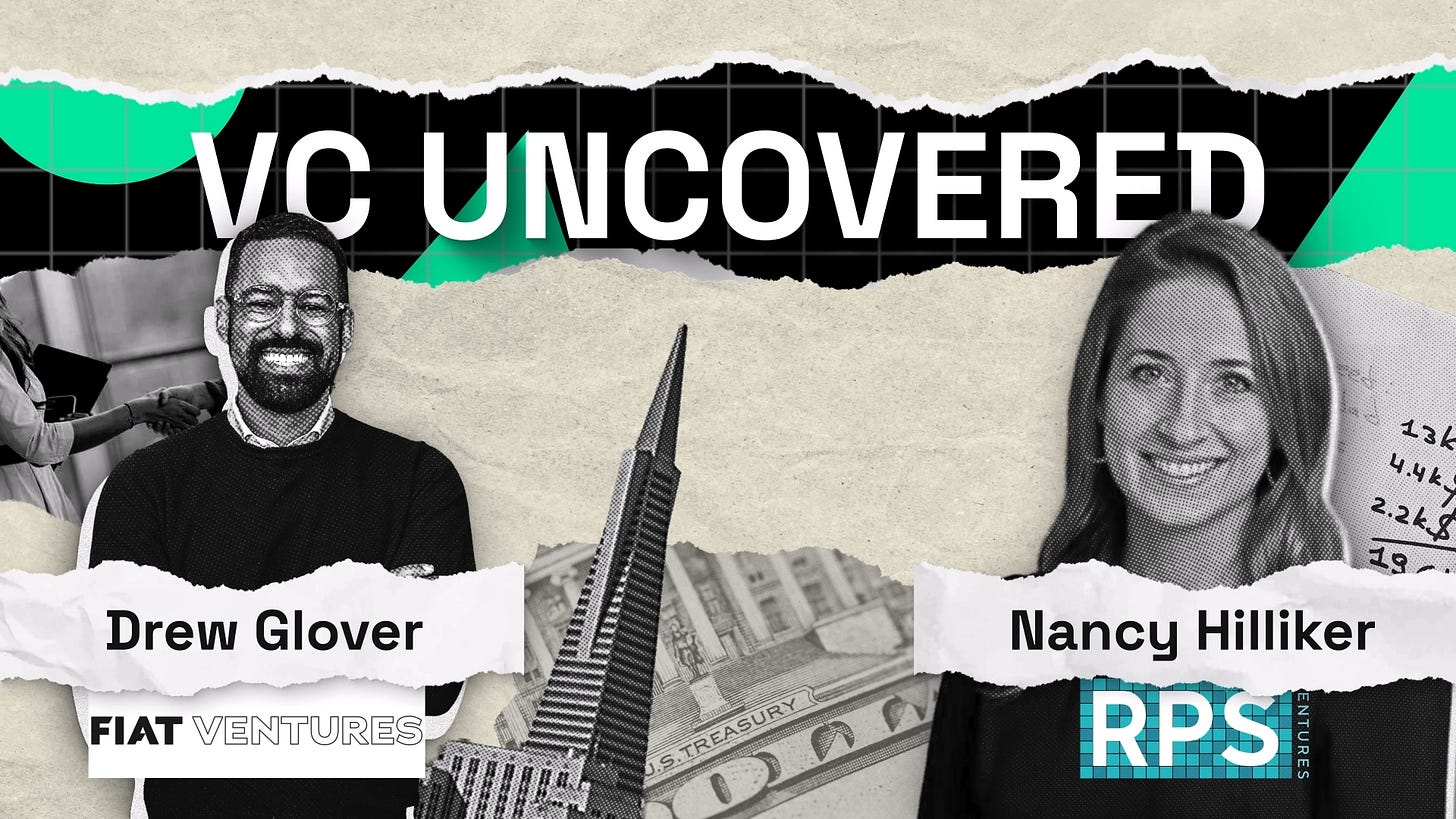
Nancy Hilliker (RPS Ventures)
Read the VC Uncovered profile:
www.vcuncovered.com/p/nancy-hilliker-rps-ventures
In this podcast:
Drew Glover and Nancy Hilliker discuss the intricacies of venture capital, focusing on the challenges and strategies involved in being a generalist investor. Nancy shares her insights on navigating the venture space, the importance of building relationships with founders, and the balance between data and team dynamics in underwriting investments. They also explore the significance of empathy and kindness in fostering trust within the investment community, as well as Nancy’s unique transition from equity research to venture capital.
In this conversation, Nancy Hilliker shares her insights on the venture capital landscape, particularly focusing on the implications of AI in various sectors. She discusses the dichotomy between the rapid adoption of technology in finance compared to the slower pace in healthcare, and emphasizes the importance of understanding the unique value propositions of AI companies. The discussion also touches on the cautious approach to investing amidst the AI hype cycle, the significance of long-term perspectives, and the necessity of networking in the VC space.
Sponsor:
This season is supported by SVB. Silicon Valley Bank, a division of First Citizens Bank. Member FDIC.
SVB is a trusted collaborator for the founders pushing boundaries and the investors who back them. We’re proud to have them as our sponsor.
Please note, this podcast is for informational purposes and is not investment, financial, or legal advice. The views expressed are those of the speakers and do not necessarily reflect the position of SVB.
More from Uncovered Media


Read the full transcript
0:00 I was talking to somebody the other day and they said, "Oh, they picked up the check." And I was like, "I'm sorry, what, a check? Who's using checks anymore?" But it is still like we forget that there are still real businesses
0:15 that we interact with every day that are not yet using AI. They're still figuring out how to, and they're still figuring out how to protect consumers' data. And so I do think we still have a long way to go before AI takes over the world.
0:31 And there are a lot of businesses in the meantime that are gonna be very interesting and have a variety of outcomes. (upbeat music) - Welcome to VC on Tupper. The series where we highlight the next generation of investors who move faster, take bigger risks,
0:48 and build shoulder to shoulder with founders. I'm your host, Drew Glover, co-founder of Theot Growth and general partner at Theot Ventures. Nancy Hillaker, so excited to have you on VC Uncovered. We've been friends for a while now, and I've just been generally the biggest fan
1:04 of how you navigate this venture space, both from a community building standpoint and investment standpoint, and just how you show up. And so it was honored to one highlight you on the VC Uncovered newsletter so much so that I really wanted to evolve this thing into a podcast.
1:22 And there were a couple kind of larger topics that you chatted about in your newsletter that I really wanted to dig into today. But before we dive into that, I would love to just get like a quick intro from you of who you are, what you're focused on, and why you're in VC.
1:39 - Absolutely. Thank you, Drew, for having me. I love working with you guys and getting to see you out in the wild, in the ecosystem, and I'm so lucky to get to work with you guys. And so yeah, a little bit of background about myself. I have been at RPS Ventures now since January,
1:56 and prior to that was at Revolution Growth. So a little bit under five and a half, six years in the venture community. Now I'm a generalist overall in the tech space. We focus a bit on enterprise S and businesses
2:11 that sell to that enterprise. That also can be FinTech, healthcare, consumer, but certainly a focus on enterprise. We do series B and later, we write checks probably five to 20 with our sweet spot, sort of being 10 to 15.
2:27 And we're excited to lead or follow, and we're just excited to find the best companies that we'd like to work with. - Awesome, awesome. My first question is one that just comes from Pure Jealousy. Like I focus so deeply in the FinTech space, and I'm lucky that FinTech is becoming so broad,
2:43 and it's very much like the bedrock of just around every business model and vertical that exists. But you're a generalist. And I remember before I became a VC and I was romanticizing what a VC was, I was always like, I'd wanna be a generalist, like I'd wanna have the freedom to really peruse
2:59 all different types of models, be able to walk through every hype cycle, every low cycle, the places where no one else is looking, but what does it mean to be a generalist versus being someone that's just like more focused on a very specific vertical? - It's a great question and something I've asked myself
3:16 over time as I thought about who I wanna be as an investor. I will say big a generalist is tricky. There are so many fun categories that you wanna spend time on. I consistently have 50 tabs open.
3:31 Different companies have come across along the way that I'm excited to dig into more and just haven't had enough time. With that said, I do think there's a different skill set at the series B and beyond level, that kind of growth mindset.
3:47 And so I like to say I'm more of a stage specialist versus a sector specialist. And I think it is an important discipline that I've noticed over time. It's sort of taking the founders' mindset and bringing them sort of into the next chapter.
4:03 How do you get to an IPO? How do you get to a M&A? How do board dynamics mature over time? When is it the right time to hire that very senior CFO or that a new head of sales that's gonna take your company to the next level?
4:20 And so I think those are questions that I often get to work with founders on as opposed to will this category work. Obviously that's important too. And you need to see growth in that category for a deal still to be successful. But there's a little bit more of a maturation
4:36 that I work with founders on. - Yeah, and that kind of rolls me into my next question which actually came from the VC Uncovered newsletter which is your general allergy to hype. And you like actually, I'll paraphrase a quote
4:53 but you've kind of developed this allergy to deals that are only driven by FOMO and hype that are just stuck in the hype cycle. And again, as a VC like we've all felt the FOMO no matter how much we try to move away from it. But tell me a little bit more about like in this world
5:11 that is truly driven around signal and momentum which is the VC space. How are you staying so disciplined in the storm of that? - Yes, it is not easy. And I will say, I'm certainly not perfect in this.
5:26 Either I get caught up in excitement and momentum sometimes as well. And you have to have that of course. You have to be excited about the deals that you're working on. With that said, I think there have been deals in the past that I've looked at and a founder.
5:43 You want the founder to be an expert but I think that founder isn't necessarily an expert in running a business and the sector and hiring and all these things. And sometimes we expect that person to kind of be like Jesus
5:59 and we really can't put that much burden on a founder. And so sometimes you get really caught up in these deals because a founder is so exciting or the category is you're going to miss the category. And I think what I've realized is sometimes
6:16 if you rush diligence, if you kind of don't do that, those calls with customers that are existing or a pipeline check or kind of get a feel for really how the business works or sometimes even just understanding how this company is going to grow over time.
6:31 And so as you know, at later stages, it's increasingly important to have a model that works, for example, and being able to understand what you're really assuming in this business over the next one year, three years, five years,
6:47 it's just sort of helpful to ground everybody's expectations at the same time. And I think there've been a couple deals in the past where our team got excited and said, oh, well, we know that there's great customers in the pipeline and we know that the existing customers
7:02 just love this product, or the founder, the founder knows everything in this space, like we can just trust the founder. And I think sometimes it's just healthy all around for everybody to sort of be on the same page
7:17 and understand those expectations going forward. And hopefully the deal is as exciting as it is, but grounding some of that in data is just really helpful. I think you see different kinds of founders, some are more visionary and some are more methodical.
7:32 And there's been success on both ends of that spectrum, but I just tended to realize that some of the deals that I was a little maybe rushed in diligently
7:48 sometimes didn't always work. - Yeah, yeah, I know, and that makes a ton of sense. And I think we're in a different market now where you're not getting as rushed as you once were in other markets. - I will also say, I'm typically investing in pre-seed and seed.
8:04 I have a little less data to play around with and you have to play around with, but I am curious as you are underwriting some of these businesses that actually come with the hype and you have the data to understand what's the actual health of the business,
8:19 but as you track that back to a founder that you know just has this uncanny ability to fundraise. They have this uncanny ability to tell a story and get investors wrapped around that story and be able to raise these massive rounds
8:35 that frankly give them a little bit more runway to maybe make a couple more mistakes and find their way to success. How are you playing both sides of that underwriting model of business? Probably could be a little healthier, but you have a founder that is just the best storyteller
8:52 of the future on earth. - Yes, and you know what, you want mistakes happen and you want to support that founder throughout those things. I think it's just about approaching it, understanding that businesses are really hard to grow
9:07 over the long run. There's going to be ups and downs, whether it's hiring, whether it's just missing forecasts, we expect that to happen, but just I think having valuation and growth expectations all aligned both on the investor side and the company,
9:26 it just sets expectations going forward so that incentives are aligned in the right way. I think as an example in the past, there was a company we were so excited about. They were a little earlier in the revenue scale
9:41 than we thought, and so obviously projections are a little hard to put your fingers on, but the founder was very focused on a high valuation. And you know, we just kind of got excited
9:56 and maybe didn't put enough material behind why that valuation made sense. And I think in hindsight, it just would have been great to spend a little more time understanding how this company was actually going to grow over the next three years and what the assumptions were in order to just better
10:13 understand and narrow what we knew and what we didn't know. - Yeah, yeah. And which 'cause where I'm investing in the early stages, sometimes I have to put a little bit more on team than I do on obviously where the business sits today.
10:31 At your stage of investing, how much more narrowed is that connection get? Like are you, how much is it team versus just, we got to lift our sleeves up and just live in the data in terms of underwriting?
10:46 - It's a good question. And I think sometimes I can be too conservative when it comes to some of that, but we of course want to be excited with the founder. We want the founder to be an expert and we want to be aligned in terms of our excitement
11:03 with the growth going forward. I think ideally at the growth stage, we also try not to underwrite something that has risk of going to zero, right? We try to narrow that return range sometimes
11:18 to three to five X or sometimes a little broader of a range, but we try not to underwrite to something that could go to zero. And so I think having the data sort of just narrows that return profile with that said, of course,
11:33 there are exciting companies that just take a lot of time to get to and invest in this infrastructure that will take longer to evolve. And so sometimes you're making decisions without as much data. I think the goal is just to narrow what you know
11:50 and understand what you don't know and what you're really betting on. And we do the best that we can, but certainly data is not the end all be all. I'm sure we've seen companies in the past that have just exceeded expectations.
12:05 I mean, even OpenAI's valuations, it's just really so exciting to see a company get so big and who knows where it's going to go next, but that was a vision in the beginning as well. >> That's right, that's right.
12:20 I always find it very fascinating as VCs, based on the stage that you're investing in, you kind of have to lean into building and nurturing relationships with potential future investments in a very different way.
12:35 For example, the relationship that I have with you is is when I sit down with you, you're like Drew, tell me more about your portfolio, who in your portfolio is on a path to make an introduction to RPS. And sometimes that means you're chatting with people
12:51 in the pre-seed knowing that you're going to have to follow that relationship for three to four years, right? And so one thing that we've talked about is this buffalo mindset, like you come from this town, you were born in this town that was really focused around
13:06 like the city of good neighbors and building trust and building these really deep relationships. And so we'll love to learn a little bit more about how you approach building really deep relationships with all these incredible founders in your pipeline
13:23 that might be at the earliest stage, might be at that teeter-totter phase of almost time to raise from a group like yours and an individual like you. - So I do think that the buffalo connection is one I'm really proud of.
13:38 I love being part of the city of good neighbors. And I really do think that these relationships and these investments that we're making do come down to empathy and kindness. And I think that both of those things hopefully drive trust with the people
13:53 that you're working with on a day-to-day basis. As we've talked about, people are human and they make mistakes. And when we start these journeys, you sort of like never know what direction this company that you're investing in really is gonna go.
14:10 Hopefully you kind of know by the time I'm investing in it. But at the end of the day, you know, you want to have that relationship with the founder or with the executive team because you're gonna be working with them all the time. Some of these founders need more hand-holding
14:25 or want more advice. Some of them want mentorship. Some of them just want a sounding board. Sometimes they want an advocate in the room and understanding that person. I love to get to know people at the early stages
14:42 and sort of foster that trust so that they know that they can call me and I'm not gonna go and turn around and talk to the board behind their back and say something. They need to know that there's an advocate in the room or that I'm gonna provide them with honest feedback so that they can grow back and change what needs to be changed
15:00 in order to get this company to the next level. I mean, all of us should be aligned that we want the best outcome for the company and ideally, you know, that founder really trusts you and helping them get there. And so I like to approach it, you know,
15:15 with empathy and with kindness, understanding that I don't expect that forecast. That's the only thing I know for sure is that that forecast will not be what the real numbers are at the end of the year. - And so hopefully I come at it with empathy
15:30 and kindness and patience so that that founder trusts that they can come to me and they're not scared to come to me when they really need to. - That's awesome. And then can we maybe just like go a little bit further back to like how these relationships are being formed?
15:46 - Yes. - Before there's even like an investment conversation because for me, in a perfect world because I'm investing in pre-seed and seed, like I want to meet this future CEO when they are still a product manager at OpenAI, right?
16:02 Like, and they're really interested in the FinTech space. But for you that might mean I see to meet them in the pre-seed or the seed. But when are you reaching out to them? And what is kind of the cadence of how you're keeping in touch with them to make it so you are their first call
16:18 when it's time for a check from RPS? - Well, first of all, I do not envy you guys because it is so hard to be able to know when a founder is starting to think about their company and finding that person at the right time
16:33 before anybody else. I really don't envy you guys 'cause I do think that ecosystem is so much more complicated. I'm very lucky because I get to work with partners like you guys and you help surface some of the best founders that are sort of up and coming in your portfolio.
16:48 So that's definitely one way. I get to attend fun events. And like that you guys plan and meet founders just live. You know, understanding human to human, again, that connection. I think there's, you know, another element
17:03 where I love to be thematic. So before business school and before investing, I worked in equity research. And I think having an opinion on the direction of a space is super important to be specific. I think it helps not only tell the founder
17:20 why you're an advocate for the company, but also just narrow the landscape. So as we talked about, being a journalist is so hard. And having a little bit of an opinion just helps narrow the number of companies that I'd be interested in.
17:35 And then, you know, I do reach out to them. I try to reach out to them. I don't know late series A, maybe they've raised just raised a B. But again, try to narrow it within a space. Most of the sourcing that I've done has been in healthcare or fintech.
17:51 And so understanding that ecosystem, being at those conferences, understanding the different investors in the space that I trust to myself, all kind of relate to finding the best founders. And again, trying not to chase founders
18:07 that are being chased by many investors. So a little bit contrarian as well. But sort of finding sort of where the ball's going next as opposed to kind of where the ball is right now. - Yeah. And I think your background in equity research and that kind of being something
18:22 that you were doing prior to venture investing is a really like strong entry point into venture. And how is that background helped you do your job so well? Is it mainly been on the diligence front?
18:39 Has it, I mean, it sounds like it's played a huge role in you having a really clear perspective on people's business models when you're talking about them. I know me when one of the values of me being so focused in fintech, when I talk to a fintech founder, I could go 25 feet deep on their business.
18:55 And there's an instant connection to be made there. But your background in equity research, how is it positively and possibly negatively impacted? How you engage with venture today? - It's a really great question. And it's such an e-typical way to have gotten to venture.
19:11 And I will say, it definitely took a lot of work to switch careers and get into venture and understand this ecosystem. I will say it was really, it's actually so much more similar though on the inside now
19:26 than I expected on the outside. In equity research, part of our goal is to decide whether a public stock is worth investing in or not. And we're writing the research and giving you data points in order to recommend that stock
19:41 or not recommend that stock to hedge funds and long onlys. And so very similar thought process when it comes to a private investment. Do I like the industry? Are there tailwinds in the macro climate
19:57 and then also company specific drivers that make this a good investment? And I do have a lot of experience in models and I understand valuation multiples and how this company should look when it gets to the public markets.
20:12 I will see areas that I am learning still and I would say we're a big learning curve are understanding that these earlier stage companies don't necessarily have it all together and there's still a work in progress and that's okay.
20:28 That's just the stage in which we're investing. And areaable safe founders always push back or ask me about operating experience. And I do think I don't have specific operating experience
20:44 when it comes to running a business. But again, I think at the growth stage, hopefully the expertise that I'm bringing is how to get that company to maybe the public sector or to an M&A exit and hopefully it's a scale expertise
21:00 as opposed to day to day. Do I use flacker? Do I hire this person? I might have expertise in terms of when to hire that person but I may not know their specific go-to-market experience
21:16 as an example. - Obviously that background gives you a really great entry point into venture. But I'm also, it makes me go back to because there wasn't a direct path into venture. What was it that made you wanna get in?
21:32 And I'll just personal anecdote. I always romanticize venture. I would say now that I'm so deep in it, I probably have over a romanticized it because Hollywood has done such an incredible job making it seem like this thing. And don't get me wrong, I love venture.
21:49 I wouldn't do anything but this if I had another option. But what pushed you to wanna get into the space? - I love this. So I was working in consumer equity research, covering companies like Macy's and Calvin Klein
22:07 and Ralph Lauren and coach and Kate Speed which were the most exciting. It was a really cool coverage to have. I got to go to the Victoria Secret Fashion Show, things that were really fun. But at the same time that consumer retail space was very difficult because the world has gone online.
22:25 And a lot of stores were seeing really negative traffic and there were a record number of bankruptcies and we have seen sort of that old school retail convert into new school retail. And at the time when I was doing equity research,
22:40 Sweet Green and Warby Parker were still private companies and coming to the public market, they were kind of gaining scale and they just seemed so much more exciting. And they were talking about growth and opening stores and record number of sales and productivity per sale
22:57 or per store and I just thought, why am I writing about companies that are dying and not part of this future? And the other thing I realized is that, again, as these companies have gone online,
23:13 they sort of lost track of who that customer was. They didn't know who was visiting their website. They didn't know if the inventory in their store was the same as the inventory online. Those things used to be separated. And so I went back to business school to focus on technology
23:29 empowering some of these retailers. Sort of thinking that maybe the supply chain could be improved by technology or inventory management systems or just understanding, you know, marketing and how that customer is engaging with that brand.
23:44 And so I did a supply chain tech thesis and I really kind of got into the, down a really big tech rabbit hole, even as you think about cashing out on a retail website, it's a FinTech implication and how fast is it
23:59 for you to be able to check out? And now we're talking about how to shop on TikTok and Instagram and even OpenAI launching this week how to shop on their website. And so all of those touch points, although they touched retail in the beginning, got me down a really big rabbit hole across sectors
24:17 in terms of technology powering and selling to large enterprises. And so it actually was the beginning of me sort of being a generalist. And I got really lucky and ended up at Revolution right out of business school. And so, you know, that journey really taught me about venture
24:35 and taught me how to love this business. I really do love venture. I think it is as good as Hollywood romanticizes it. - I love it. And what, as a generalist, what are some of the trends that you're finding yourself obsessing over right now?
24:51 - I do think all eyes are kind of on AI. And while that is like extremely buzzy. And again, I'll go back to like, I don't want to invest in hype. I do think understanding where AI goes and how extensive AI is in our day-to-day lives,
25:07 very similar to sort of, you know, retail going online. How is the world changing with AI? And just sort of understanding the implications there, I think has been extremely interesting to me. I will say we haven't played a ton in AI
25:24 because we're nervous about whether open AI or anthropic decide to do a lot of these things on their own or whether that's owned by separate companies and applications. And so I think that is something that I'm really fascinated about right now.
25:40 And again, I continue to spend time across sectors just how they engage with AI. I'm trying to think a lot of other category specific within FinTech, you know,
25:57 it's hard to find categories that haven't been somewhat innovated. I do think actually the FinTech category is one where people do love to adopt technology. On the contrary, I think healthcare has been slower to adopt technology. Both categories have very sensitive personal information,
26:14 but I do think that finance, financial services and FinTech have adopted tech, while a lot of healthcare players have been slower to adopt it. And so I continue to be fascinated by that dichotomy as well. So continue to focus in those categories.
26:30 And then at the same time trying to wrap my head around really exciting AI, you know, opportunities that might be relevant over the long run. - As you're thinking about AI, are you thinking about I wanna be investing in companies that have a really strong AI strategy
26:47 or you wanna be just purely investing in like a hundred percent AI first companies. And like now we can kind of get into a conversation around like, I feel like the majority of even like the highest flying AI companies
27:02 that are very hype based are, there's still AI wrapper companies. Like these are companies that have a version of chat GPT and it focus on a very specific use case or edge case, but it's wrapped around a very specific story.
27:18 And that could be legal tech, that could be health tech, that could be around diseases or lifespan versus health span. But how are you thinking about investing in like more AI wrapper companies that have just like hit a really strong hype vein
27:35 in the venture space versus, for example, a money management tool that has a boatload of data at hundreds of thousands of users that are taking that proprietary data and using AI to turn that into really valuable
27:50 like personalized experiences. - It's a really good question and I don't think anybody officially knows the answer. So certainly not claiming to be the expert here. However, I do think there is a difference
28:05 in an AI wrapper that has unique value add. And so we did do an investment in luminance when I started at revolution, they have a bench of judges
28:21 that actually evaluate the different responses across LLMs and that foundation layer so that it isn't just based off of one. It's sort of grounded in a value add there and it is specific to the data
28:36 that they are receiving from their customers as well. I will say there's another, you know, companies like you mentioned within healthcare space that have a very specific value add. So at Revolutionite worked on a deal
28:51 where they are actually taking phase one clinical drugs and finding through AI use cases better outcomes for those drugs. And I think that that's something that maybe, you know, the foundation layer will not go after because they aren't experts.
29:07 There is proprietary data that drives those outcomes which makes it sort of defensible and much more sustainable over time. So I am excited about AI as it drives outcomes in those specific sub sectors.
29:22 The other way to look at it though, and I did, I was chatting with the founder friend the other day, as long as there is a very clear differentiator between what comes out of an LLM and what that AI application drives,
29:37 I think that's just really helpful to understand is there a data outcome that's different? Is there a visual outcome that's different? Is there some outcome that's measurable between, you know, the base layer and what your services or application is adding?
29:53 That is, I think fundamentally what all of us are sort of evaluating right now. And the more data or the more information you can provide, I think is how we're gonna be making decisions as investors, you know, in the near term at least.
30:08 - Yeah, and I do feel like there, you know, there are a lot of VCs and adventure funds out there that are like, no, we are all in. I think there's a lot that are saying they're in, but technically they're out because they haven't really made a lot of bets
30:23 in the space yet. I'd say like, as you got the big jump rope growing, you're like, dude, you're deciding when you're gonna jump into the jump rope. How are you guys underwriting when you plan on kind of jumping in fully? - I will see our eyes are open and we're looking.
30:38 But we're trying to be very careful about where we make a bet. Yeah, and it is tricky. And again, I hope we don't miss opportunities that do actually become great. I feel like it's a tricky question.
30:55 Again, with that said, you know, we're looking at a company that has a specific niche in regulated industries. And I feel like maybe that's a sub-sector in which the foundational models are less interested in.
31:10 Or maybe they are interested in, but they don't have that data layer or that governance layer that kind of sits on top of an LLM. And so we're trying to find, I think, those adjacent plays that interact. I think you have to assume that they're going to interact
31:27 and leverage those foundational models, but don't, I guess, sort of reproduce the same outcomes that those foundational models are currently seeking. I think it's ultimately a bet as to where OpenAI and Anthropic
31:42 and these platforms really want to go. Obviously, like we saw this week, maybe commerce will be part of those platforms or maybe travel will be part of those platforms. And so I think, again, trying to focus on sub-septors that are a little more specialized
31:58 and use AI as part of the process versus revolutionizing the entire behavior of somebody. Even in financial services, understanding, underwriting better, is one component of the whole process of loans, for example,
32:14 versus dispersing loans in an automated way, let's just say. Because maybe that is a just relying on the LLM itself is just not enough. You have to add that kind of extra layer. Yeah, I think it's really interesting.
32:30 I would also just say, based on the stage, you guys invest, right? You also have to think about it from the standpoint of, when I invest, I might invest at a $10 million post valuation and OpenAI acquiring my business for $100 million is like, it's technically, it's a win for us, right?
32:47 Where if you're investing in Series B or Series C or even later, then you're basically optimizing for an IPO of some kind. And you kind of have to make sure that you're not just gonna get your money back or potentially that just being an investment
33:03 that does not drive the return, especially with the amount of work you guys are putting into every investment you make. Absolutely. And you know what? It is a really good point. I do think that we are looking at companies that can exit via M&A as well and that does have valuation implications.
33:19 And so we have started to look at companies, I would say that are earlier B, but also are open-minded to those later stage companies. And so watching those companies over time has given us a little bit more confidence.
33:34 Sort of watching the go-to-market strategies, the enterprise sales cycles and understanding better how quickly incumbent Fortune 500 enterprises are actually responding to this. We get caught up in this AI hype cycle
33:50 just to go back to our discussion. And we think AI is gonna take over the world, but you still have the government and healthcare and financial services, which currently are not prepared for open AI to take over.
34:05 We're not gonna be doing our banking on open AI tomorrow. And so there's so much time between now and the point where AI is actually taking over our lives that I think there is still so much opportunity and so much time. And so we don't feel, I guess, rushed
34:21 because if there is something that is fundamentally going to change our lives, we will have the opportunity to look at that in the next six months, one year, et cetera. And so right now collecting that data and understanding maybe that company, we saw that company a year ago
34:36 and they're doing really well and we can get more comfortable that they're go-to-market motion and their product is actually winning with that customer. And so again, it goes back to having a little bit of data that kind of grounds some of that hype.
34:51 I think it's a really important point. And like you mentioned, there are a lot of incumbent fortune, 100 companies that weren't the AI solution, but were really popular for data
35:07 or developer software or any kind of software. And now they want to adopt AI forward solutions. And so I do think that there is going to be a lot of consolidation of AI based applications
35:23 that can augment and improve like the base that existed five, 10 years ago. And so I do think that there's a lot of opportunity for these applications. It is very important though, to be a little bit prudent about valuation when it comes to some of it. Yeah, totally.
35:38 And I do, I really do like your point on, I won't call it FinTech. There's definitely some unsexy parts of FinTech, but there is a lot of unsexy parts of government and some of these super high regulated spaces that AI can't just like flip a switch
35:55 and like kill 100 companies overnight, right? Like these are, this is infrastructure that legally needs to be scrutinized in terms of how tech plays a role in it. Specifically AI, specifically the person
36:10 that has oversight of that technology. And so I agree that there are quick plays that are medium plays that are slow plays in this AI space. And I do believe that a lot of the generational businesses that pop up or even though they have AI involved in them
36:26 are not necessarily gonna be overnight successes because of the spaces that they're building in. So yeah, super interesting. - Yeah, people are still writing paper checks, right? Drew, like, I mean, people are still using old school-- - They're still wiring, yeah, dude, yeah. - Yeah.
36:41 (laughing) - Yes, I know, I was talking to some of the other day and they said, "Oh, they picked up the check." And I was like, "I'm sorry, what? "I'm checking who's using checks anymore." But it is still like we forget
36:56 that there are still real businesses that we interact with every day that are not yet using AI. They're still figuring out how to, and they're still figuring out how to protect consumers' data. And so I do think we still have a long way to go
37:13 before AI takes over the world. And there are a lot of businesses in the meantime that are gonna be very interesting and have a variety of outcomes. - Yes, yes. Apologies to all of our listeners for bringing us into the hype cycle again. But I promise you, neither me or Nancy
37:30 are the ones to get caught up in the FOMO. We do everything we can to stay out and then lean in when it matters most. With that, I wanna close this out with what I typically do, which during our conversation, I'm like writing down these really quick questions,
37:47 like kind of a speed round that I do at the end of every single podcast. So if you're cool with it, I'm gonna jump into these things. - I'm ready. - All right, all right. If you had to choose one investment vertical to focus on, what would it be? - Oh, that is so hard.
38:03 Okay, I'm gonna cheat a little and say tech enabling legacy industries. I like that. Like, unsexy legacy that can be optimized by technology and maybe even a little bit of AI.
38:19 Higher margin legacy businesses. - Yes. - Cool, I like it. If you had to assume the role of CEO of any company in the world and it could not be the CEO of a VC firm, what would it be? - Ooh, I think it would be a travel company.
38:34 Something like Expedia or, you know, we're investing in Get Your Guide. We just think it's such a fascinating company. I think something travel-oriented. - I love that. Also, I randomly heard this stat that 80% of all travel across, like,
38:49 specifically FinTech brands, like if you're inside of Chase or Amex, they're all run by Expedia, which is not-- - It's wild. It's wild. And I will say those experiences could be innovated on. So. (laughs)
39:04 - There's an opportunity out there. Any of you potential founders listening. - Yeah. - Okay, great. What's the first thing you do when you wake up? - Besides brush my teeth and, you know, make my bed a coffee. Run to start making some coffee.
39:19 I do try to get out and walk every morning, but, you know, sometimes it's not in the cards. - Making beds, that's important. That's an important one. That's probably the first thing. I'm gonna take that as the official first thing. - I've read somewhere, you know, those little tasks of, you know,
39:34 you can win making your bed in the morning, just set you up for success for the rest of the day. - It's 100% a win. One that my wife has, like, made sure I do every morning, but pre-wife, it was like-- - Just bringing you and being so successful.
39:49 - Yeah, depending on how I woke up in the morning, very much depends on how good my bed looked. What AI tech tool do you use today, which you would kind of share as a hack that everyone else should be doing? - I think leveraging AI to shortcut
40:06 some industry knowledge. And I think different platforms are better than others. I like to actually dig into where the source information comes from too, but it aggregates sources and it aggregates things a little bit faster than we used to do when we're writing a research report.
40:23 You know, like even understanding macro trends, I think the other day I said, show me the relationship between, you know, labor statistics and something else. And it just shows me the chart. I know where to go find that data to reproduce that chart or like, whether that is the right relationship
40:39 of what I really want to like dig into, but it's sort of shortcut me going to five different websites and playing with data in order to sort of get to that same outcome pretty quickly. So I'd say that's my hack, is just sort of getting the 101 on something completely. - Yeah, are you using CHICBT, using CLOD?
40:57 What are you using? - I used both CHICBT and Gemini, and I sort of compared their responses. What do you like more if you had to choose one? - I think Gemini. - I've been hearing that lately. I've been hearing that lately. - I think so too. They also have this really cool feature that does deep research for you.
41:13 I will say I like it. I'm not sure if I love it because I still have to read a long report and like what I like to use it for is to know where to go for the source information. I'm not sure if I like fully trust everything that's in a deep research report yet.
41:28 - Right on, right on. Okay, last question here, any advice to an aspiring VC currently working in an adjacent industry? - Two things, have an opinion, have a thesis, have an opinion, have an angle on the world
41:46 that you think really needs to be innovated on. I think that really helped me understand so, you know, like what's important and where to focus initially. And then the other thing is network. Network your butt off. Those relationships as you recruit for that job
42:02 and get into the space become increasingly important as you become a VC. I mean, half of our job is getting to talk to each other and making sure that, you know, we stay in touch so that I can follow the founders that you work with and get to know them and that I trust you in that process.
42:19 So like half of our business is really just trust and a great network that you really feel comfortable with and you can call to say, my diligenceing this correctly. How do you feel about this? And so at like network network network,
42:34 because even, you know, my old industry contacts are still valid as I like diligence and you deal. So those are the two things that's it. - Love that, love that. Nancy, so thankful that you were able to come on, share your knowledge, share your insights.
42:50 Always an honor to see you and more importantly, excited to continue hanging out with you and sharing all the diligence together as we continue to scale up in our career. But I appreciate you. - Thank you so much, Drew. It was great to hang out. - Awesome. - Talk soon. - Talk soon.
43:05 - This season is supported by Silicon Valley Bank. For decades, Silicon Valley Bank has been a true partner to the innovation economy, helping both founders and funders grow. Silicon Valley Bank, a division of First Citizens Bank, member FDIC.
43:21 Please note, this podcast is for informational purposes and not investment, financial, or legal advice. The views expressed are those of the speakers and do not necessarily reflect the position of Silicon Valley Bank.
Transcript generated automatically; it may contain errors.
Questions this answers
What does Nancy Hilliker at RPS Ventures invest in?
Nancy Hilliker is a generalist investor at RPS Ventures focused on enterprise SaaS with some fintech, healthcare, and consumer, investing at Series B and later with checks typically between $5 million and $20 million, sweet spot $10-15 million.
How does Nancy Hilliker avoid getting caught up in VC hype cycles?
She grounds decisions in data such as customer calls, pipeline checks, and growth models instead of relying solely on founder storytelling or category excitement, and tries not to underwrite deals with risk of going to zero.
Why does Nancy Hilliker emphasize empathy and kindness with founders?
She believes empathy and kindness build trust so founders feel comfortable coming to her with problems rather than hiding them, since founders make mistakes and businesses rarely follow their original forecasts.
How is RPS Ventures approaching AI investments?
RPS is cautious about AI hype and looks for companies with a clear data or governance layer that differentiates them from foundation models like OpenAI or Anthropic, favoring sub-sectors such as regulated industries where foundational models are less likely to compete directly.
What was Nancy Hilliker's career path before venture capital?
She worked in consumer equity research covering companies like Macy's, Calvin Klein, Ralph Lauren, Coach, and Kate Spade, then went to business school to focus on technology enabling retail and supply chains before joining Revolution Growth and later RPS Ventures.
Originally published on VC Uncovered · By Drew Glover