Tarun Gupta
Jump Capital
Forget TAM: Why the Best Companies Don't Find Markets. They Create Them.
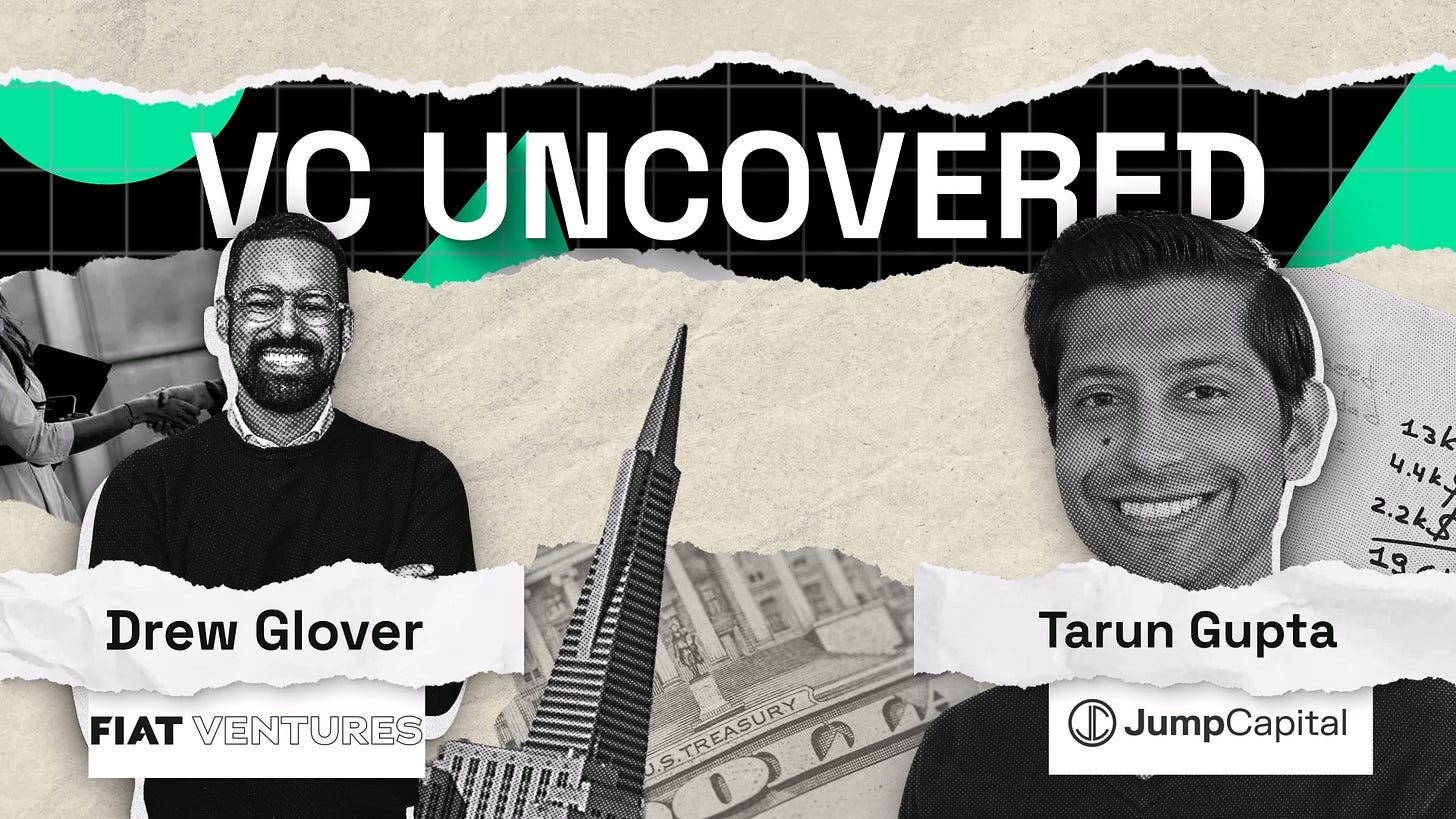
Tarun Gupta (Jump Capital)
Read the VC Uncovered Profile:
https://www.vcuncovered.com/p/tarun-gupta-jump-capital
In this Podcast:
Drew Glover talks to Tarun Gupta, Partner at Jump Capital, for a deep discussion on the foundations of high-conviction, early-stage venture capital investing. Drawing on his previous experience in M&A and corporate development within the sports betting industry, Gupta outlines his unique, outcome-oriented approach to identifying generational companies. Central to his philosophy is the “Quit Your Job” litmus test, asserting that a strong investment must inspire such belief in the founder and the problem that an investor would seriously consider leaving their post to join the venture. Furthermore, Gupta challenges the conventional reliance on Total Addressable Market (TAM), arguing that an overly narrow focus can cause VCs to overlook revolutionary companies like Uber or Toast, whose founders ultimately define new market opportunities through clarity of execution.
Gupta explains that this strategic foresight extends to approaching every investment with an M&A mindset from inception. He stresses the critical importance of positioning a company for exit and having frank discussions with founders about the optimal timing for a transaction—often before they feel they have reached their peak value creation. The conversation also explores how Jump Capital is strategically engaging with the rapid advancements in Artificial Intelligence. Gupta clarifies that their focus transcends merely using AI to improve margins in existing services. Instead, they seek out AI-enabled business models that can profitably serve previously un-addressable or underserved markets, thereby creating new, venture-backable categories.
The episode concludes with a rapid-fire Q&A session where Gupta offers sharp insights on specific investment topics. This includes analyzing the success of the live online gaming company Evolution Gaming, recognizing the surprising, transformative operational efficiency of AI note-takers for VCs, and identifying London and the UK as a primary target for international FinTech investment due to its unique market position and talent pool.
Sponsor:
This season is supported by SVB. Silicon Valley Bank, a division of First Citizens Bank. Member FDIC. SVB is a trusted collaborator for the founders pushing boundaries and the investors who back them. We’re proud to have them as our sponsor.
Please note, this podcast is for informational purposes and is not investment, financial, or legal advice. The views expressed are those of the speakers and do not necessarily reflect the position of SVB.
More from Uncovered Media


Read the full transcript
0:00 Look, we obviously are in this job to make money for ourselves and our LPs. That is a very core component of it. But life's short, you only want to work with people that you enjoy spending time with. And I think that's another thing that I look for and think through is, hey, if
0:17 this founder called me on Saturday morning, Mike's excited to go solve his problem with that . Welcome to VC On Tougher, a series where we highlight the next generation of investors who move faster, take bigger risks, and build shoulder to shoulder with founders.
0:32 I'm your host Drew Glover, co-founder of Theat Growth and general partner at TheatVentures. Tarud, thank you so much for joining the VC Uncovered Podcasts. We've known each other for years, man, and if co-invested together, have been in diligence together, have been in the trenches together, have spent days on end at
0:50 different conferences like Money 2020 and Fintech Meetup. I can keep going down the list, but I'm glad that we can just jump on this podcast, just riff for a little bit. We were able to spotlight you on the VC Uncovered newsletter. You had some really thoughtful ideas and thoughts around how you think about
1:06 investing. So excited to pull those out and dig into it a bit more. Before we jump in, I would love for you to just quickly introduce yourself, tell us a little bit more about JumpCap, and tell us a little bit more about what you're focused on today. Yeah. Thank you.
1:21 And intro, great to see you, Tarud, and excited to chat. So maybe just really quick on myself, Tarud, started my career in investment banking, did that for a couple of years, M&A Southside and Raju worked. Interesting stuff, got to be a part of some really unique transactions, but
1:36 wanted to have a little bit more of a say in how some of these deals were getting done, and instead of just being an advisor, stick your neck out on the line, when you want to lean into a business. So then moved over to CorpDev at a publicly traded casino game and sports betting company called Scientific Games, a bunch of years there, really interesting cast of
1:53 characters that you mean that ecosystem, very cool experience, and then eventually hopped over to Jump. Been with Jump for almost six years now, will lead our FinTech and FinTech adjacent investments, which can include a lot of things in vertical AI, commerce, et cetera.
2:08 And so Jump has been around for 14 years. We're an early stage fund, focusing at Seed Series A and Series B. We can write checks as low as $2 million as high as $15 million, kind of that Series A 5 to $12 million check sizes our sweet spot.
2:24 And we're investing out of our seventh vehicle, which is a $350 million fund, which we closed a couple of years ago. We have three very broad buckets of focus where deployment is roughly evenly split for us. So one bucket is called more IT infrastructure cybersecurity. Another is more of a catch-all of enterprise vertical software and AI.
2:41 And the third is FinTech, and I kind of spend my time across the latter two categories. Just a little bit on Jump. Maybe I'll pause there and you can push me on where to go next. No, that's great. Obviously, you're guys approach in terms of investing very much to lines with a
2:57 lot of stuff we do at Fiat Ventures, hence, since our ability to partner a time together. There's one thing you touched on, which is your role prior to Jump, which was in this online betting space. I'm always so fascinated by online betting that entire space, because the under
3:14 writing model of betting ecosystems are so specific, so scientific, I'm curious how that is affected in either helped or hurt your ability to become a really strong investor on the VC side. It's interesting.
3:29 I have very strong opinions on the sports betting wave that we are seeing. A lot of it is really interesting probably going to get into some issues with problem gambling, which we're already starting to see and there's some interesting businesses popping up to address that. And I think the holy grail for that industry actually isn't sports betting.
3:47 It's online gaming, unfortunately, for the industry that's only been legalized in a handful of states. Anyway, that's separate rabbit hole. Your question was more around how it's informed, how I think about things today . On the personal side, I'm not a very active gambler after seeing all of the
4:02 nuances of how the deck is stacked against you in terms of how it's influenced things at Jump and how I think about just venture investing. I would say less from the specifics of numerical and formulaic side of things that I learned there, more from the standpoint of when you're in that role in Corp Dev, you
4:21 have a very clear view of what you're looking for when you're acquiring a business and how they need to present themselves, how they need to potentially fold in to the company that is acquiring them if they're a strategic. And so I think that's probably the biggest learning that I took away is when I 'm working with the startups that we partner with, it's not something we think about at
4:38 the very beginning of the journey given how early stage that we invest. But as they progress, I have hopefully a better sense of from that scientific games experience, how they should be positioned, how they should be thinking about structuring the next level of their infrastructure, their business, their management, to be able to
4:55 facilitate the types of outcomes and transactions that they might want to if they go down the strategic emanate path. That's super insightful. I can only imagine that having an understanding of how to underwrite some of these different things on the gaming front is only kind of inspired your ability to approach
5:12 this best because you're investing in the early stage and the later stage. So obviously you have little amounts of data and you have a lot more data. How would you say on the earlier side that that's impacted your ability to kind of underwrite? Because I think from a series A series B, we got a couple of years of stuff
5:27 that we can really dig into and kind of build the story that we need to build to drive conviction, but conviction is a little bit different on the earlier side. Totally, and I think some of the earlier stage stuff was an adjustment when I first got into venture. The A and B, maybe the B more so than the A, came a little bit more nationally
5:45 because as you said, you used to have a lot more data to drill into to kind of build conviction that, hey, this is working from a financial go-to-market and commercial standpoint. When we invest in seed stage businesses or A businesses that are maybe earlier on the traction side, this is venture cliche, unfortunately, but it's all founder and
6:03 market focus. And so, for us, on the founder side, it's understanding why does this particular individual or set of people have unique insight that other people in the industry don't to solve in this problem?
6:19 It doesn't necessarily mean that they have to come from industry or had to have worked in a role that had direct exposure to this, but they've had exposure to this problem in some way, shape, or form, and through that have built some unique perspective on how it should be solved a different way. That's probably the most important thing that we look for.
6:34 The other stuff I think is pervasive across any category you look at, it's are they obsessed with this type of problem? I think a lot of venture investors balance the fact that are you focused on mission-driven founders or folks who are trying to build big businesses, there's some, I think , balance to it. You want people who believe so strongly in what they're building that, yes, the
6:51 economic return is very important to them, if they hit walls, they will break through them because of how much they believe something needs to be built. So those are the things we look for on the founder standpoint and all the other things that you expect. Can you recruit really exciting talent?
7:06 We love seeing when founders can bring people around the table to work for them that they have no business. Doing so, I think of different instances where we've invested in really young founders and they've brought on these 30, 40-year-old veterans of industry that are heavy hitters, how did you convince them to join this company and those are great signals that were
7:23 magnets of talent. So that's the founder side. On the market side, this is always tricky because some of these categories that we invest in are so emerging. That being said, we try to spend a lot of time with the prospective customers of these solutions
7:38 to understand where their pain points are and how big of a problem they're facing is it a quote-unquote hair-on-fire issue where, "Hey, I need this salt yesterday and if you bring me a solution that's addressing it, I will look at it immediately."
7:54 So balancing that prioritization of where they have pain points and where something new could potentially slot it. One thing that you talk about in the newsletter issue that we brought up is this idea of this tamless investment approach and you even touched on it. A lot of times in the early stage, all VCs want to see that one slide that says
8:11 the total addressable market is in the trillions in the multi-billion. We all, as investors, especially earlier-stage investors, we are power law investors. We want to invest in a generational business. I think some of the things that you brought up are really important, right? Can you recruit really well?
8:27 Can you raise money really well? Can you be a really great storyteller of what this ultimate vision is? But Tam is something that is intrinsically a part of all of us being great. If you were to get the 5, 10% of this market, how big would this company get? But you talk about taking that out of a conversation and you touched on a
8:44 couple of those things, but what are some of the other things that replace Tam as you're looking at quote-unquote maniac founders that are obsessed with the problem that they're trying to solve ? Yeah. I got some good jobs internally for my tamless comment. I think when I mentioned bifurcated in two things, the first segment of it is a
9:03 lot of VCs have gotten themselves in trouble by using Tam as a crutch on whether or not they should invest in businesses. We have been wrong as VCs a lot in as much as we're supposed to be optimists and try and envision this grand future in underwhelming how big certain businesses can
9:22 be because founders effectively create new markets, they create new demand, and they shift to tang ential markets that at the beginning, none of us believe were possible. The classic examples that are given right is Uber is always cited. As an example, Bill Gurley has a very famous post where he goes after folks who
9:40 said that they passed on Uber because they thought it was just the San Francisco cab market. Not realizing that Uber totally transformed the ecosystem and people who weren 't ordering caps would start to order Uber's because of how much easier it's load of transportation. I think VCs get in trouble when they think of just, "Hey, this is the market
9:59 someone's playing in and we have to underwrite it to this," and so how big is it and what percentage can we get? That's the piece that people miss. I like to keep an open mind to that and not use that as the reason to invest or not invest in a business.
10:14 If you have high enough conviction in a founding team and you have high enough conviction in the problem that they're solving is something that is a huge pain point for their customers. I think you take that leap and you believe that those founders can iterate and find ways to build tangential products and offerings on top of that.
10:30 Thank you, Bill. You have a really good point of one is Uber, which I think is a little bit more straightforward where if you can unshackle your brain from like taxi cab unionization and just think to yourself, "Okay, if it can work in San Francisco, it can work in every city
10:45 ," that's one example, but as you are underwriting some of these earlier stage businesses , how imperative is it for them to be able to see the generational business that they are going to transform over time versus the initial idea that might be an incredible go-to-market strategy
11:04 but might not be that generational idea today? Does that need to be there on day one? That's such a tough question to answer. The ideal is, of course, that they have some sort of grander vision and they can map out
11:19 that, "Hey, this is the first problem to solve," but by solving this problem, it enables us to have the right to go solve this other problem. That is the ideal scenario is how we can get to this really, really big type of outcome. I think what gets dangerous, though, in this ecosystem, which I'm sure you've
11:37 seen a lot, is people who pitch really grand visions but then when you push on the detail, there is no depth of thought on how to get there. If you made me pick just between those two, I would take someone who has very
11:52 clear thought on how to execute on the immediate term in front of them and believe that because they are such a good executor and have such clarity of thought that as a result of that execution, even if they don't see the next wave, they will be in a position to potentially capture
12:07 it because they have executed so well. So someone who is purely vision and maybe can see that next wave happening but can't execute to the point to actually win the right to go be a part of that next iteration. I would 100% agree. I think it's a balancing act because I want to know with 100% certainty that
12:24 you can get to the first stop. You can get to the next train station and be 100% positive there, but I also need to feel really confident that the end goal is something that you can tell me a really strong story about and I just believe that you can, as you talk about recruiting and
12:39 fundraising, I want to know that you can use your other powers to orchestrate that future. You have to feel uncomfortable with the uncontrollables. I want to know they can get to the next step, but those other two, four, five, six, seven steps, I feel confident that you're the right person that's going to be able to
12:56 get us in that direction. It's the toughest part of the VC side, especially early stage investing, which you both played a role in, which goes topic that I want to pull out is you, you made a statement that hit really close to home. This philosophy, you are leaning in with an investment and you found conviction
13:12 in a business. That business should make you want to quit your job to join that company. And so what we just spoke about of you talking about building this vision, but also being able to talk about how you can get to the next stop. If someone can do that really well and I build conviction, I'm thinking to
13:27 myself, should I be jumping over to, but tell me more about that because if that's how you think about it, then you're thinking about quitting your job, you know, 10 times a year. Yeah, I'm sure my entire team loves that frame of thinking. So I wish I could take credit for thinking this way.
13:42 One of my former colleagues, Peter Johnson, who now leads crypto investing at Brevin Howard kind of started a framework for me when I first joined jump. And it really resonated in the sense of as a firm, we make six to 10 investments every
13:57 year. As a partner on the team, I make one to two investments each year. And basically over the course of the year, you meet a lot of interesting people and companies.
14:12 And you can get drawn into a lot of them because they're incredibly charismatic . They have really got perspective on their category. They're going after or they have some interesting traction. And I found that that advice that Peter gave me years ago has really helped
14:29 guide on which ones to prioritize and focus on. You can only do one or two of these a year. So you have to believe so strongly in it that you would basically be willing to take the leap to working for that. And so I think that's one part of the framing that I really like.
14:45 I think the other part of it is, look, we obviously are in this job to make money for ourselves and our LPs, that is a very core component of it. But life short, you only want to work with people that you enjoy spending time with.
15:00 And I think that's another thing that I look for and think through is, hey, if this founder called me on Saturday morning, Mike's excited to go solve this problem with them and figure it out across the weekend. And if that doesn't energize me, I'm in the wrong business of venture generally
15:17 , you know, you need to back the people that you'd be willing to spend time with, you 're excited to spend time with and you want to go solve problems. And I think just a framing of if you would quit your job for them, helps you try and get all that in a way that forces me to really look hard in the mirror. All right, is this the one company that I want to invest in this year and
15:33 partner with? Yeah, I think it's a great cheat code to build conviction because beyond post investment, I think something, especially that one aspiring VCs or VCs early in their career, it's a really great framework to live by because when you're sitting in that investment
15:50 committee meeting, when you're sitting in that I see, and you got to stare your partners in the face and bang the table for a deal, me knowing that I'd be willing to go jump and work for this company gives me the ability to really back my conviction.
16:06 I feel like one of the hardest things that I've personally had to do in my VC career is get to a point where I have the confidence to bang the table in the face of a room full of nose if they don't believe in it. And even if we don't make that commitment because of my conviction, at least I
16:21 can look back on it and say, listen, I'm happy we split the room in the room to have really uncomfortable conversations thesis that maybe I believe in, but they don't believe in or maybe push them to think about it differently and help us towards investment.
16:37 Totally great. Yeah. You can't be intellectually those meetings with your team. If you don't have that level of conviction that this is something you want to lean into. Yes. Yes. Yeah. Because when wrote that in the VC uncover newsletter, I wrote that down in my notes section. It was like, I'm stealing this because it's a really strong north star to look
16:54 at your teetering on the side of, do I want to back this or not? Because if the answer is no emphatically, then it's a very bond. I want to save some time here to work on the deals that excite us the most, even though you didn't come up with it, I'll give you credit for it. Your background in M&A helped you really think about this idea of being an
17:13 acquirer from day one, which you speak about, this idea of beginning the process with the end in mind. What is the opportunity and the ultimate outcome for a business like this? Can you talk a little bit more about your mindset of how M&A has you
17:29 approaching investments from the early stage when you initially are speaking to a business that you're excited about? I think there's a little bit of it where you're always trying to understand who the potential buyers of a business might be. It's a little bit of fool's gold in the sense that we as VCs are never the best
17:48 at predicting who might buy a business, markets evolve, companies evolve, the company that you thought might be a logical buyer, might not be five, ten years down the road. But it certainly doesn't hurt if you have some sort of clarity of thought, even if you're wrong down the road. This is the highly acquisitive market because, again, at the end of the day, we
18:07 need to achieve exits and return capital. If you're in highly acquisitive markets, that's really good for your opportunity set of a company to get acquired and generate meaningful returns. That's one component of it on how we think about it from the earlier stages. It comes more into play once we have invested in a company and they are
18:25 starting to scale. The things that come into play there are, one, thinking through what is optimal for different buyer sets, depending on the industry and obviously growth is always generally someone's North Star, but in certain categories, maybe it's more product velocity, maybe
18:41 it's more actual profitability. You just need to figure out, based on the segment you're in, what buyers are optimizing for and what is most important to them. Then I think the hardest part about the job post-investment is, and I've seen this from the Corp Dev side the other way.
18:56 You were most excited to buy companies before they were ready to sell. If you're now on the VC side and you work with portfolio companies, when you all agree that it is time to sell your business or go look for a buyer, it's too late.
19:11 You've already missed the opportune window, because if you think it's time to sell, because you think you've maxed out value creation for your business, most of these strategics have pretty solid teams internally that will come to the same conclusion. It doesn't mean you won't transact, but you'll be leaving value on the table.
19:28 The most uncomfortable conversations are having a discussion with a founder where they still think there's room to squeeze on where they can go and making the decision to potentially transact before they're fully comfortable. That's where you see the best value creation happen, because once you know it's
19:46 too late, everyone knows it's too late. I'm also curious how you weighed through the moment of a company you've made a significant investment in. There's a moment where they are wanting to sell or have an opportunity to sell,
20:03 but obviously as a VC, we haven't realized that 10, 20, 30, 40 X moment. This is something that I personally struggle with. Sometimes it might be a founder where the outcome might be incredible for them and it's not ideal for us, and then the other one where it is I just truly don't believe
20:19 it's time. These moments as a VC where you struggle with when advisor and to helper keep all of my founders, I shouldn't be letting the bias or should I be letting the bias of my venture
20:39 returns, my venture fund get in the way of making sure that I'm providing the value that I want for this founder that might sell today but might start that next general generational business tomorrow, and I want that opportunity to invest in that business as well. But I feel it's this huge juggling act sometimes, especially in crazy markets.
20:56 Right now, I think two years ago, two, three years ago, we were in a market where this was happening almost all the time of these companies that were looking to sell, but it wasn't their time to sell in my eyes, but there was a desperation trend in culture being
21:11 created. Yeah, it's really interesting, and foremost, even though we might all have strong points of views on how some of these things should play out, at the end of the day, we are in service to the founders that we work with and we are there to support them and advise them to the best of our ability.
21:26 So at no point are we pushing for them to do something that they themselves don't believe or are comfortable with, that just wouldn't be a good productive relationship. And so I think when we have those conversations,
21:42 it's just talking out with them on what they're trying to achieve, where they think this business can go, and is that in their best interest? In time, we start to think about what type of return is it for us here versus there. I think you get into very low that I think we all try to avoid. And so not every company is going to be the 10, 20 acts
21:58 that returns our fund and makes our fund, but there are a lot of other good companies along the way, and it's working with founders to understand what they're optimizing for. I think what we've tried to do as a result of that is have harder conversations before we invest
22:13 on what people are trying to achieve. I think one of the biggest mistakes in venture is most companies probably shouldn't take in venture dollars, just because of what it means to take in venture dollars, because of what VCs are shooting for in terms of outcomes, right?
22:29 We are shooting for highly, highly irrational outcomes. And you have to, in a lot of ways, almost be a highly irrational individual to say, I'm gonna take in this type of money and build this type of size of business. Because, hey, if you build a 200 million enterprise value
22:45 business and go sell it and you haven't raised a ton of money, you will have made a lot of money for yourself, for your family, that you'll be fully set up for generations. And that is the goal of a lot of this, and that should be celebrated. But to your point, unfortunately,
23:01 for just the way we invest, that type of exit doesn't return the type of capital that we needed to to make our funds work. And I think having very transparent conversations with founders, math, how it works, and what we're looking for and what they're looking for,
23:16 we're trying to do more of that at the early stage. To align incentives and align the vision. And if it doesn't align, that's totally okay, because VCs need pretty irrational outcomes for the amount to work. - And that's exactly right. It's an expectation setting. We all know this is VCs, that comes from a lot of reps
23:32 of talking to a lot of different founders, a thousand plus conversations a year, of being able to quickly see, of hold on, this doesn't feel venture backable, being very transparent upfront with that. Seeing their response, you know, you're right, that irrational type of maniac founder,
23:50 they might tell you something different, and you're like, "Okay, I get it now, yeah, we're aligned." I think that's really important, really good call out, that I triple down on this, and especially, I think more so than we've ever seen before, because of how easy it is to turn key a business,
24:05 there's going to be more non-venture backable businesses that we've ever seen before over the next decade to come. Everyone's assumption is because of the appeal of the venture industry, we just go get a top tier investor and do this, which will just mean we'll have more conversations
24:21 and more really hard, you know, expectation setting moments. This is a feature, it's not a product, or I just don't believe, I believe that this is a great $20 million business, but it's not a great $100 million business. Fully aligned, fully aligned there. I want to know a little bit more of your approaching AI,
24:36 'cause you guys are investing in multiple different verticals, I'm assuming that, or I know every single one of those are verticals, it intersects with AI. I know that there's some folks looking to purely invest
24:51 in infrastructure businesses and other ones that are saying, hey, we believe in investing in these specific verticals and making sure that they are fully optimized by AI, but are you kind of leaning into both or one side? - So it's a little bit of both for us, and I would say it depends a little bit
25:07 on the vertical of focus. So in the security looking a lot at how AI changes the attack vectors for organizations, and where is there a need for new security solutions, new security layers to help combat ever-changing ecosystem?
25:24 So there's a lot that we're doing in that realm that is in reaction to how AI is accelerating things. In more traditional categories, we're looking at how AI can accelerate either the internal product build, go to market
25:40 for organizations. So that's another piece of it. And then on the last one, we're looking at how AI might open up new markets or enable business models to be venture backable that were venture backable before.
25:56 And so I think that one's, in my view, the most exciting, but also the most challenging to think through on where does AI make new businesses possible that we should be leaning into that three years ago, four years ago, we would never have thought of looking into
26:13 because it just didn't seem like a viable venture business. - I'm very much aligned with that. It makes a ton of sense. I keep thinking about what are the modes that are left. So now that basically speed the build, it's not a moat anymore. - Feels like they're not many, yeah. - I think about it as basically data
26:28 as being one of the core ones. I think brand/community is a really big one as well, but that takes time. You can turn key data pretty quickly, which I still think data is strong. I think talent's another one. Again, being able to get top tier talent, but I'm constantly asking myself,
26:44 what are the modes that are left? What's the thing that someone couldn't do a hackathon over the weekend for and show up and say, "I can beat you." And so when it comes to AI, there's a lot of stuff that can be redone, but I love the fact that within FinTech, within in SureTech, some of these FinTech adjacent businesses,
26:59 or just data heavy, or if you're able to mix private and public data in really creative ways and visualize them to end users or end customers in really creative ways, it creates some pretty impenetrable products, but that private data is so key right now.
27:17 - It totally is. Access to certain types of data and being able to reinforce learning on that data, it is really interesting. I think one of the other things that we look for, are depth of understanding and knowledge
27:33 of founders in certain ecosystems, where having that industry in tell and perspective enables you to build product in a way that other people can't, even if they have incredible engineers,
27:48 they just don't have the industry know-how to adjust a product in a way that fits the end customers. Unique workflow, unique needs. I don't know how sustainable of a moat that is over time, because theoretically that other company could hire some sort of industry expert and go along that same vein.
28:03 But if you're able to get in first, I think that's what we're seeing a lot of these, the markets feel like land grabs at the moment, where the belief is if you get in with a really strong product, no one's gonna rip you out. Now, we'll see, if you have the counter to that, is there a lot of AI solutions that are popping up that are really easy to adopt?
28:18 And so the beauty of that is just how fast you can scale revenue, the counter is, well, it's easy to adopt, it's pretty easy to rip out too. Yeah, how durable some of those businesses will be. Do you think AI is a cure-all for all industries? Most VCs you say, what are you excited about? They're saying, hey, I'm excited about unsexy industries
28:35 that historically we're 20, 30% margin businesses that now if you just embed AI into it, AI infrastructure, then magically it turns into a 50, 60, 70% margin business. We're seeing this in fractional finance spaces. We're seeing this in much back businesses.
28:51 I'm curious how you think about these age-old models that we're just basically human-powered and being able to transition over into these venture-backable businesses? Yeah, so we're spending some time in that category too. That feels like every venture firm is, at least making sure they're aware of what's going on there.
29:06 I would say our view of it is we're not a private equity firm, so we're not in the business of taking on these strategies of full-on roll-ups where you have to acquire businesses to be viable in a given sector. I think for us, what is more interesting
29:21 is if you can achieve organic growth in a category that maybe used to be unattractive without AI to change the margin profile as you described. But I think there's a double-click there on, okay, what is AI actually solving that you weren't able to do so before?
29:36 A lot of it is document-heavy, data-driven processes, great. I think what's more interesting to me than that, which I still think is interesting, there are a lot of people going down, hey, how do you better AI-native tax businesses? I think that's super interesting.
29:51 But I think the next level of what's really interesting is where does AI enable you as a business to serve a previously underserved market? Because that market was so unprofitable to serve from the effort and customer acquisition cost of bringing sewing in to the revenue you're able to generate from them
30:08 and given your cost structure, you couldn't make it profitable. That to me is more interesting. If you can find AI solutions and AI-native businesses that are attacking markets that previously they couldn't be served and they can do so now profitably, that to me is even more unique
30:24 than someone who's going after an existing market that was already served by a service business was served maybe reasonably well, but not a great margin profile and now you're applying better margin through AI. I find it a little bit interesting because there's some companies coming in that are trying to start from scratch.
30:39 These businesses that are built in these unsexy spaces and trying to create these AI opportunities. And I struggle sometimes with the VC because I feel like, again, we're not PE firms, but there are some businesses doing five, six, seven million
30:54 dollars a year right now with the right type of mind, piece of talent in that business could quickly turn into a very venture backable business. But the culture that that venture has very much created is we want to invest in folks from the inception
31:09 and they build them up. And so it's not saying I want to quit my job and go join some small nuance PE firm, but I do find myself unearthing these existing businesses and I'm like, dude, this is venture backable, but the people coming to me are just starting from inception. Dude, this has been so fascinating.
31:25 I want to end this out with a couple of speed round questions. You ready to go? - Let's do it. - Cool. If you had 10K that you had to spend on an online gaming game, what would you spend that on based on what you knew about online gaming? - Okay, this is a little bit of a,
31:44 it's a semi-comp out answer. I don't think it's a full-comp out answer. And obviously none of this is investment advice. But there is this publicly traded company called Evolution Gaming that I am just absolutely fascinated by. I actually have a chance to chat with their chief product officer a couple of years ago.
32:02 And what they do, it's big in Europe, it has achieved some level of traction in the US, but because online gaming has its restrictions in the US, it hasn't blown up the way that I anticipate it will. What they do, you're gonna find this crazy.
32:17 They basically, if you're gambling online and you're on your phone and you're playing Blackjack or you're playing roulette, you feel the game is inauthentic because you're just seeing cards or a roulette wheel on your phone and you're like, this just doesn't feel real.
32:32 I feel like I'm getting scammed, right? Or obviously the deck is stacked against you, but it really feels stacked against you. Evolution pioneered this idea of in warehouses, we're gonna set up a bunch of different table games. And they're not gonna be any people physically
32:47 playing at the table games, but we're gonna have dealers at each of these tables and we're gonna broadcast it as you can play on your phone and see someone live deal you cards, see someone live spin in a roulette wheel. And through that, they've dramatically increased user engagement with these online games.
33:02 And the business is, if you want, you should take a look at their public filings, immensely profitable, growing crazy in Europe. And they've established a foothold in Jersey and Pennsylvania in the US. And I think that if online gaming expands and gets legalized further in the States,
33:17 they are going to be even larger than they already are today. - Great idea, great idea. I will definitely be looking at those public filings. I'm also curious to know how much they're spending on a real estate to get these massive spaces. - Right, right.
33:32 - To have these live, small productions going on all at the same time, but super fast. It makes a ton of sense because right now, scamming the inauthenticity of that entire online gambling process
33:47 is just going to continue to feel the cards are stacked against you. I will definitely be looking into that. I have no doubt all of our listeners will do. What's an AI efficiency tool that a huge unlock for you, personally? - I'm gonna acknowledge this is a really lame answer,
34:02 but it is true in how much I think it's unlocked. As basic as they are, I think AI note takers are a game changer for how we do our job. They, there's this element of simple, a great notes, understand what's going on a conversation so you can live back on it.
34:17 But as you're trying to take notes, you don't engage as well with the people who you're talking to, and you're so focused on making sure you don't miss anything that in addition to maybe the engagement slipping, you don't think strategically about the next critical component you should be asking,
34:32 a founder about or asking someone else that you're on the phone with about that really takes the conversation to the next level. And if you're able to have all that happen in the background, you can really focus in on the conversation, I think just have better discussions. And so as basic and lame as an answer that is, I think that actually has been a game changer.
34:49 - If you had to invest in fintech in another country, what country would it be? Exclusively. - That's such a hard question to answer. You're really coming with the hard questions. The cop out answer that comes to mind for me
35:08 is the UK and London, just because we have spent a lot of time in that ecosystem, because it is a financial capital in the world, there are a lot of interesting founders, building interesting businesses, and there's a really unique set of talent.
35:23 And if you were able to start a business in that ecosystem, you in theory have the ability to not only expand to Europe, but you can also expand to the US. And so that's probably the one that I would call out because we have some familiarity with it.
35:39 Just not as familiar or deep in the Latin fintech ecosystem as an example, even though a lot of great companies and investors have spent a lot of time there. And that seems to be growing like crazy. My cop out answer is London and the UK. - Nice, okay, no, not South America and the UK
35:56 are probably the two that we spent the most time in at Fiat as well. So I probably choose South America, but that's only because I don't want to agree with you. - Last question, I'll make a nice and easy one for you. You go to the airport, you have a free round trip ticket for two weeks.
36:12 You can bring you plus someone else. Who are you bringing? Where are you going? - At the danger of prior trips, not being able to really live up to the hype of the prior one, my wife and I, our honeymoon was in my orca.
36:27 So I think we just run it back. Now she's always warned me that, look, we go back, there's no way it can be as good. You have rose coated glasses from that experience, but I'd like to test that out. - Amen, amen. - Tarun, thank you so much for taking the time, dude. This was awesome to dig in a little bit more into
36:43 what we discussed on the newsletter, but also just like just the broader understanding of how you view venture, super fascinating and excited to see you in a couple weeks of money 2020, man. - Likewise, thanks for having me, always good to chat. - Peace.
36:59 - This season is supported by Silicon Valley Bank. For decades, Silicon Valley Bank has been a true partner to the innovation economy, helping both founders and funders grow. Silicon Valley Bank, a division of First Citizens Bank, member FDIC.
37:14 Please note, this podcast is for informational purposes and not investment, financial or legal advice. The views expressed are those of the speakers and do not necessarily reflect the position of Silicon Valley Bank. (upbeat music)
37:31 (upbeat music)
Transcript generated automatically; it may contain errors.
Originally published on VC Uncovered · By Drew Glover