Sam Gibson
Hadron Energy
The $10,000 Reactor Builder
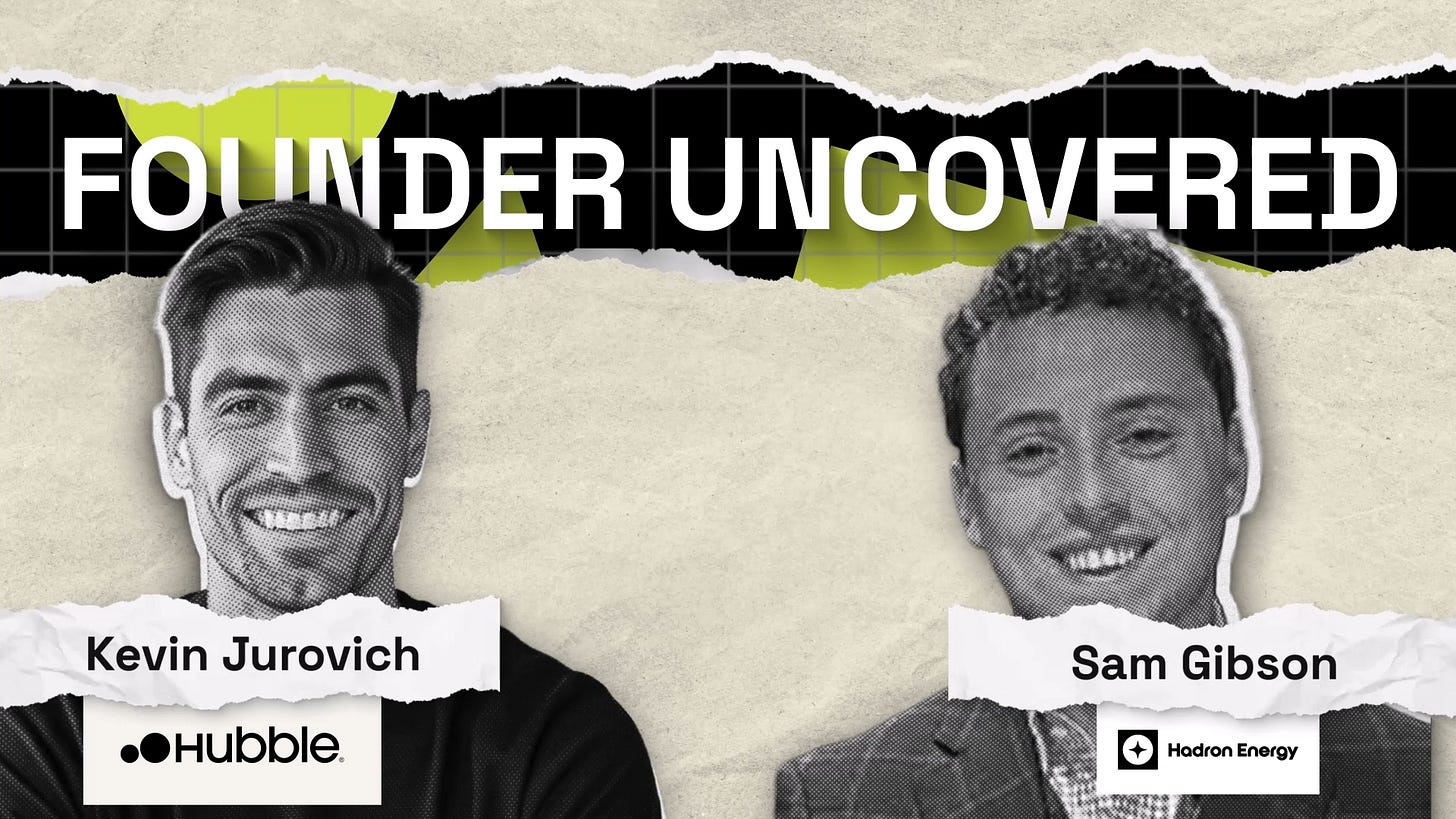
Sam Gibson left a stable engineering job in Kansas City with $10,000 in his bank account and a plan to build a miniaturized nuclear power plant. Two and a half years later, his company is merging with a publicly traded entity at a $1.2 billion valuation. The story between those two facts is the one worth telling.
A Cold DM and a Calculated Leap
The first move Sam Gibson made toward building Hadron Energy was sending a direct message to a founder he had never met. He was living in Kansas City, working a steady engineering job, and describing a business idea that even his eventual mentor, podcast host Kevin Jurovich, privately filed under “crazy or genius.” Kevin, a founder himself who makes a point of responding to early-stage builders, got on a phone call with Sam. Then another. Then several more.
“I thought you were partly crazy,” Kevin admitted during their recent sit-down on the Founder Uncovered podcast. That was in 2023. Sam was 22 years old.
By July 2024, Sam had packed his car and driven to what he thought was the Bay Area’s promised land. He landed in East San Jose, a neighborhood Kevin described diplomatically as “the opposite of quintessential San Francisco,” and signed an Airbnb lease that doubled as his founding office. He officially incorporated Hadron Energy there, with roughly $10,000 to his name and no investors yet on the cap table. The first check he received was $2,000. He took it.
What Hadron Actually Builds
Hadron Energy is developing what Sam calls Lightwater Micromodular Reactors, a compact nuclear power system that produces 10 megawatts of electric output, enough to power 10,000 homes simultaneously. The company is targeting data centers, critical infrastructure, and remote communities as its first customers, positioning clean nuclear energy as the most direct answer to what Sam describes as the defining constraint of the AI era.
“Power is the limiting factor for AI,” Sam said. “When you’re talking to hyperscalers and data centers, that’s the most important thing.”
The company’s engineering headquarters remains in the Bay Area, where Sam draws from a hiring pipeline anchored at Berkeley and other regional universities. Sam himself now lives in New York City, where he leads the capital markets work for the company’s pending NASDAQ listing.
To date, Hadron has raised just over $8 million across pre-seed, seed, and a small Series A. The company is currently merging with GigCapital7, a Special Purpose Acquisition Company (SPAC) with $212 million in trust. Bankers have valued Hadron at $1.2 billion. Sam expects net proceeds of approximately $200 million after what he anticipates will be a low redemption rate, plus an additional private investment in public equity (PIPE) raise he is actively leading.
The Builder Behind the Company
Sam’s background is in mechanical engineering and engineering leadership, which explains both how he got here and how he thinks. He does not describe himself as someone who woke up one morning with a billion-dollar idea. He describes himself as someone who always knew he would start a company and spent years building toward the moment when it made sense to stop preparing and simply move.
“There always comes a day when you have to stop studying and just make the jump,” Sam said. “There’s always the analysis paralysis where you get stuck in a loop of doing constant research. There’s something to be said about trusting your instincts.”
At 24, Sam leads a team that includes engineers and professionals significantly older than he is. He addresses the age dynamic with a straightforwardness that reflects how he approaches most things. “If you surround yourself with the right people, age doesn’t matter,” he said. “There shouldn’t be an age requirement for success. I don’t subscribe to that mentality.”
His personal routine reflects someone who treats operational consistency as a professional edge. He goes to bed early, wakes up early, and keeps regular dinner hours. He called himself “an old soul” with a laugh, but the point underneath the joke is a genuine one: he structures his days to protect his capacity to work.
Two books he returns to are Robert Greene’s “The Laws of Human Nature,” which he recommends for any founder navigating investor and team relationships, and “Meditations” by Marcus Aurelius, which he credits with shaping his long-term mindset. “If you have the right mindset, you can do basically anything,” he said.
How Survival Became Scale
The hardest stretch of the Hadron story is not the merger or the regulatory meetings in Washington. It is the months between Sam’s first $2,000 check and the point when checks started arriving fast enough to keep the company alive.
“I started the company when I had like $10,000 in my bank account,” Sam said. “Many months later, I had $20,000 and I’m like, I’m going to be patient. We’re going to keep pushing. There were many times where I felt if I don’t receive this investor check, this is going to put me in a really hard spot.”
He does not frame those months as a crisis he survived. He frames them as the natural cost of operating at the idea stage in a capital-intensive industry during a difficult fundraising environment. What kept him moving was a belief that persistence in the right direction compounds over time. The first round target was $500,000. It took longer than he expected, but he closed it through friends, family, and former colleagues. Then the checks grew. A $100,000 investment. Then $200,000. Then several at $500,000. Then the first million-dollar check arrived.
“It’s a lot of work and legwork to get from the early day angel checks to the more institutional, sophisticated investors,” Sam said. “Those are the folks we’re talking to now.”
The regulatory side presents its own sustained challenge. Nuclear energy requires ongoing engagement with the Nuclear Regulatory Commission, the Department of Energy, and other federal bodies. Sam travels to Washington frequently, describing the process as one that rewards consistency and direct contact. “It’s about showing up and having boots on the ground, face to face interaction,” he said. “That is really what drives the ball forward.”
He described the diligence process behind the SPAC merger as something he will never forget, and not because of the valuation number. “I cannot believe how much diligence went into that merger and going through the process,” he said. “It was obviously very exciting.”
What the Next Chapter Looks Like
Sam’s goals for 2026 center on completing the NASDAQ listing, scaling the engineering team, and making measurable progress on the licensing work that will eventually allow Hadron’s reactors to connect to the grid. He also wants to build the brand into something recognizable beyond the capital markets audience currently paying attention.
“I really want to make Hadron a name brand so that when people think of clean energy, they think Hadron,” he said. “A nuclear reactor is pretty complex, but what we’re doing is trying to make it as simple as we possibly can for the average person to understand.”
The mission framing is consistent and specific. Sam has repeated throughout this journey that the valuation and the capital story are tools, not the destination. Putting reactors on the grid is the destination. Everything else is infrastructure toward that goal.
When Kevin asked Sam what personal quality he credits most for how far Hadron has come in under three years, Sam did not hesitate. “I am very stubborn and very persistent,” he said. “If you truly believe this is the right way, you stick to your guns. Naturally, people will follow that the longer you do it. I know for a fact where I’m going. It’s a matter of if this person wants to join.”
That is not the language of someone chasing a valuation. That is the language of someone who once sent a cold DM from Kansas City with a nuclear energy idea and a very clear sense of what came next.
This season is supported by Perkins Coie. Perkins Coie is a leading international law firm known for providing high-value, strategic solutions. The Emerging Companies and Venture Capital team counsels startups and the investors who back them, supporting clients from formation to exit. In the past three years, clients have raised more than $23 billion in private markets between the pre-seed and growth stages. Perkins Coie combines tailored counsel with sector experience, so when it’s time to accelerate, whether for the next financing round, a strategic deal, or going public, your team is ready. To learn more, visit perkinscoie.com
More from Uncovered Media





Read the full transcript
0:00 You're gonna get listed on the NASDAQ. What's that? What's your company? What's the valuation? The bankers that we're working with, they've valued our company at 1.2 billion. And it's obviously an exciting number. It's fun. Did you cry when you heard
0:18 that? I was honestly, it was right on the mark was what I thought it was going to come back to. One of my favorite sayings is the harder I work, the luckier I get. And that's what I would say happens. I love that. We are the music makers and we are the dreamers of dreams
0:39 . Come along. I'm Kevin Jervitch. Welcome to Found Air Uncovered. The show about those brave enough to dream big and bold enough to swim away from the safety of the shore. Here, we dive into the origin moments
0:55 before the noise, before the spotlight, back when it was just a vision, a hunch , and a founder crazy enough to chase it. For all the dreamers listening, this is where your story begins. Perkins Cooey is a leading international law firm known for providing high
1:13 value strategic solutions. The emerging companies and venture capital team councils, startups, and the investors who back them, supporting clients from formation to exit. Before we jump into today's episode,
1:29 I want to give you a quick little heads up and share some backstory. When you start listening to the interview, you're going to notice pretty quickly, Sam and I are both pretty laid back. Because of that, the conversation definitely settles into a low key chill vibe. But I'm telling you,
1:45 be sure to stick to the entire episode because what Sam is doing is truly amazing. The wild part is he's only 24. To give some context how we met, Sam actually reached out to me out of the blue in a LinkedIn DM. At the time he was just out of college from the Midwest and
2:04 had a mechanical engineering background. I decided to take a chance on him. I DM him back and about an hour later, we were on a phone call and I was walking around my hometown listening to this crazy idea. 99% of the stuff he was talking about was flying over my head. I even remember
2:21 getting off the call, thinking to myself, "This guy's either crazy or a genius." And I don't know which one it is. We kept doing these monthly check-ins. I really started to like the guy. He was genuine,
2:36 crazy passionate and I could just tell in my gut he was really onto something. Fast forward to today, it's insane what he's accomplished in just a five-year window. He's literally building mini nuclear power plants that not only power tens of thousands of homes, now
2:53 they're powering data centers. This company is commercializing and valued at over a billion dollars with a B. It's pretty crazy to say this. Despite all that, he still hasn't changed a bit. He's literally just
3:08 a normal, humble, smart, quiet guy. I'm crazy proud of him. I know you're going to enjoy this story and journey. So kick your feet up, stick around and enjoy my conversation with Sam. Dude, it's so good to see you, man. Crazy story. Why don't you tell everybody
3:29 how we met? Yeah, yeah. So starting out, I was working in Kansas City at the time. I'm from South Dakota, so the Midwest and was working at this job that maybe I wasn't super excited
3:49 about and ultimately had this crazy dream that I was really wanting to move out to the Bay Area and follow this dream. So I came across your profile and saw the work that you did. I just said, "Hey, why don't I just reach out to Kevin and share what's going
4:10 on? I have this passion for what I'm doing and I have this idea. I want to chase." And so lo and behold, I was very surprised that you responded and we set up a phone call and we started
4:27 texting from there, got in touch and then you were like, "You have to move to the Bay Area. You got to do it." And just little not in like that, I think, are what's really important to follow exactly
4:42 what you need to do. So that's a little bit from my perspective, but what about from your perspective? How do we meet? I don't remember how many years ago it was, but basically Sam DMs me out of the below. And I don't want to say I'm the most popular person
4:59 ever, but I do get a lot of DMs. And there was something even in the DM. I don't remember the exact words, but it was just super authentic. And I think you even mentioned something about maybe being a student or just like wanting to start a company and I read it, I responded. That was at a time
5:17 in my life and I still try to do it, but it was a time in my life where I really tried to respond to like any single founder because anybody who started a company knows most of the time it's hard and in the beginning, it sucks. Once you start to win, it gets a little bit more fun. So I have a lot
5:33 of empathy, like most founders do for other people that want to start stuff. But I remember that first call, like, you know, we connected, you sent me that DM, and then you went on to talk about this crazy idea that I knew nothing about. And I would love for you to like jump in and
5:51 tell the world like what your idea is because it's truly incredible. But I remember like after that first call thinking did this dude is crazy or he's genius. And I think I told you this like on the third call that we had, but basically like, yeah, once every few weeks, you and I would
6:08 talk for like an hour. And yeah, man, we're going to get into where you're at today, but I'm so proud of you. And why don't you tell us a little bit about your company? I want to learn more about it. But yeah,
6:23 what do you got? Of course. Well, it's a great transition here. We're doing some pretty exciting things right now. The company is called Hadron Energy. I'm the founder and CEO. And Kevin, as you mentioned, I think we I think we got in touch back in like 2023. So it's been
6:40 like a few years and I officially moved to the Bay Area in July 2024. Like you, I packed everything in my car and drove off to San Francisco, the Promised Land. But you actually didn't land in the
6:57 Promised Land, you landed in East San Jose. Yeah. Only in the Bay Area, the East San Jose is think about quintessential San Francisco. East San Jose is kind of the opposite . The reason I landed there was I got an Airbnb, which is actually where I
7:17 incorporated all of Hadron. And I was just trying to find my apartment, get to know the area a little better, and little did I know Kevin was letting me know I was in a kind of more of like a dangerous part of town. So it was pretty funny. That's mildly fun. Yeah, yeah, mildly fun. Yeah.
7:37 So yeah, but the founding story is pretty fun and exciting for me to look back on. But at high level Hadron Energy's building, they're called light water micromodular reactors. And it's a miniatur
7:53 ized nuclear power plant producing 10 megawatts of electric, which that can power 10,000 homes simultaneously, 10 year refueling cycle. And my background is mechanical engineering, engineering leadership.
8:08 And we, yeah, as we'll get into it a little bit, have developed a company pretty rapidly. A lot of engineers were hiring from Berkeley from various schools in the area.
8:23 We have our engineering headquarters in the Bay Area still, but I live in New York City. And happy to provide some more updates there. But at a high level, that's what we do is we're providing carbon-free power for data centers, critical infrastructure, remote communities. And yeah,
8:43 I can get into the details too. This sounds like so technical for me. And for most people that don 't know anything about energy, it's like Mandarin or Chinese. How, how, because I remember when you would tell me about this. And in the back of my mind, we already talked like I thought you
8:59 were partly crazy. How are, how are you like sim? And I know you have an awesome team now, but like, how are you able to pull this off? Because we're going to get into like where the companies at now eventually. And some of these things that I've been able to see and talk to
9:14 you about. But how come PG need didn't pull this off? Or how come one of these huge conglomerate company energy companies didn't pull this off? And how come, and how are you guys able to do this? That's a good question. I feel like it's the very much the classic startup
9:31 story of the large incumbents move very slowly. They're highly bureaucratic. All it takes is one disruptive team to come in and, and take over, you know, and really the biggest
9:47 thing is there's never been a time like today because the demand is so incredibly clear for power. And the biggest thing is with, you know, everything AI, it powers the limiting factor for AI.
10:03 So that's something really important as we talk to all these hyperscalers and data centers. But the reason I bring this up, the timing has never been better. Public perception is at all time highs. And for a fast moving startup,
10:19 you can kind of grasp onto that a lot quicker than sort of the larger companies . Even if they have far more resources, that's how we've been able to essentially outpace, you know , some of the developments of others is because we move very efficiently.
10:36 That's awesome. And you know, one thing I've never told you, and I'm going to look you in the eye and tell you right now, I'm so proud of you. How? Because I think there's a lot of people out there. I fell into this bucket. It's like, I remember you were working that job in Kansas City.
10:52 Yeah. Yeah. It's a, it's a good, like, it was a great engineering job. It's just, I always knew, I had it in my heart in mind that I was going to start a business. I always knew from a very young age. So there's nothing wrong with the job. It was more like,
11:09 I know I could do so much more. And being a founder enables you to leverage every ounce of your skill set. You know, you have to put everything you have into it. Yeah. What do you think like
11:24 that one moment was when you're like, dude, I'm out of Kansas City, like, I'm going to go do this. And the thing is, like, the thing that you're building is not just some SaaS tool, right, or like some super basic marketplace. Like what gave you the confidence to say, I'm leaving not only my
11:41 steady job, but like the hometown, and I'm going to dip to San Francisco or East San Jose, where you started. Yeah. What gave you the confidence that you could actually pull this off, and then you ultimately, you know, pulled the trigger? Yeah, I think there always comes a day when if
11:58 someone's looking to start a business, you have to stop studying and just make the jump. Because there's always the, you know, analysis paralysis where you get stuck in a loop of doing constant research of, well,
12:14 how do I do this? Well, how do I do that before I get into it? And there's something to be said about trusting your instincts and trusting that it'll work out for yourself, making that big jump. That is the most important step to the whole journey, because most people
12:31 probably wouldn't make the jump. And yes, there's there's risk involved, but the way I look at it, there's far greater risk involved if you don't take the jump. And I think on day one of declaring,
12:46 like, I'm now a founder, I'm going to do this for myself and for the community and the world, then that's when you really can rely on, again, yourself, you steer your own ship. That's where I think the real impact is made. I love that point. You know, I
13:05 think a lot of founders think, oh, you have had it all lined up. It's all figured out. Literally, I've actually never met a founder that had it all figured out or had the playbook perfect before they took that leap. It's really this kind of mindset of like, say yes, the best people I've
13:24 ever worked with, the best founders I've ever seen, they say yes. And then they step into the roles that they're not fully prepared, actually to execute on. But that forces you, it's a nice forcing function to grow and to be better and to learn. And you rise to the occasion, I think us as
13:41 humans and founders were crazy resilient. You know, we're also a little crazy, for sure. Because leaving the shore and like swimming off into the abyss of the ocean is wild and it takes a special person. But I think the thing that you hit on that's so important is like, you didn't have
13:58 it all figured out. You just had that belief inside of you of like, I know this is here is not going anywhere. I got to go chase it, you know. And one of the things that's been so cool to me is how will do you, by the way, I'm 24 right now. And I, yeah, I'll turn 25 in May.
14:15 So Sam is 24 years old. Yeah, the amount of people that I see working at your company, the gray-haired folks, just the older, more established professionals. How is it working and
14:30 hiring and them working essentially for you? Like, and sometimes these people are two or three times your age. Like, how have you dealt with that? Yeah, well, it's a good question. And the funny thing that I'll poke fun at myself, I consider myself like an old
14:46 soul, if you will. I'm like a kind of like an old man. I go to bed early. But yeah, I mean, I go to bed early, I wake up early, you know, I have really early dinners. And like, this routine
15:03 is really important for just getting in the groove ultimately. But I think at the end of the day, if you surround yourself with the right people, age doesn't matter. And frankly, I never think it should. There shouldn't be limitations. There shouldn't be an age requirement for
15:20 success. I don't subscribe to that mentality. And I think a lot of people should follow suit that you can be successful at any age. And you know, it's clearly showing that if you just
15:35 follow what you believe in and you're very persistent, then good things will follow as long as you're heading down. Obviously, you have to pivot every now and then. But if you go in the right general direction, then the right team will notice that. And I think that's the most important.
15:53 Was there a moment like in the last, you know, three years since you moved higher, was there a moment where you're like, Oh, shit, I'm screwed. Or like, hey, this is the dead end. Or like, how are we going to get this regulatory body to like,
16:08 approve this thing? Was there ever a moment in time or moments when it felt like this is the end? Yeah, that's a good question. I can tell you that I always
16:24 knew it was a matter of persistence. And the way I look at it is the long game. I think if, as a founder, if you can get past the first year and be successful, you're in a really good spot because in a lot
16:42 of cases, it's more about surviving than it is hitting like something massive right away. If you can, if you're in the right industry at the right time and you're staying alive, that's perfect. For my case, I would say the biggest problems in the very early days was at the
17:02 idea phase, it's incredibly hard to raise funds. And it's not maybe the most favorable fundraising market right now. So I remember when, you know, I started the company when I had like $10,000 in my bank account. And many, many months later, you know, continuing
17:22 operations and we were successful growing. But even many months later, I had $20,000 in my bank and I 'm like, well, I just, I'm going to be patient. We're going to keep pushing. And there's many times where I felt if I don't receive this investor check, like this is going to put me in a
17:39 really hard spot. But nonetheless, very, you know, very much persistent and remained on track. And I think that's what enabled me to achieve that first year. And after that, that's when I saw a
17:54 massive wave of exponential growth. I remember when you were like raising your first round, I don't think you like announced it to me, but because you would send me text messages when you would get like a new investor. And I remember because raising money is hard in any environment,
18:13 right? Like, maybe boom times, valuations are higher, it's still hard to get capital for businesses, unless you have crazy traction, or crazy technology, and an incredible team and story. But I remember when you were texting me and all of a sudden it felt like it was
18:30 a wave. Remember, you're like, you've got 100k investor, you've got a 50k investor. And it was like every week, there was like two or three, four or five. And then I think like, correct me if I'm wrong, but I remember like within the span of two weeks, you guys have like raised a couple hundred k
18:46 and it's sort of off to the races. How much did you guys end up raising in that first round? And what was the like for you on your side? Yeah, so the first round was very much the friends and family, which is where I always recommend starting. And I know I think you
19:01 offer a similar point of view on that, rather than going the venture capital route. Because this, I think really streamlines the access, you know, your friends and family know you, and even just past colleagues, there's a lot of ways to raise early capital.
19:17 My target in the early days was to raise 500,000. It took much, much longer than I thought it was going to take. But we got it done. I don't recall the exact timeline that it took. But then after that,
19:32 we started, as you were mentioning, started receiving much larger investments. We would get 100, 200, and eventually we got a few $500,000. And then we got a few for a million and it kept growing. So I can tell you the latest, you know, the first investment I ever
19:52 received was a $2,000 check. Most recently, we received a million dollar check. As I was mentioning, this obviously did not come easily. It's a lot of work and light work to get from the early day angel checks to the more
20:08 institutional, very sophisticated investors. And those are the folks that we're talking to now. And that's been my favorite part is learning about this, you know, old capital market side of things. My background in engineering, it's what I'm very passionate about the
20:24 capital markets and understanding how we can capitalize the, you know, clean energy industry. So that's what's been fun for me. 24 years old, getting a million dollar checks. And as I'm hearing your story, I have a
20:39 little egg on my face because I could have invested early. And I didn't. It's okay. It pains me. I didn't know it was 2,000. Was that the minimum? No, that was just, I was accepting basically whatever I could get in the early
20:56 days. Why don't you tell me this? So yeah, you know, it's all part of being a scrappy founder, as you know. It's not like a, it's not going to be like a textbook solution, step by step.
21:14 In fact, instead of it being a few steps, it looks like a crazy, you know, random process, honestly. Yeah. You raise like 900k as a pre-seed and then most recently we're closing 4
21:31 million dollar seed round. If there's one thing, you know, I always say this as a founder CEO, you kind of like three core things, right? It's like set the vision of the company, you know, hire great people and don't run out of money. And those are all hard to do.
21:48 Raising the money part is definitely, at least in my experience, painful because you're like not talking to your customers, you're not focused on your product, you're not like growing your business. You're like doing these sales calls was what it feels like, which is obviously
22:04 important. You have to have capital and oxygen in your company to build the thing that you 're trying to build, but it sucks. It's painful. People say no a lot. There's a lot of that that comes with it, but what's the total raised to date?
22:20 Yeah, so total, I believe we've raised just over 8 million dollars ahead of our listing with the SPAC. So it's been, I consider it like, you know, we had a pre-seed seed and like a
22:36 small series A ahead of this listing. So the listing we're emerging with good capital seven and they are publicly traded on NASDAQ. They have 212 million dollars in their trust account.
22:54 And we are optimistic based upon, you know, what we're seeing, we believe based on industry trends as well that redemption will be very low. So I expect our net proceeds to be about 200 million in addition to this pipe
23:15 raise that we're doing. So that is essentially what my main focus has been on. Can you explain this a little bit to me because that's something I'm not familiar with. So you guys got acquired or you merged merging it, you're going to get listed
23:32 on the NASDAQ. What's that? Your company. What's the valuation? Yes, the bankers that we're working with, they've valued our company at 1.2 billion. And it's obviously an exciting number.
23:49 It's fun. But did you cry when you heard that? I was honestly, it was right on the mark was what I thought it was going to come back to because they mostly do, you know, industry comparison.
24:04 Personally, I can tell you for me while the valuation and fundraising is, it's rewarding. I'm very mission driven. The most important thing for me is putting reactors on the grid.
24:20 I know that this is part of the story, but I can tell you that it was, it was obviously very exciting. It was a lot of, I cannot believe how much diligence went into that merger and doing the,
24:35 you know, going through the process and it was, yeah, it was something that I 'll never forget, that's for sure. I know like in this AI world, we can like get numb to these billion dollar
24:50 valuation so quickly, but like, and I love the fact that you said you're mission driven. I think like any founder out there, if you're starting something for the money, you're going to quit before you ever achieve any level of success.
25:06 But in saying all of that, man, like think about, like we just talked about that first DM 2023 and here we are sitting like barely in the 2026. So it's not even three years, two and a half years, let's say, you ever take a
25:21 second and just take a step back and be like, I can't believe what the hell just happened. I can tell you that I think about, I'm incredibly grateful and it's not to say
25:37 it's without its sacrifices as well. As you know, being a founder is incredibly demanding. It requires a lot from you and a lot of attention and, you know, moving to San Francisco as
25:52 you know, kind of on my own as a solo founder to start and getting everything to where I thought it could be successful. It's all about timing as well. I mean, that's one of the most important things. One of my favorite sayings is the harder I work, the luckier I get and that's
26:11 what I would say happens. I love that. Yeah, man, if we're not working hard when the opportunity presents itself, doesn't mean you're going to be successful, but if you're not working hard, the odds that you will are
26:26 basically zero when you put in when you put in the work, you have an opportunity potentially to be successful when that opportunity or that piece of luck comes your way. But yeah, we, Sam and I got a chance to meet for the first time in person, it's
26:42 probably like four months ago, maybe something like this, got to see him in San Francisco, got to take a selfie. Yeah, it's been sick. Now is home for you San Francisco or are you in the East Coast or where are you at now? Yeah, I live in New York City full time now, leading the public markets
27:01 transaction from there, meeting with various investment banks and the investment community because they have obviously very extensive public markets network there.
27:16 So that's been really fun for me. I always knew I wanted to have a presence in San Francisco and New York. I lived in San Francisco a little over a year and then I made the move to New York August
27:31 of 2025. So yeah, it's been. Are you in the East Coast guy or West Coast guy? It's so hard. I really like them both to be honest with you. For different reasons, the West Coast, you cannot beat the scenery.
27:48 I love the nature and having my car is awesome because I can't have that in New York. There's pros and cons. I mean, both have amazing food. It kind of comes down to the culture. I think it depends what stage you are as a founder.
28:07 I go wherever the best opportunity is for me at the current stage. For me, there's no better place to start a tech company than the Bay Area. And I think always having a footprint there is very important. Our engineering headquarters is still in the Bay Area.
28:24 So as you're talking and I'm thinking about, you know, people say all the time, I want to start a company. Think about like the story you just kind of told, right, from the Midwest reaching out to me via DM, getting up the courage eventually to move on your own.
28:40 You're like 22 years old. You probably have no money in your bank account. Moving into East San Jose, it's like the roughest neighborhood in the Bay Area or one of staying there for a while, then getting all your stuff, packing it in the car, driving it up to San Francisco and like knowing nobody, right?
28:57 And now you're living in New York. Now you went from to the West and now you packed up everything. Now you're in New York making it happen over there and like, that's a sort of all-in commitment that you need, you know, it doesn't mean you have everything figured out. Like we talked about earlier, it's not about having the whole roadmap and the
29:15 whole guide to success is never that. But the fact that you put yourself out there, when maybe you weren't ready or you didn't know anybody or you didn't have any money in your bank and you found a way, I wish and
29:30 I hope more founders realize that's what it takes. You know, that's the sort of bet, I guess, on yourself that successful founders take. And yes, it doesn't always work out, but life does have a funny way of working
29:46 itself out. Like even if it didn't go perfectly as planned, when you take those sort of calculated bets and you go for it and you chase after what's in your heart, good things always happen, right? They really do. What do you feel like in, it's the new year, I know with my team, we just
30:01 planned out all our goals and like, here's what we're going to accomplish. What does that look like? You know, for you guys, you're over a billion dollar valuation, you're going to get listed on the NASDAQ, you have this merger that just is happening.
30:17 Getting back to maybe like the mission of your company, like what is 2026 look like as far as the impact you guys are going to have and what are you excited about? Yeah, there's a lot to be excited about. And I would say the biggest focus for me, you know, getting this listing
30:34 through and really starting to share the story on a much larger network and getting it out there, I really want to make Hadron a name brand so that when people think of clean energy,
30:51 they think Hadron because it's something simple that people can understand. As you know, nuclear reactor is pretty complex, but what we're doing is trying to make it as simple as we possibly can to, you know, make it understandable for the
31:09 average Joe. But in terms of actual progress and goals and things, I really want to significantly scale up our team. And we're going to make a significant amount of engineering and licensing
31:24 progress. That's the most important in this industry is working with the regulators. So I'm always going to DC as well, I'm going to DC in two days. So I meet with the Department of Energy, I meet with the Nuclear Regulatory
31:40 Commission. I've even met a few times as the Department of War now. And it's like you're saying to Kevin, it's I think most of the time it's about showing up and having boots on the ground face to face interaction.
31:56 That is really what drives the ball forward, I think. That's incredible, man. When you look back on your journey, what's one thing that sticks out? I know it's just started, but it's already, you've already climbed like crazy high and I know you still have lofty goals, but what sort of attribute about yourself or
32:15 your decision making that you kind of attribute this success that you've had at such a young age? I would say there's two things I am very stubborn and very persistent. So even though, and the thing is, like you're saying too, to make very like
32:32 calculated decisions, if you truly believe this is the right way and you need to kind of stick to your guns a little bit and say this is what I'm going to do, and naturally I think people will follow
32:47 that. The longer you do it over a very extended period of time, I think the more it grabs hold of people and the message becomes clear. But I would say, Kevin, I was listening to your interview and you're mentioning
33:07 how founders talking to 50 investors, they'll likely all say no. Believe me, I don't even know how many times I've been told no. It doesn't even phase me because I know for a fact where I'm going, it's a matter of if this person wants to join.
33:24 I love that, I love that man. I'm so proud of you. And I think mostly the fact that you're working on something like this and the impact it's going to have in society is awesome. It's like you're not working on, not to hate on Tinder, but there's not another
33:41 dating app, right? Yeah. So I think that's so cool. I've been lucky to have kind of a front row seat on the last two and a half years and dude I'm pumped to continue to have this front row seat on the next two and a
33:57 half plus. It's been an honor man and glad that we hopped on this pod before we leave. One or two books you've read in the last year that most impacted you as an entrepreneur as a founder.
34:12 Oh, this is a really good question. Half of, I would say if not half the vast majority of being a founder is being a good salesperson. So understanding human nature, Robert Green, the laws of human nature, that's
34:29 an incredible book. And just generally for your mindset, I didn't read this one recently. I read it a while back, but it's always stayed with me as meditations by Marcus
34:44 Aurelius. So I highly recommend those two books mostly to have the right mindset. I think if you have the right mindset, you can do basically anything. I love it.
34:59 And in the beginning of the pod, there's a, there's a, there's a quote we didn 't hear it, but it's in the in show. We are the music makers and we are the dreamers of dreams. And man, you totally amplify that and I'm going to be rooting for you.
35:15 Don't wait to see what happens with you and the company and yeah, man, next I'm in New York. I'm going to hit you up. Of course. Thanks so much, Kevin. And when we look to ring the bell, I'll shoot you an invite. Ah, dude. Love it, man. It's awesome. Yeah.
35:30 Thanks for coming on. Thanks so much. Appreciate it. Thank you. Thanks for listening to founder and covered. If you found this conversation helpful, please follow the show notes so you don 't miss out on next episodes. We also have a newsletter where we profile early stage founders sharing
35:45 tactical and advice you can use right now. You can find the link in the show notes. One conversation can change everything. I'll see you next time. Perkins Cooey is a leading international law firm known for providing high
36:01 value strategic solutions. The emerging companies and venture capital team councils, startups and the investors who backed them, supporting clients from formation to exit. In the past three years, clients have raised more than $23 billion, with a B in
36:17 private markets between pre-seed and growth stages. Perkins Cooey combines tailored counsel with sector experience. So when it's time to accelerate, whether for the next financing round, a strategic deal, or even going public, your team is ready to learn more, visit PerkinsCooey.com.
Transcript generated automatically; it may contain errors.
Originally published on Founder Uncovered · By Kevin Jurovich