The CleverTap Big Leap - FTW NYC
Three Fintech Marketing Leaders on what changes when AI agents replace browsers, trust replaces funnels, and taste becomes the last competitive edge.
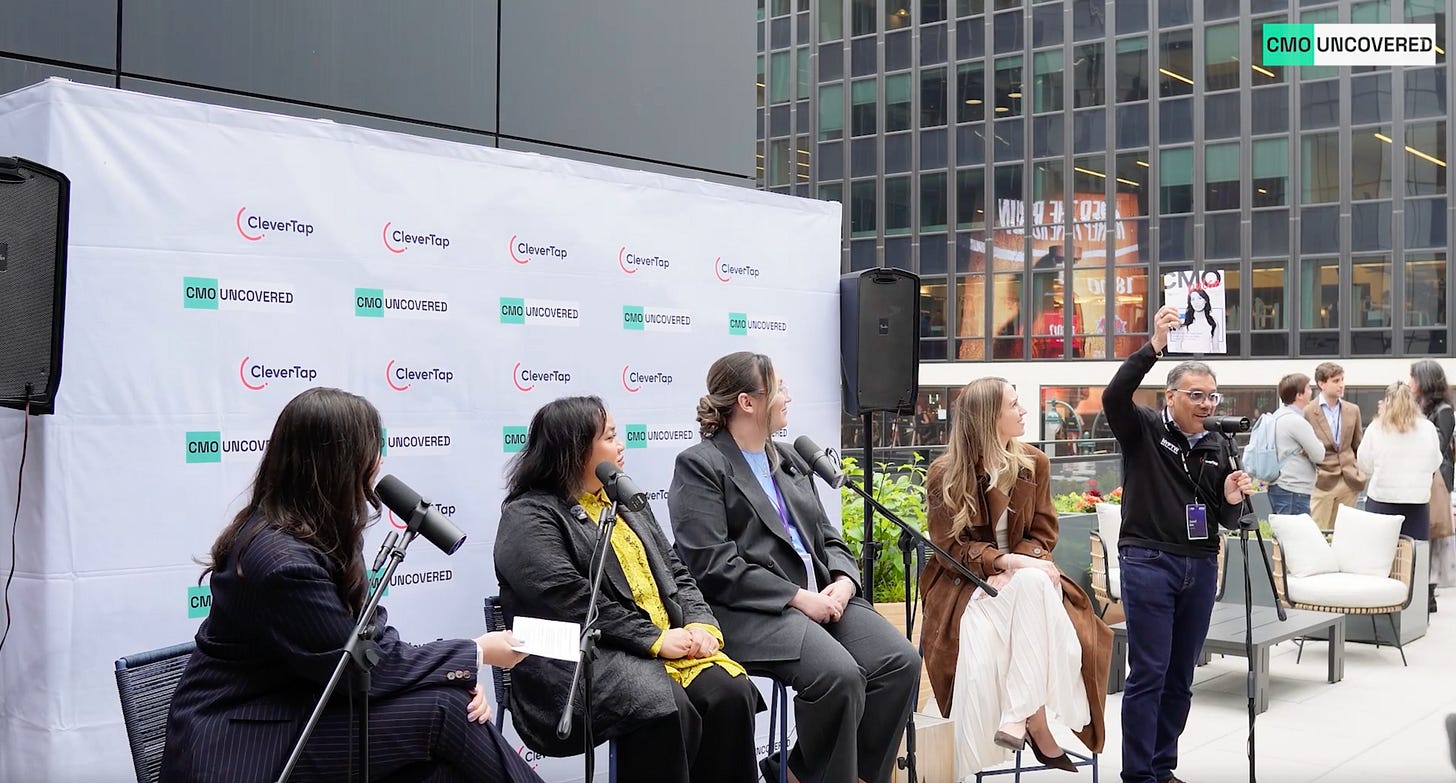
Ashley Kiolbasa didn’t hesitate when she told a crowd gathered on the rooftop terrace at 2 Penn that the rules of marketing have been rewritten.
“We as people have stopped browsing the internet completely. We’ve offloaded that chore to AI without even thinking about it, and that fundamentally changes the customer journey.”
She was one of three marketing leaders on stage at the Big Leap VIP Experience during New York Fintech Week, where CMO Uncovered recorded a live panel conversation sponsored by CleverTap. Nicole Casperson, Founder and CEO of Fintech Is Femme, moderated an ESPN-inspired round robin panel designed by Drew Glover, Co-Founder of Fiat Growth:
5 provocative topics
3 operators
0 rehearsed answers
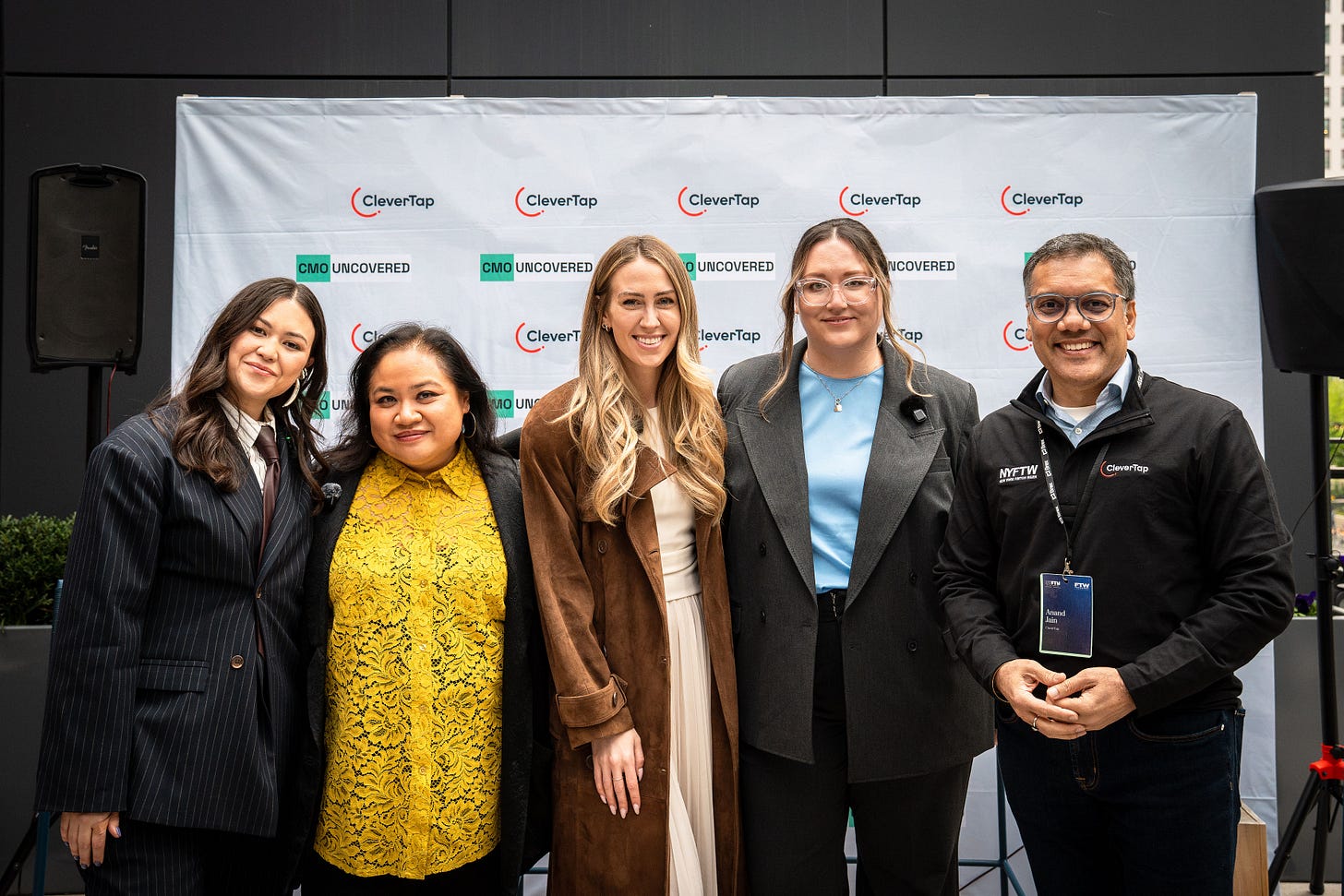
The panelists: Veronica Mendoza, VP of Growth Marketing at Betterment, an online investment platform making financial advice accessible and affordable. Kathryn Flynn, VP of Marketing at Zip, a buy now, pay later company focused on serving America’s underserved population. And Ashley, the CMO of Prove, a digital identity company that helps businesses verify people are real.
Before the panel kicked off, Anand Jain, Co-Founder of CleverTap, took the stage to mark Big Leap’s second year. “In the world of notifications, emails, everything that you can’t see and touch, we have launched a magazine,” he said, holding up CleverTap’s first print publication to cheers from the crowd.
Your Next Site Visitor Runs on a Large Language Model
The opening topic was blunt: AEO is the new SEO. The panel agreed, then pushed further.
Veronica set the frame. “AEO is not just the new SEO, it’s the new search, sort of wholesale,” she said. “People are using LLMs as their entry point all the time.” Marketers now need to show up in the conversational layer that LLMs pull from: Reddit, review sites, and press. “If you’re not there, you’re just gonna be missing entire swaths of users.”
Kathryn split the challenge in two. Human discovery still works the way it always has: great content, consistency, brand work people talk about. But agent discovery is a different problem. At Zip, her team is preparing for a world where autonomous agents make purchases on behalf of humans. “For us, it starts with governance. It starts with security,” she said, pointing to trust frameworks and identity preservation.
Ashley landed the point with a specific example. Her team at Prove adopted Scrunch, an AI search optimization tool, to monitor how the company appears in LLM-generated responses. One finding caught her off guard.
“Last week I learned that our competitors were being cited more often because they have Wikipedia pages. Now my team has the mandate to go create a Wikipedia page, which I can’t imagine having asked them to do six months ago.”
High-Trust Channels and the 3X Content Play
The second topic tested whether the traditional funnel is dead.
Ashley reframed the question around trust instead of structure. What changed is not that the funnel broke but that low-trust channels cratered. “Some of the low-trust channels, cold outbound, have gotten so bad that we feel comfortable ignoring them completely,” she said. When she joined Prove a year ago, her first two investments were customer marketing and community, then partner marketing. “Whenever we can have a customer speaking on our behalf, we want to create that platform for them to do that.”
Kathryn had the data. Zip launched a customer ambassador program where real customers create content in their own homes, sharing honest takes on why they use the product. “We have seen such strong engagement rates to that content, 2X, 3X what we’re seeing from actor or static,” she said.
Veronica pushed back on calling the funnel dead. “Maybe not necessarily that it’s dead, but that we’re all reckoning with the fact that it was always kind of an oversimplification,” she said. At Betterment, she tracks account-based marketing prospects who move “two steps forward and one step back” through their journeys. The goal is to be present at every stage, not to force people through a linear path. She pointed to Betterment’s B2B campaign built around SpongeBob SquarePants, a nod to CEO Sarah Levy’s history as COO of Nickelodeon.
“B2B customers are not just B2B buyers. It’s important to respect that people could be sitting on their couch at night and see something amusing from one of your B2B solutions.”
Taste, Bravery, and the Sea of Sameness
When every team can generate thousands of assets with AI, the panel agreed: production is no longer the constraint. Differentiation is.
Ashley tied the challenge directly to Prove’s mission. “Authenticity really becomes the moat, and taste is how you build that authenticity,” she said. For an identity company whose entire purpose is helping people prove they are real, operating in a world of AI-generated content carries a specific weight. “We have no choice but to operate by that standard ourselves.”
Kathryn argued that taste extends well beyond campaigns.
“The brand is not just the campaign. The brand is how your product works. It’s their product working every single time someone goes to use it at a critical moment in their day.”
Veronica screens for taste during hiring. What she pushes her teams toward is bravery. “Can you not worry too much about what has worked in the past or looks the same as everything else?” she said. “Let’s take a big swing and learn fast because now we have the luxury of time.”
Don’t Shrink the Team. Multiply It.
The fourth topic pushed back on the narrative that AI-native marketing teams must be smaller.
Ashley cut through the noise immediately. “If your team does not look like five marketers and 100 agents, you’re fine. Normal,” she said. She called out a growing, unspoken pressure. “A lot of marketers are silently sitting in AI shame jail right now because they feel like their team should look different than it does.” Her team at Prove is 25 to 30 people, and she has no plans to reduce it.
“The things that move the needle right now still require humanity.”
Kathryn pushed the conversation to a structural level. “It’s rethinking completely how this team operates,” she said. “What is this team accountable for delivering? And where in that system does the human judgment need to sit?” As AI removes the resource constraint, the real challenge shifts to decision-making: teaching more junior people how to make strategic calls they have never had to make before.
Veronica described the AI-native org as resembling “the scrappy and lean startup marketing orgs of the past,” but with a meaningful upgrade. Marketers can redirect time from execution to strategy. “The question starts to become less of ‘can we get it all done’ and more of ‘are we doing the right things?’”
Attribution Was Never a Perfect Science
The closing topic was the most provocative prompt of the night: is attribution is a lie everyone keeps paying for?
Veronica did not need convincing. “I have always been an attribution skeptic,” she said. She started her career in search marketing at the dawn of pay-per-click, the clearest attribution line possible: last click to purchase. But as she moved up funnel, the clarity disappeared. “If any vendor was promising clarity, it felt very disingenuous to me. It would be based on a set of assumptions that were clearly going to be biased. There was never a perfect science here, and there has just always been a lot of hand-waving, and it was all in the pursuit of credit.”
Her solution: stop chasing perfect attribution and align with finance. “When we can align with our buddies over in FP&A on CAC, on ROAS, it gives you the freedom to play within those constraints and take the swings that you can afford to swing at,” she said. That alignment breeds better cross-team partnership because everyone operates toward one goal instead of fighting over credit.
Kathryn traced the problem back to its origin. “I blame the beginning of digital marketing for this,” she said. “CMOs were finally able to go to their CFO friends and say, ‘Look what we can do now.’ That was really exciting. That probably wasn’t very true then, and it’s certainly not true now.” The answer is not better dashboards. “It’s about unlearning that truth and relearning a new set of truths that are credible across your organization so that there is that collective buy-in.”
The panel also called out the structural incentive problem: media vendors report on the efficacy of what they sell in silos, and when CMOs try to stitch those reports together, the result is what one panelist called “a little bit of a house of cards.”
Glasses Up on the Rooftop
Nicole closed by asking the crowd to raise their glasses. “We went through the round robin. They were honest,” she said, noting with a laugh that the panelists were drinking water.
Across all five topics, every panelist landed in the same place: the tools keep changing, but the decisions that matter, what to prioritize, what to say, and how to earn trust, still belong to people.
Ashley put it most succinctly when describing the new reality of site visitors.
“In a world that runs on AI, the most important visitor that’s landing on your site now is not even human.” The challenge for CMOs is making sure the humans behind the strategy still are.
This season of CMO Uncovered is supported by CleverTap. CleverTap is the world’s leading engagement platform, helping brands build meaningful relationships through data-driven personalization. Powering over 2,000 customers globally, CleverTap’s AI-powered engine processes billions of data points daily to help marketers predict behavior and automate engagement at scale. From onboarding to advocacy, CleverTap provides the infrastructure needed to optimize every stage of the customer journey. For the CMOs building the next generation of iconic brands, CleverTap offers the precision and scale required to win in a crowded market. To learn more, visit clevertap.com.
More from Uncovered Media





Read the full transcript
0:00 We as people have stopped browsing the internet completely. We've offloaded that chore to AI without even thinking about it. And that fundamentally changes the customer journey. So in a world that runs on AI, the most important visitor that's landing on your site now is not even human.
0:16 And so that really changes the game. AEO is not just the new SEO. It's the new search, like sort of wholesale. People are using LLMs as their entry point all the time. And so influencing the sort of conversational layer,
0:33 Reddit, review site, press are like equally important in driving up the prominence of your brand. And if you're not there, you're just like going to be missing entire slots, I think, of users. I think the human judgment will always play a role
0:49 in successful organization because a lot of the strategic decision-making has been prioritization decisions, right? We have a limited amount of resources. We're not going to do this thing, and we are going to do this thing. Well, when that constraint goes away, then the decision-making piece of that becomes really important. AI has basically made content production infinite.
1:09 We call it AI slot. Every team can generate thousands of assets, so production is no longer the constraint. How does that change the role of the CMO? I'm actually going to go to Ashley first. Yeah.
1:25 Welcome to CMO Uncovered, which is proudly sponsored by CleverTap, the all-in-one engagement platform, helping brands turn customer moments into measurable growth. If you're serious about retention, life cycle marketing, and using AI to drive smarter engagement, CleverTap is the partner you want in your corner.
1:42 I want to thank everyone for coming to the second big leap put on by CleverTap. And also our live podcast here that we are doing with CMO Uncovered, which is the third podcast that we'll be recording,
1:57 and really excited to have such an incredible panel and incredible moderator as well. And I really just want to just give a little bit more insight into how this was created. Around eight months ago, we partnered with CleverTap to
2:12 think about a new way to build community and build conversations around growth, and not just the growth that works, but the things that we're struggling with, the different ways that we're trying to scale a business, and the many tests that we do and fail on
2:27 so we can quickly figure out ways to be really successful. And through that process, not only have we been able to build this incredible CMO VP Growth Mind Network, but we've also been able to build a deeper partnership with CleverTap.
2:42 And they've been an incredible partner, have really led the conversation on a lot of growth topics. And I just implore any startup in this room. If you are doing anything that touches growth or marketing, to have a conversation with them, learn about them, and really just join the larger growth community that we're building with
2:59 uncovered, and specifically CMO uncovered. So with that, I want to pass it over to one of their co-founders, Ananda, a close friend. And then after that, we will dive into the festivities. Let's do it. It's hot out here.
3:19 Hi, everyone. I really want to welcome everyone here. It's been two years. This is year two, and it's solid. I think like 10x bigger, like at least that's what it feels like. It's an incredible feeling to be here. Big leap is something that we built for operators and builders.
3:38 Right? It's not for spectators. It's a community of people that actually are practitioners who are building the next phase of growth, figuring out how to grow their respective companies, backed with data insights. And what's a better place than the New York Fintech week?
3:57 To launch it, we launched it last year here, and then we are here back again. This year, we are here alongside the big leap. We want to thank our partners, especially Fiat.
4:14 Thanks a lot for the partnership, for being there always for us. We have also done the CM1-covered podcast, and it's shaped up really, really well. It's a look forward to those episodes.
4:30 Please go and watch them. They're really full of insights. It's shaped up amazingly well. And I think the practitioners come and share things that you would not find written somewhere else. This is a candid conversation, and it's done very, very nicely. Also wanted to thank Fintech as a fan.
4:48 Thank you, Nicole. Thank you, Anton. This is something truly special for us, your partnership truly makes us incredible. And we are doing this right here in the heart of Madison Square Garden. I don't know, it's an incredible feeling for me.
5:05 This is one of the world's top arenas for all things. And to be standing here and doing this, it's an amazing thing. Today, we are also launching something physical in the world of digital,
5:20 like they say, swim against the current. In the world of notifications, emails, everything that you can't see and touch, we have launched a magazine. For real, you can take it back home. There's a copy for everyone.
5:37 Oh my gosh, whoa, that is so cool. Thank you. And this made this spark a thousand ideas, and feel free to share those in forums like these. And once again, I want to welcome you all. Thanks a lot, means a lot to me.
5:53 And have a great rest of the evening. And let's listen to the podcast now. Yeah, thank you so much. And I will say, first of all, as someone who long worked for magazines and is obsessed with physical magazines, still amazing. Second of all, that's our friend Katy Perry, for real, for real.
6:10 Third of all, I think you just have your next four cover stars. Yeah, are you going to keep making them? All right, I've only been on a few magazine covers, but I've never, never been on CMO uncovered. So I'm going to add that to my bucket list of things.
6:25 But in all seriousness, I also just wanted to share from our perspective at Fin TechIsFEM. Honestly, today became possible because it's a rainy day in November. It's San Francisco. I'm leaving the Fiat Growth Summit.
6:40 I'm walking beside Anan and learning more and more about CleverTap. At the same time, I'm telling Anan I'm talking his ear off about this vision I had, this vision I had to be the next era of New York FinTech Week, and to lead that through the power of storytelling growth community.
6:57 And when I told him all of that, he totally got it. From that rainy day walking outside to dinner together, to being here in real life, to being here in person, to having Nicole Patterson on stage with us in the main stage, in the big hall.
7:12 Yeah, to having Renal in our videos and our social and the face of some of the digital content, it's been an absolute pleasure. Like I said, New York FinTech Week was not going to happen without this partnership and this FTW experience, so just thank you all for being a part of it,
7:27 for seeing the vision early, and I can't wait to continue to grow together, and to continue to help FinTech grow in its new era of scale. So now that I've been on the Shigoshi, let's get into some fun. So we are going to do a kind of round the robin flow as Drew had designed it as
7:47 something in the world of ESPN. I'm not gonna lie, I don't sport, so I'm gonna do my best Drew impression up here, but excited to see how it goes. All right, I had some of this tequila.
8:02 All right, this is a happy hour, right? Okay, first question, topic takes. That's what we're doing, what in topic takes. Very different from previous cycles. All right, first thing, AEO is the new SEO.
8:17 We've spent the last decade optimizing for search, but now AI agents are researching, recommending, and even buying on behalf of users. First take, if your brand isn't showing up inside LLM answers, you're invisible
8:32 . Thoughts? Well, I agree. Yeah, I mean, I completely agree. I'd say I'd take it a step further and just say that AEO is not just the new SEO, it's the new search, sort of wholesale.
8:49 I think the search engine response page is less and less real estate that is accessible to brands. We've been getting pushed down for years, whether it's the organic search or the paid.
9:04 People are using LLMs as their entry point all the time. And so we don't need to abandon SEO principles completely. I think a lot of those still are effective and useful. You should be developing content, creating thought leadership.
9:19 But at the same time, influencing the conversational layer, Reddit, review sites, press, all of those things are equally important in driving up the prominence of your brand and creating more influence
9:34 for your brand within these conversations. And if you're not there, you're just going to be missing entire swaths, I think , of users. Our first take from Veronica, who leads growth and marketing at Betterment, everyone. I will say, when people purchase tickets to this event,
9:56 and I always have a question in there that says, "How did you learn about us?" And of course, the typical responses are newsletter, website. But I had a solid mix of people who said they found this event because of either anthropic or Chachibiti, and that made me very happy.
10:11 So yes, okay. Up next, Catherine of Zip. How are you thinking about this shift from SEO to AEO in practice? What's it take? Yeah, absolutely. Great question. And thank you for having me. My name is Catherine. I lead marketing at Zip, which is a by now payleader focused on serving America
10:30 's underserved population. And it's such a great point. It's super relevant. I think the way that I think about this is it's actually two things. We're talking about human discovery first. And that is, I completely agree with Veronica, it is really, at its core,
10:47 I think the tactics to fuel discovery are the same as they ever were. I think there's a lot of hype around everything's changing. And actually, I think in terms of being found, it's great content. It's doing great work that is consistent and on brand and crucially discover able by
11:02 the engines that's always been true. And I think pursuing the growth hacks to try and gain these algorithms is short -term strategy in the same way that it was at the beginning of SEO, link farms, et cetera. I just build great content, do work that people talk about to your point about
11:17 other sites. Certainly, what is changing is the metrics that you need to look at to understand the stakes. Unlike a ranking where everyone is there, you're just below someone else. You're not there at all, if you're not being sourced.
11:32 So there's definitely a lot evolving. I don't mean to suggest that there isn't. But I think there is also a decent amount that's staying the same. I think when we talk about agent discovery, which we're spending a lot of time and energy on as well, which is to say that there is a future and it's soon. It's now where there may be autonomous agents making purchases on behalf of
11:50 humans as a payment. What does that mean for us as a lender? What does that mean for us? How do we lend to autonomous agents? What are the considerations? And for us, it starts with governance, it starts with security. Broadly, we're focused on building trust frameworks around identity
12:06 preservation and audit trails. So it's two things, right? It's like human discovery that remains core to the brand and the growth. But there's also this new frontier of agent discovery that we're focused on as well. What a fascinating transition to our final guest here in the round robin.
12:24 Ashley, the CMO of prove, who's also a part of the FinTech Security Summit that is happening tomorrow as well. I know your CEO Roger will be joining us on stage. All right, Ashley, bring us home on this first topic. AEO is the new SEO. Yeah.
12:40 So I would say we as people have stopped browsing the internet completely. We've offloaded that chore to AI without even thinking about it. And that fundamentally changes the customer journey, right? So in a world that runs on AI, the most important visitor that's landing on
12:57 your site now is not even human. And so that really changes the game. We as marketers have spent the last 20 years learning how to build websites that are beautiful and interactive. And when an agent lands on your site, they don't care.
13:14 It's a large language model. I'm just looking for language. It's looking for really deep product descriptions. It's looking for honest customer testimonials on your site. And that's not the way that sites are built. We weren't built for that.
13:29 So at prove, and as marketers more broadly, we have to do a little bit of un learning, is my view. And at prove, we adopted an AI search optimization tool called scrunch,
13:44 little plug there that helped us do quite a bit of learning as well. It also helped us understand how we were showing up in responses on the AI engines and also relative to our competitors, how our buyers are prompting the engines.
14:02 And there's some really interesting insights that are coming out of that. I'll just share one. Like last week, I learned that our competitors were being cited more often because they have Wikipedia pages. And LLM is like the Wikipedia page because it's just long-form content.
14:18 It's easy to read about your products and your company. And so now my team has the mandate to go create a Wikipedia page, which I can't imagine having asked them to do six months ago. But here we are. So certainly the rules of the game have changed. The game has changed.
14:34 So first and foremost, we have to learn what game we're playing and what those new rules are. That is insanely helpful. And I'm interested in looking. Now that I know that people are buying tickets to my event through like LLMs, I must get on this platform that you are on.
14:49 All right. So then I'm just going to go ahead and pull the audience really quick. So it seems as though AEO is the new SEO is the overruling on what's happening on this panel. Audience. All right. So AEO is the new SEO screen for yes.
15:06 Yes. Yes. Any nose? Any nose. G-E-O. Yeah. Same. Same. Same thing. Yeah. Fabulous.
15:21 Fabulous. Shall we go on to the next topic? Are you ready for it? Okay. Next. The funnel is dead. Friendship is the funnel. A reminder drew wrote these.
15:36 I'm just reading them. It feels like the traditional funnel is breaking. Trust isn't built through ads the way it used to be. It's built through peers, creators, and communities. I mean, that's how we're here today. What does friendship is the funnel actually look like in practice?
15:54 I want to take that one. I can start. Who's got some friendships? Yeah. I mean, like word of mouth continues to be one of our top acquisition drivers. It will continue to be one of our top acquisition drivers.
16:09 I think people just like to hear from people, which is kind of radical based on the answer to that first question. And I think there's a tension there that's worth discussing. But there is definitely that we're seeing. And I think what we're doing at ZIP is we've actually launched a customer
16:27 ambassador program, and we have direct relationships with our customers, where we're asking them to create content in their own home on their schedule. That is genuinely just their takes. What it is that you use it for. Why does it help you? Why do you like it? Post it on their channels if they want.
16:43 Share it with us. We use that as content across our ecosystem. And we have seen such strong engagement rates to that content. Two X, three X, what we're seeing from actor or static. And I think it just speaks to the fact that there is like really high responses . When you see someone that you trust and that you can relate to giving you
17:02 information, I think there is. There is a trust there that is real and worth paying attention to. I mean, fun facts for you all, since this is like a cool, you know, closed VIP community. Honestly, we did this entire event with all three days of this FinTech Week.
17:18 Summit with all organic marketing. All organic, all just my newsletter, my emails, DMs, Francis's DMs, are like just word of mouth. So the fact that we could be at this scale, just word of mouth. I think this friendship is the funnel is becoming clear.
17:36 All right, if cold outbound and paid acquisition are getting less effective, what's actually working to build pipeline today? So curious from the betterment perspective. Yeah, so I think that my view on the funnel, like in general, is like maybe not necessarily
17:51 that it's dead, but that we're all reckoning with the fact that it was always kind of like an oversimplification of all the things that like we do. Like we wanted to believe there was a linear, you know, like sort of journey from, you know, unengaged product prospects all the way through to like engaged referrer.
18:08 And I think that the reality is that there's always been like a more of a kind of like chaotic mess of people moving two steps forward in one step back, like through their process and their relationship with our brand. And so, you know, we've, I think we look at this a lot specifically with our
18:27 like account-based marketing efforts on RB2B business lines. Like it's a generally a closed universe of like target accounts. We really, you know, orchestrate and track and like pay attention to how people are going sort of forwards and backwards throughout their journeys with us.
18:43 And we're really, we really try to be in all of the places where people have, you know, challenges that they want to solve and that we can help them solve. So those are in, you know, through content that we distribute to them. It's some content that we host ourselves. It's, you know, on stages at events
19:03 and trade conferences where we can provide our solutions to people who, you know, maybe like really like hotly in need of a, you know, an answer that day or who might need one nine months in the future. And we just want to always be like repeating and presenting like sort of deeper
19:20 solutions to the things that will like pop in front of them. And so we want to just meet people where they are. I think that's like always been kind of the name of the game. And it's never been one that's like necessarily linear. We just want to respect people for where they are and give them what they need when they need them. No, I mean, and I think that's important, right?
19:36 To have this like kind of hybrid, just a binary ways of thinking of this. And I want to share like a fun fact. So I, I've known your CEO Sarah Levy for some time. I wrote about her in my book. I'm, you, when you were talking about all of that, I am not going to lie. There's an image of your SpongeBob Squarepants content.
19:55 And we're out there, which for a B2B marketing campaign is mad unique. For those that do not know, Sarah Levy is a CEO of Betterment. She was formerly the COO of Nickelodeon and via comm and absolute icons.
20:11 She said, she spoke on my stage a few years ago. She said, if you love SpongeBob, you can thank me. And for the people in the certain rage that know SpongeBob, I thank her. Anyways, but yes, there were some Mr. Krabs things going on. It was very creative.
20:26 But to that, that point of me, people where they are, even in a B2B world, look how much you all enjoyed just hearing about it. Imagine if you saw it. Absolutely, you like B2B customers are also not just B2B buyers, right?
20:41 Like you wear too many hats throughout the day, and it's important to respect that people could be sitting on their couch at night, see something amusing from one of your B2B solutions. And it doesn't have to be a really buttoned up LinkedIn post that can be Sponge
20:58 Bob. I can be a SpongeBob. See, and I remember it. It was like forever ago. I remember it. Okay. I actually take us home. The funnel is dead. Friendship is the funnel. What's something that brands maybe still try to buy today that actually has to be earned now? Yes, I think great question.
21:13 Friendship is the funnel. I would say yes. But I don't think there's anything really new here at all. I refer to these as high trust channels. And I think that high trust channels have always been the best performing. I think that what is maybe new is that some of the low trust channels,
21:31 like we talked about cold out down, just have gotten so bad that we feel comfortable ignoring them completely. And of course, the reasons why these channels work is because we're able to leverage the credibility that others have spent years building.
21:48 We're able to tap into that influencer or that partner. We're able to engage with them one to one and take advantage of their larger audience. So it has the benefits of a one to many motion. It's exactly for this reason when I first tried Prove a year ago,
22:06 the two first investments I made were in customer marketing and community and in partner marketing. Whenever we can have a customer speaking on our behalf, we want to create that platform for them, do that. Whenever we can have a partner walking us in the room,
22:22 of course, we want to facilitate that as well. So it's not a trend. It's just how trust works. A thousand percent. I actually have to shout out Prove for that. Because the way that you have done your content and partner content recently
22:37 has been leaps and bounds honestly. I'm watching it. I'm following you. All right. I guess we can shout out Sage over there who is a part of the frontier in the room. I know. I mean, you see the way that she is here and doing the content, and thus you will see it later in your marketing ads.
22:54 Right. Like also just the organic. You know, I think I've been seeing you guys do those tiny mic interviews and putting the content out there. And even in a world where like a LinkedIn company account feels so dead, which should have been a question on here, but it isn't is like, it's so true.
23:11 But to see the Prove one just like blow up because you guys are interviewing your clients, interviewing your customers, doing it in an intimate setting, and then like just letting the content go out and live organically. So people can consume. It's huge. And I do think that's what builds trust. I did kind of how I do it too. So I really, I really resonate with that.
23:30 Okay. So then we're back at the, I'm gonna, this isn't a part of it, but I've decided for it to be a part of it where I pull the audience for the topics at the end. So just whatever they said don't, the funnel is dead. Friendship is the funnel. Yes.
23:45 Ooh, that was not as good as Ayo is the new SEO. There's some disagreements there. All right. Let's try the funnel is dead. Friendship is the funnel. No. Guys, someone needs to get more contrarian up here.
24:01 All right. Doesn't think it's a binary choice. Fair. I will roll with it. All right. We're going to move on to our next subject. Thank you for your participation. I appreciate it. Okay. Up next. Creative is infinite taste is the moat.
24:19 AI has basically made content production infinite. Hasn't it? We call it AI slop. Anyone else? All right, every team can generate thousands of assets. So production is no longer the constraint.
24:35 I'm not gonna lie, I might beg to differ. Okay, how does, although we move very fast, so maybe I'm wrong, anywho, how does that change the role of the CMO? I'm actually gonna go to Ashley first. Yeah, so of course the cost to create content
24:52 has crumbled and that sounds like a gift until you realize that everybody else has just been given the same gift. And as you mentioned, more often than not, the outcome or the output is really slop. It's less trusted, it's less differentiated
25:08 and there's infinitely more from a volume perspective. So taste does start to become the moat for sure, but kind of pushing that even a little bit further, I would say that authenticity really becomes the moat.
25:25 And taste is really how you build that authenticity. So the question we're asking ourselves now at Prove is how do we create authentic content at scale? And we think about this a lot at Prove, we're an identity company, so literally,
25:41 all we do is help people prove people are real in a world where it's harder than ever to figure out if anything is real. So that irony is not lost on me for sure, but it also means that we have no choice
25:56 but to kind of operate by that standard ourselves. So again, authenticity I think is, it's not just a brand value for us, it's definitely a mandate for how we operate. - I will say it definitely sticks with me for you to say,
26:11 to be able to create that organic, authentic, tasteful content at scale is maybe the new challenge area because now we've like figured it out, at the end of the day, the taste, the discernment, for what is quality is on us humans.
26:27 How will we continue to scale that? I guess we shall see. I believe that a lot of these, all of our fintechs are just gonna continue to be household names in the space, but I might have a role to play in some of that. Now, let's go, (humming)
26:44 to Catherine, if everyone can create what actually differentiates brands now? - Yeah, that's a great question. I think similar to the point that Ashley made on the last one, I think I would argue that taste has always been the mode,
26:59 I think it is the role of the marketer and it has always been the role of the marketer to discern what should be said, what's worth saying, what is and is not on brands. And I think that like, especially as the product becomes more of a commodity or as everybody
27:14 is kind of creating similar solutions to similar problems, the brand of the experience, right? 'Cause the brand is not just the campaign, the brand is how your product works, it's the product working every single time someone goes to use it at a critical moment in their day, like that consistency and that experience
27:30 is their experience of the brand and that matters so much. And that is actually what drives that word of mouth thing that we were talking about, right? So this is cyclical, it works when it works really well, it's a growth cycle that is critical, frankly, for success and I think taste and judgment
27:47 is at the center of that and that has always been the marketers role. - Well, Veron, really well said and Veronica, for you, I want to ask like, how do you build tastes inside in an organization, like culturally, I guess, you know? How do you, how? - Yeah, I think it's, I don't know if we're sort of constantly
28:06 in the pursuit of like building it, I think it's like hopefully something that we're screening for at the onset and have built teams that like have that like sort of like present in the DNA. I think what I, in this era of mass production,
28:22 where the risk of same sameness like is so, so real, I think actually what I, and we hope to build within our teams is like a sense of like kind of bravery, like, can you take a big swing?
28:38 Like, can you not worry about too much? - Hell yeah. - Yeah, like, can you not like worry too much about like what has worked in the past or looks the same as everything else or, you know, like let's take a big swing and learn fast because now we have the luxury of time
28:53 and like the, you know, it requires fewer resources to sort of pivot and learn from that swing and do something else fresh. And so I think that's how we can sort of stand out and that's the kind of sort of like new skill
29:09 that I think we want to like feed into like our teams like from across the whole organization like from the sort of create a side all the way through to performance is just like take bigger bets and like let's like really take advantage of the resources that have been freed up by this technology.
29:26 - Yes, yes, learn by doing, right? I mean, it makes a ton of sense. That was so well said and I totally agree. One of the best pieces of leadership advice I've ever received in marketing advice is to make big calls on big bets. I don't really even want to pull the audience on this one
29:41 'cause I would love to see the person who wants to disagree with this. If you're out there, you let me know. Feel free to come up here. I would love to hear from you, but I think taste is the new mo. I don't have a bell, ding, ding, ding, winner. Okay, we have two more topics here
29:56 before we are out of time. So next, the AI native marketing org. We are seeing teams shrink, not grow. A small team with AI can now match the output of a much larger organization,
30:11 a take when in note of itself. All right, what does an AI native marketing team actually look like? Veronica, maybe I'll start with you. - Sure, yeah. I mean, I think it looks a lot like the sort of scrappy
30:27 and lean startup marketing orgs of the past, but I think that what is exciting about all of the new technology available to us is that rather than having to wear like 50 hats all the time and figuring out exactly like how to distribute your hours and time and money across
30:45 all of your responsibilities to all those different hats, we know that there are savings to be had in the execution arm of this. We can like really focus more of our time and resources and thinking to the sort of strategic part.
31:00 So the question I think starts to become a little less of can we get it all done? And if so, it needs to start now and more of like actually are we doing the right things? Should we do this? And then when we feel that we can answer those questions
31:18 with a lot of like intention and like a lot of like confidence then enlist a lot of the sort of new technologies to help us deliver on that quicker and also optimize on it quicker as well. - Yeah, no, I mean, the speed is an important part.
31:33 In fact, I think Drew sometimes often says things on his LinkedIn about speed being a moat but he didn't put that on his question this either. But I know that that is a part of it. So it's awesome that you said that. All right, Catherine, where do I guess teams maybe struggle to adopt being AI native?
31:50 What are you seeing on your end? Do you agree with this? What's up? - Yeah, it's a good question. I think there is still a bit of a gap between this future state that we're all talking about and like where teams actually are in practice in most places and that is a tension
32:06 that everyone is feeling all of the time. I think to your point, it is an exercise in redesigning workflows and operating systems, right? It's not about taking the work that a human is doing and saying, okay, I'm gonna give this now to an agent. I mean, maybe that's step one but it's rethinking completely how this team operates.
32:23 What is this team accountable for delivering? What is the operating system necessary to deliver that output? And where in that system does the human judgment need to sit? Because I think the human judgment will always play a role in successful organizations. I don't think that that's going anywhere. In fact, similarly, I would argue
32:38 that it's getting more critical as the decision-making becomes more strategic, right? Because all of the strategy or a lot of the strategic decision-making has been prioritization decisions, right? We have a limited amount of resources. We're not gonna do this thing and we are gonna do this thing.
32:53 Well, when that constraint goes away, then the decision-making piece of that becomes really important and building the proper delegation of that decision-making to more junior people who don't typically have to make those decisions is a big part of maybe what's missing today
33:09 to really get us there. So it's a lot of upskilling and re-skilling. I think the skills to be successful in this future of the workforce, which it is evolving. We're seeing that real time are different. They're different today than they were a couple of years ago and they're certainly gonna be different next year
33:24 to retain the value that we get out of the humans. But I think that will remain a critical part of success for organizations. Oh yeah, forever and never and more. I, so Ashley, from your perspective, are there roles that are disappearing? What roles are becoming more important?
33:40 Is that question strange? You tell me. Yeah, I mean, first of all, I just wanna say that if your team does not look like five marketers and a hundred agents, like, you're fine. I feel like there's a lot of marketers or marketing leaders that are silently sitting
33:57 and like AI-shame jail right now 'cause they feel like their team should look different than it does or they feel like they're behind and you're not. It's okay if you wanted to wait until the tools got a little bit more mature
34:12 or you wanted to see some other people build out the workflows first. We're there now. The tools have reached maturity where any one of your marketing team members can pick them up and have incredible value from them. We have these great kind of pioneers,
34:28 marketing pioneers who we can follow and learn from to build, but my team is 25, 30 people at prove. I'm not planning on scaling that down to five people anytime soon. And that's really because, I think,
34:45 similar to your point, the things that are differentiating, it's really everything we just talked about, the things that are differentiating for marketing teams right now are the authenticity, are the friendships, are the way that we can build relationships in real life.
35:02 So the things that move the needle right now still require humanity and I think that the AI native marketing org isn't necessarily smaller, it's just freeing our marketers up to do the things that they do best.
35:17 All right, then in that case, we might actually have one topic here that's kind of a, we're not so short, right? Like, it's more of the blend, the hybrid, the mix, the, you know, maybe not scaling your 25 to 30% team down to 10 and a bunch of Asians,
35:32 but maybe instead keeping your 25, 30% team and then figuring out how they multiply, right? Because of what you're able to do with AI. So any objections? Y'all are too easy. Okay, next, we have one more topic
35:48 to go over before we wrap here. So, topic here is, attribution is a lie. (laughing) What? Everyone keeps, oh, this is the whole sentence. At your attribution is a lie everyone keeps paying for.
36:05 (laughing) Okay, attribution is getting harder to trust. Not easier. Cookies are gone, iOS is locked. AI agents are interacting on behalf of users. How are you thinking about attribution
36:20 in this environment? I'm gonna open the floor. Go nuts. Sure, I have always been an attribution skeptic. I started my career like 20 million years ago
36:38 in search marketing, like at the dawn of pay-per-click. And, you know, this is like your highest intent kind of customer, the clearest attribution line sort of possible, that last click to purchase. As my career has expanded and I've gone like up funnel
36:54 and into different channels, it has always just been like an increasingly like impressionistic picture of what is happening. And it has always felt like if anyone, any sort of vendor
37:09 or, you know, any vendor was sort of like promising clarity, it felt very disingenuous to me. Like, it would be based on a set of assumptions that were clearly going to be biased. Just like there was never a perfect science here.
37:25 And there has just like always been a lot of hand waving. And it was all in the pursuit of credit. Like, you know, like giving credit to one thing. And I like to think about marketing as a system
37:41 and ensuring that the system works. And I think that like metrics are obviously important. I'm like a performance marketer at heart. Growth is very important to what we want to do. But I like to anchor our strategies on like actually sort of like precise and measurable things,
37:57 even if they are like sort of ultimately at a blend. So like CAC, like ROAS. And I think that when we can align with our, you know, our buddies over in FP&A, like it is, it gives you the freedom to then play within those constraints
38:14 and take the swings that you can afford to swing at. And to be conservative when you need to be conservative and look at the entire like mechanism and think of it all as success. And I think it also just kind of like breeds
38:29 a better partnership across like different channel teams and creative teams and all of that. Because like we're all like sort of operating towards like one goal and our ability to be creative within that like just sort of like is dependent on our success in hitting that, so.
38:44 Yeah, okay. So then is there a metric that you think people are really over relying on right now? I got some, but you guys go. Say it. Say your truth.
38:59 Say your truth. I don't know if there's like, I think every business has their own set of metrics. I can probably tell you what I think it is for zip. But I will say that to your point, there is a tendency especially cross functionally to really try to anchor on the thing
39:14 you can absolutely measure, right? Like this is tied to this, this click is tied to this outcome. And I do blame the beginning of digital marketing for this, right? We were all sold. CMOs were like finally able to go to their CFO friends and say like, look what we can do now. That was really exciting. And everyone was really excited about that.
39:29 And that that probably wasn't very true then. And it's certainly not true now. And I think it is about unlearning that truth. And so it is about and relearning a new set of truths that are credible across your organization so that there is that collective buy-in. Because ultimately it is your job
39:45 not just to grow the business as a marketer but to make sure that there's shared buy-in to the like credible science that underpins the decisions and the investment decisions that you're making. So yeah, the easy metrics maybe. The easy ones that are like trackable
40:01 and not thinking broadly about all of the ways that everything else that you're doing is lifting those folks. And I think that the, you know, I love all my vendors, of course, but all my media vendors. But they do all like sort of like rapport on the efficacy
40:17 of what they're selling to you like in vacuums, like in the silos. And so when you try to feed those into these like huge models, it like everything just kind of gets really murky. And so I think that like the, you know, whatever like metric they're calling it,
40:33 they're also calling it the CAC that they're providing you or the CPAs that they're providing you or like whatever. But it just really captures like too small of a sliver of like the whole picture. And then, you know, and then the tools that try to connect it all like add this layer of sort of pseudo gravitas
40:49 like dashboards and spreadsheets and like all that stuff. And like it all is kind of like a little bit of a house of cards. And so I, so yeah, so I feel like those are the metrics that I'm always a little bit like wary of or the ones that come and spreadsheets from like one of our,
41:05 you know, like our media partners, because I know that they're just, they want another check for next month also, you know? So, and I want to give it to them. And I do believe in the power of all these things, but individually, I think it's not, it's just not the picture. - Well, you have the full picture and it makes sense.
41:21 And honestly, even as a media company myself, I'm evolving with that because, you know, I'm like, that's so cool that you want to see how many LinkedIn impressions this thing got or like this one post and I'm just like, I mean, it got a lot of LinkedIn impressions. I don't know how to exactly explain to you what the ROI is on all of those LinkedIn impressions.
41:38 But what I can do is explain the ROI on the LinkedIn impressions in addition to the time on stage, in addition to the podcast, in addition to right. So to your point, like all of these like creating more of a diversified flywheel of metrics that we're pulling from that maybe, you know, are there, are a part of how we're seeing
41:53 a more accurate picture of attribution since the other part is a lie that we keep paying for. That is kind of how I'm seeing it. But any other thoughts on this last one, on this last thing, is there a metric that you think people are overlying on right now?
42:09 Anything like that? - I think our performance marketers here are gonna say it better than I mentioned. - They crushed it. They crushed it, okay, all well done, all right. Any rebuttals, now's the time. All right, okay, we're all in agreement.
42:24 This is great. All right, we all love each other. We're all in agreement. I love that for us. We're all going to collectively take a cheers and a drink together. Actually, should we just do that right now together? All right, everyone raise, 'cause we're done. Raise your glasses, huh? - All right. - We did it.
42:39 We went through the round robin. They were honest, they're drinking water, but all right. There's no such things as being bad luck to cheers with water. There, thank you so much for joining us on this amazing happy hour rooftop terrace. We did not get rained on.
42:54 We enjoy the cooing of birds and the planes that have gone above us. Thank you all so much for joining us and also just being open, honest, sharing your perspective. There is so much that I learned from this, so I really appreciate you being here taking the time
43:10 and excited for you all to attend. Essentially, you were a part of a podcast today, so you'll get to listen to it again later. And once again, just thank you to CleverTap and the CMO Lounge and this VIP experience. I know we have some food that I can smell
43:27 and I'm so excited to eat. So please be as excited as me to eat it, connect, enjoy. Please continue to be a part of this community. I love that, honestly, like the growth and marketing senior leaders in FinTech, definitely I think need more gatherings, more communities.
43:43 So I'm excited to help support and make it possible. So Ashley, Katherine Veronica, thank you so much for joining us. Please a round of applause. - Thank you.
Transcript generated automatically; it may contain errors.
Originally published on CMO Uncovered · By Mrinal Parekh